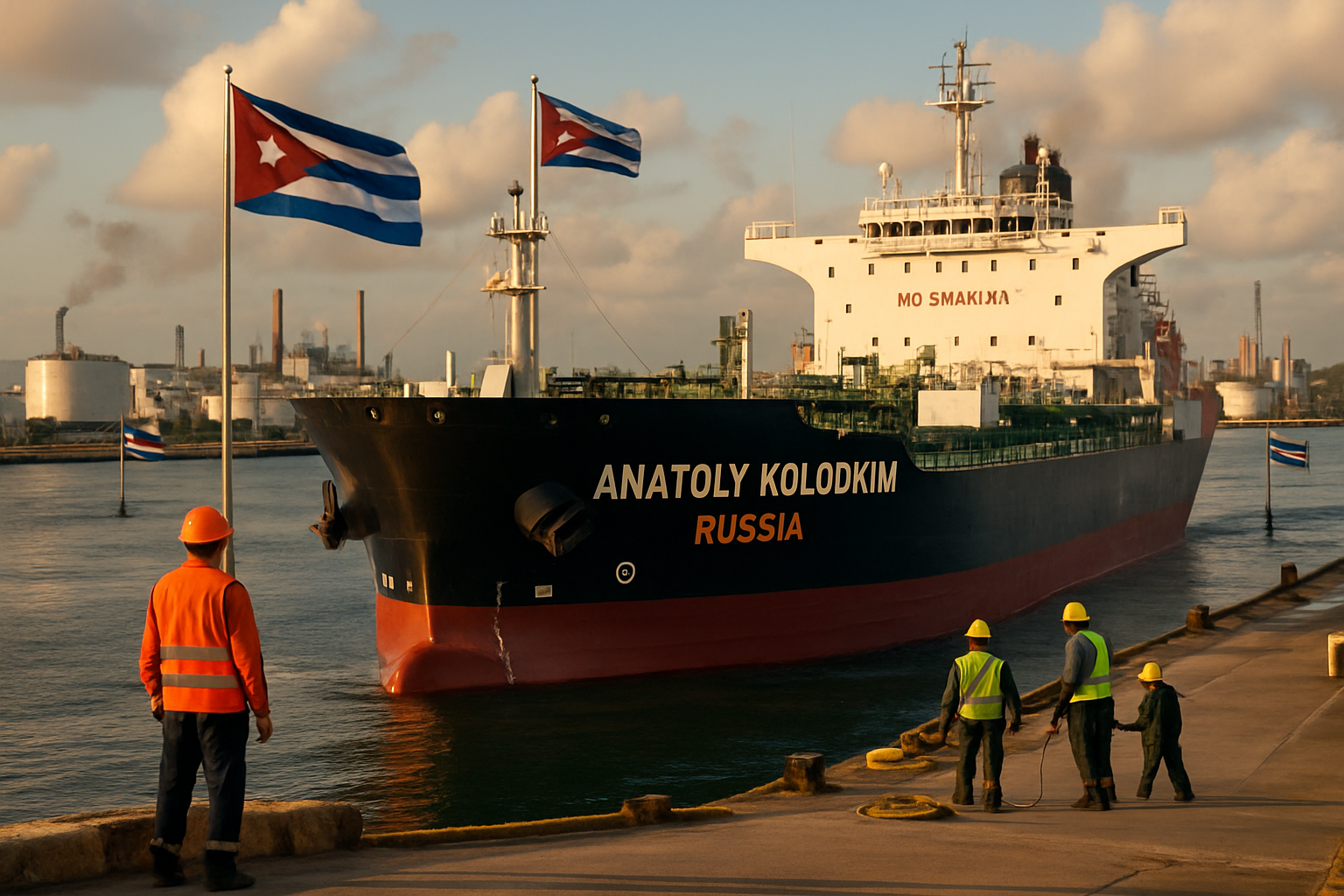
The Russian oil tanker Anatoly Kolodkin has arrived at Cuba's Port of Matanzas carrying 100,000 tons of crude oil, marking the first successful energy shipment to the Caribbean island in nearly three months and representing a significant breach in President Trump's economic isolation campaign.
The arrival of the vessel, confirmed by Russia's Ministry of Transport, comes after President Trump appeared to reverse course on his own fuel blockade, stating Sunday he had "no problem" with countries sending oil to the crisis-stricken island nation. This marks a notable shift in the Trump administration's "maximum pressure" strategy that has brought Cuba to the brink of complete economic collapse.
Breaking the Energy Siege
The Anatoly Kolodkin, part of Russia's sanctioned "shadow fleet," represents more than just a cargo delivery—it symbolizes the first crack in what European observers have characterized as a "deliberately engineered humanitarian emergency." The vessel's 100,000-ton cargo will provide Cuba with energy supplies for several weeks, offering temporary relief from the island's worst crisis since the 1990s Special Period.
According to shipping tracker MarineTraffic, the tanker had been positioned off Cuba's eastern coast before receiving apparent clearance to dock. The U.S. Coast Guard's decision to permit the shipment, despite ongoing tensions, signals a potential recalibration of American policy toward the island nation.
The Humanitarian Crisis Context
Cuba's energy emergency has reached unprecedented proportions under Trump's January 30 executive order threatening 25% tariffs on countries supplying oil to the island. This policy successfully forced both Venezuela and Mexico to halt their traditional petroleum shipments, despite decades of regional solidarity.
The crisis has manifested in multiple devastating ways:
- Complete aviation isolation from February 10 through March 11, with zero jet fuel at all nine major airports
- Evacuation of over 25,000 foreign tourists, including 21,000 Canadians and 4,000 Russians
- Closure of major hotel chains including Meliá, Iberostar, and Blue Diamond
- Systematic power outages affecting 51% of the population (5.5 million people)
- Healthcare system collapse with surgery suspensions and medical equipment failures
The Cuban peso has plummeted to a historic low of 500 units per dollar, while domestic oil production has collapsed from 3 million to just 700,000 barrels daily. Agricultural production has become insufficient to meet national needs, and transportation systems have experienced complete paralysis.
Trump's Policy Reversal
The apparent shift in U.S. policy comes after months of escalating rhetoric from President Trump, who had previously suggested a "friendly takeover" of Cuba and declared the island would "fall pretty soon." The reasons behind this reversal remain unclear, though sources suggest it may reflect concerns about the humanitarian implications of the complete energy blockade.
Secretary of State Marco Rubio, positioned as the administration's lead Cuba negotiator, has been conducting high-level discussions, though Cuban authorities have not publicly confirmed such talks. The involvement of Raul Castro's grandson as a potential facilitator has been reported by multiple sources, suggesting possible back-channel diplomatic engagement.
International Response and Implications
The Russian oil delivery has drawn mixed international reactions. While European media have praised the humanitarian aspect of the shipment, it also represents a direct challenge to American regional dominance in the Caribbean. Russia's decision to provide this aid, despite potential U.S. retaliation, demonstrates Moscow's commitment to maintaining strategic partnerships even under pressure.
China has demanded that the United States "immediately cease pressure" on Cuba, while Mexico continues to provide humanitarian aid through naval vessels carrying 814 tons of supplies, carefully avoiding petroleum shipments that could trigger U.S. economic retaliation.
Historical Significance and Precedent
The current crisis exceeds even Cuba's devastating 1990s Special Period in its systematic nature, representing what analysts describe as the most comprehensive economic isolation since the 1962 Cuban Missile Crisis. Unlike the Special Period, which resulted from external collapse following the Soviet Union's dissolution, the current emergency stems from deliberate U.S. policy targeting Cuba's energy infrastructure.
Energy expert Jorge Piñón of the University of Texas has described the situation as "zero hour"—a critical juncture where Cuba's energy reserves have become insufficient to maintain basic services without immediate intervention. The Russian tanker's arrival may provide temporary relief, but experts warn that sustained imports are necessary to restore normal operations.
Regional Implications
The Cuba crisis has forced Caribbean nations to choose between traditional solidarity and economic relationships with the United States. Trinidad and Tobago's Prime Minister Persad-Bissessar has dismissed CARICOM's "zone of peace" concept, while Jamaica faces uncertainty regarding the renewal of medical personnel agreements.
The success of the Trump administration's economic pressure campaign demonstrates the gravitational pull of U.S. economic influence, forcing even ideologically sympathetic nations to comply with American demands. This has created what analysts term the "Corolario Trump"—a 21st-century update to the Monroe Doctrine combining military pressure, economic coercion, and selective engagement.
Civil Unrest and Political Pressure
The energy crisis has sparked unprecedented civil unrest, with protesters successfully storming Communist Party headquarters in Morón, Ciego de Ávila—the first such attack on a major party facility since the 1959 revolution. Widespread "cacerolazos" (pot-banging protests) have occurred across the island, forcing the government to prioritize "defense of internal order."
These developments suggest growing political vulnerability for the Cuban government, with the energy crisis potentially catalyzing broader demands for change. The government's inability to provide basic services has undermined its legitimacy and created openings for political opposition that were previously unimaginable.
Future Outlook
While the Russian tanker provides immediate relief, the underlying crisis remains unresolved. Cuba's critical infrastructure requires sustained investment and maintenance that remains impossible under current economic constraints. The island's domestic oil production capacity has been severely degraded, and the February fire at the Ñico López refinery has eliminated crucial processing capabilities.
The path forward requires either a diplomatic breakthrough with the United States, alternative supply arrangements that can circumvent American pressure, or fundamental changes to Cuba's energy infrastructure. The international community faces a test of its response to economic coercion affecting entire civilian populations, with implications extending far beyond the Caribbean.
Template for 21st-Century Diplomacy
The Cuba crisis represents a template-setting moment for modern international relations, demonstrating both the capabilities and limitations of economic warfare in achieving political objectives. The success of the U.S. campaign in achieving complete energy supply severance shows the effectiveness of systematic economic pressure, while the humanitarian consequences raise questions about the morality and legality of collective punishment.
As the Russian tanker completes its unloading at Matanzas, it marks not just a temporary reprieve for Cuba's energy emergency, but a potential turning point in one of the most significant diplomatic crises of the modern era. The outcome will influence how great powers conduct economic coercion, how international law addresses humanitarian protection, and whether diplomatic solutions can still prevail in an increasingly polarized world.