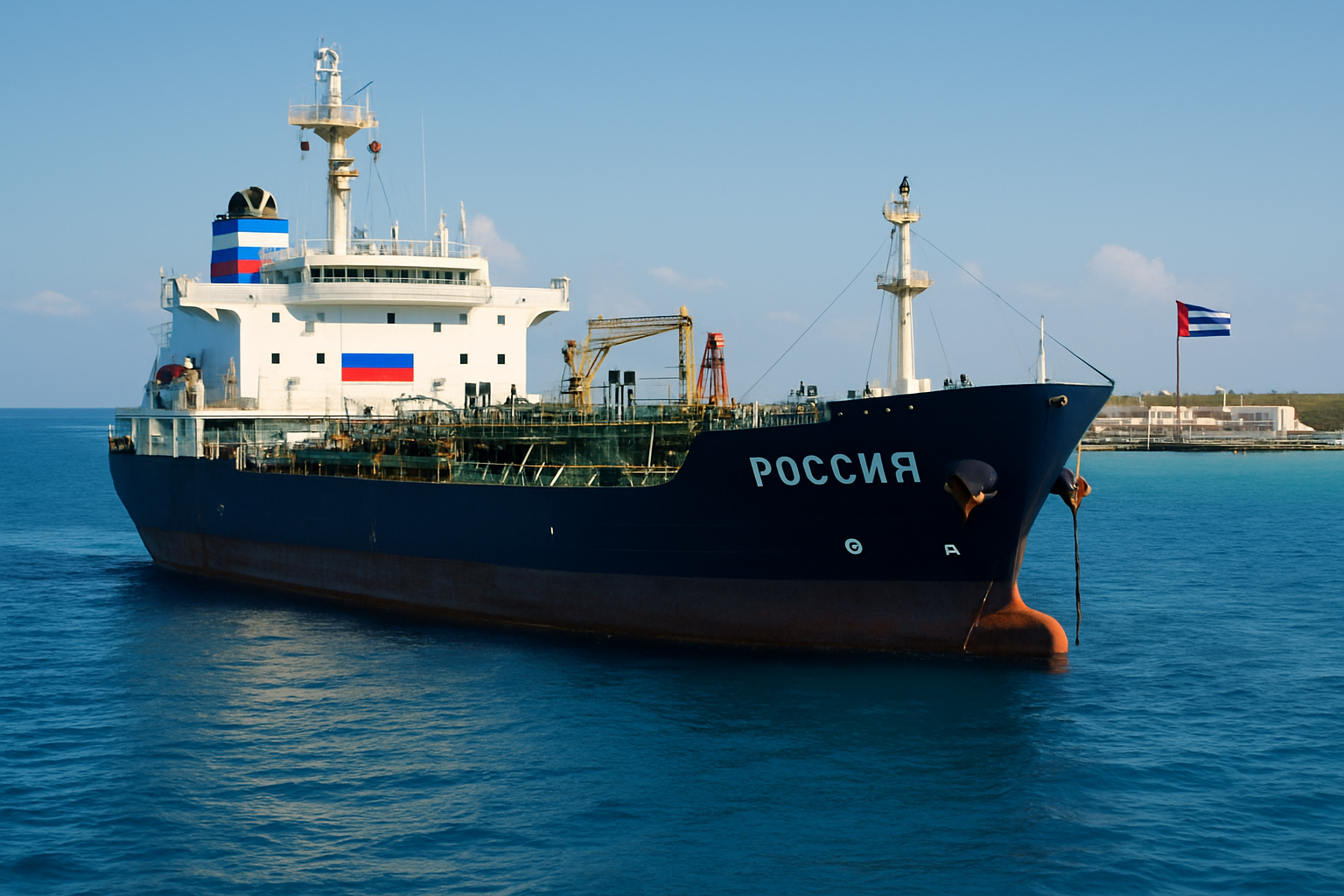
A Russian oil tanker carrying 730,000 barrels of crude oil has successfully reached Cuba's Port of Matanzas, marking the first significant energy shipment to the crisis-stricken island in nearly three months as the White House authorized a humanitarian exception to its comprehensive blockade policy.
The vessel Anatoly Kolodkin, which departed from Russia's Primorsk port 20 days ago, docked at the Cuban port on Monday after the United States permitted the sanctioned Russian tanker to proceed for humanitarian reasons. The arrival represents a significant development in what has become Cuba's worst energy crisis since the 1990s Special Period.
White House Maintains Policy While Allowing Exception
White House Press Secretary Karoline Leavitt emphasized that the decision does not represent a fundamental policy shift toward Cuba. "This is not a policy change. There has not been a formal change in sanctions policy," she told reporters Monday. "As the president said last night, we allowed this ship to reach Cuba in order to provide humanitarian needs to the Cuban people."
The administration maintains the right to seize vessels violating US sanctions policy on a case-by-case basis, Leavitt added, signaling that future shipments are not guaranteed passage.
"We allowed this ship to reach Cuba in order to provide humanitarian needs to the Cuban people."
— Karoline Leavitt, White House Press Secretary
Cuba's Energy Crisis Reaches Critical Point
The oil delivery comes as Cuba faces an unprecedented humanitarian emergency that has exceeded the severity of the 1990s Special Period through what European observers have characterized as "deliberately engineered" economic pressure. The island's energy infrastructure has collapsed systematically since January, when President Trump's executive order threatening 25% tariffs on oil suppliers achieved complete energy supply severance.
Currently, 51% of Cuba's population—approximately 5.5 million people—experience scheduled blackouts daily. The country's oil reserves have dwindled to a critical 15-20 day supply, while domestic production has collapsed from 3 million to just 700,000 barrels daily following infrastructure failures and the February fire at the Ñico López refinery that eliminated processing capacity.
The crisis has triggered six major nationwide blackouts since late 2024, with the most recent occurring when the Antonio Guiteras thermoelectric power plant in Matanzas province failed, leaving over 10 million inhabitants without electricity.
Aviation and Tourism Industry Devastation
The energy shortage has created the most comprehensive aviation blockade since the 1962 Cuban Missile Crisis, with all nine major airports maintaining zero jet fuel from February 10 through March 11. This unprecedented isolation forced the evacuation of over 25,000 tourists, including 21,000 Canadians and 4,000 Russians.
Major airlines including Air Canada, WestJet, Air Transat, Rossiya, and Nordwind suspended operations entirely. The tourism industry, a crucial source of foreign currency, has collapsed with major hotel chains like Meliá, Iberostar, and Blue Diamond closing their Varadero facilities. Canada issued its highest travel advisory, effectively ending the winter tourism season.
International Response and Diplomatic Tensions
Moscow has welcomed the tanker's arrival, with Kremlin spokesman Dmitri Peskov expressing satisfaction over the delivery of petroleum products to what Russia considers a strategic ally. The successful shipment represents Russia's direct challenge to US hemispheric dominance and tests the limits of American economic coercion.
The crisis has divided international responses. China has demanded an immediate cessation of US pressure on Cuba, while European media have characterized the situation as a "deliberately engineered humanitarian emergency." Former British Labour leader Jeremy Corbyn has announced plans for an international flotilla to challenge the blockade.
Mexico, despite historical solidarity with Cuba, suspended oil shipments under US pressure while maintaining humanitarian aid delivery of 814 tons of supplies via naval vessels. This demonstrates the Trump administration's success in forcing regional allies to choose between US economic relationships and Cuban assistance.
Civil Unrest and Government Response
The crisis has triggered unprecedented civil unrest, including the first successful attack on a Communist Party facility since the 1959 revolution. In March, protesters stormed Communist Party headquarters in Morón, Ciego de Ávila, chanting "¡Libertad!" while burning party materials. Widespread "cacerolazos" pot-banging protests have spread across multiple cities.
The Cuban government has shifted priorities to "defense of internal order" as infrastructure collapse continues. Healthcare systems face crisis conditions with surgery suspensions, medical evacuation elimination, and power outages threatening critical equipment and medicine storage.
Trump's Policy Reversal Signals
President Trump's decision to allow the Russian tanker represents a significant reversal from his previous rhetoric. In March, he made the most explicit US control statements regarding Cuba since the 1960s, declaring he could "do anything I want" with Cuba and describing it as a "very weakened" and "failed nation with nice landscape."
The policy shift suggests pragmatic recognition that complete isolation was causing humanitarian consequences while potentially strengthening Cuba's ties to US adversaries like Russia and China. Secretary Marco Rubio has been positioned as the lead negotiator for potential diplomatic engagement, though Cuba has not confirmed such talks.
Regional Implications and Strategic Context
The Cuban crisis represents a template for what analysts have termed the "Corolario Trump"—a 21st-century Monroe Doctrine update combining military pressure, economic coercion, and selective engagement for hemispheric dominance. The approach mirrors the successful Venezuela model, where maximum pressure led to strategic partnership following Nicolás Maduro's removal in January 2026.
The crisis has forced Caribbean nations to choose between US economic relationships and regional solidarity, demonstrating America's economic gravitational pull in forcing compliance despite ideological commitments. Trinidad's Prime Minister has dismissed CARICOM's "zone of peace," while Jamaica faces uncertainty over renewing medical personnel agreements.
Energy Supply and Economic Recovery
Energy expert Jorge Piñón describes Cuba as being at "zero hour"—a critical juncture where energy reserves are insufficient for basic services without immediate intervention. The 730,000 barrels delivered by the Anatoly Kolodkin provide temporary relief equivalent to several weeks of energy supplies but cannot address the underlying infrastructure crisis.
The Cuban peso has collapsed to historic lows of 500 units per dollar, representing a 15% weekly decline. Emergency government measures include four-day work weeks, closure of 90% of gas stations, suspension of hospital surgeries, and implementation of semi-virtual university classes.
Historical Significance and Global Implications
The current crisis exceeds the 1990s Special Period through systematic targeting rather than external collapse. Unlike the previous emergency, which maintained some international connectivity, the current isolation achieved complete aviation severance unprecedented in modern Cuban history.
International law experts express concern about the normalization of collective punishment affecting civilian populations. The success or failure of resolving Cuba's crisis will influence future approaches to economic coercion, territorial sovereignty enforcement, and humanitarian protection principles globally.
Path Forward
Crisis resolution requires either diplomatic breakthrough, alternative supply arrangements circumventing US pressure, or fundamental Cuban energy infrastructure changes. The international community faces an unprecedented test of response to economic coercion affecting entire populations.
The Russian oil delivery represents both temporary reprieve and strategic precedent. Whether this becomes a one-time humanitarian exception or signals broader policy flexibility remains unclear as diplomatic channels potentially open between Washington and Havana after six decades of antagonism.
The stakes extend far beyond bilateral relations to international cooperation principles, global governance evolution, and territorial sovereignty enforcement in an era of great power competition. The Caribbean serves as a laboratory for testing American economic dominance reconfiguration in the multipolar era, with outcomes potentially reshaping international relations for decades.