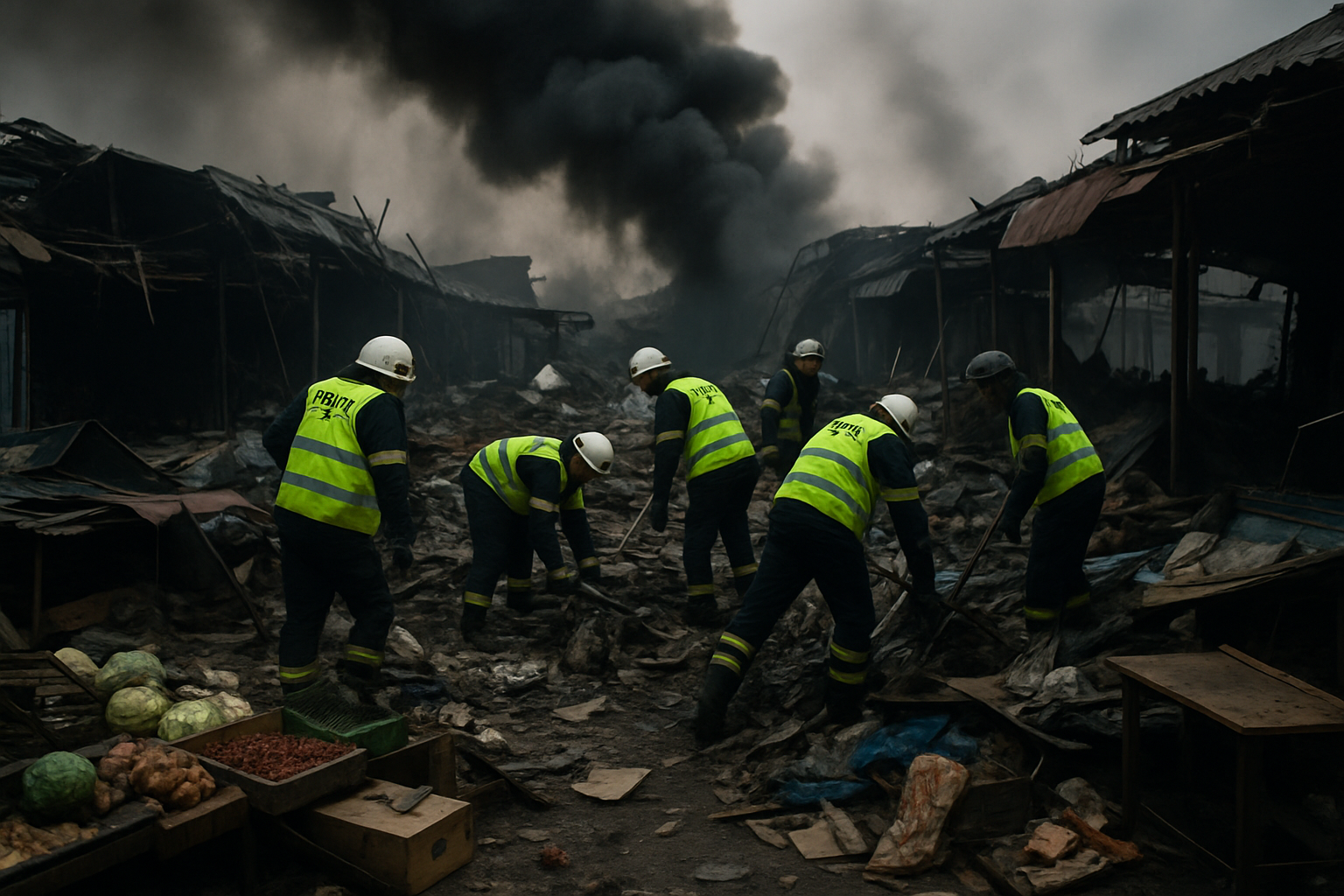
A Russian drone strike on a covered market in the eastern Ukrainian city of Nikopol on Saturday morning killed five people and wounded at least 25 others, marking the latest in a series of escalating attacks on civilian infrastructure as peace negotiations remain indefinitely suspended due to the Iran crisis.
The attack occurred at approximately 9:50 AM local time in the Dnipropetrovsk region, targeting the busy market area during peak shopping hours. Initial reports indicated 19 wounded, but Ukrainian officials later confirmed the casualty toll had risen to 25 injured, with a 14-year-old girl among those in critical condition.
Ukraine's Prosecutor General condemned the strike as "another war crime committed by the Russian Federation," adding to mounting evidence of systematic violations of international humanitarian law. The attack follows a documented pattern of Russian forces targeting civilian gathering places, markets, and essential infrastructure throughout the conflict.
Massive Drone Assault Campaign
The Nikopol market attack was part of a broader Russian offensive involving unprecedented numbers of unmanned aerial vehicles. Ukrainian Air Force officials reported that Russia deployed 286 drones overnight, of which Ukrainian air defenses successfully intercepted 260. This represents one of the largest single-night drone deployments since the conflict began nearly four years ago.
The scale of the assault demonstrates Russia's expanded drone warfare capabilities, with Moscow now deploying what military experts describe as the largest dedicated drone force in modern warfare – approximately 101,000 troops by April 2026. The systematic use of FPV (first-person view) drones for precision targeting of civilian infrastructure has become a hallmark of Russian tactics.
Additional strikes during the same period targeted residential areas in Kharkiv, where a child was injured when a Russian drone crashed in the Slobidskyi district, and energy facilities in the Poltava region, where Russian forces again attacked Naftogaz Group installations without causing casualties.
Diplomatic Crisis Deepens
The attacks occur against the backdrop of suspended Ukraine-Russia-US trilateral peace negotiations, which have been indefinitely postponed due to the Iran crisis consuming American foreign policy attention. President Volodymyr Zelensky announced that there are "no necessary signals for trilateral meeting" until the security situation in the Middle East allows.
This represents a major setback to diplomatic momentum that had achieved significant breakthroughs in February 2026, including a historic 314-prisoner exchange – the largest in five months – and the restoration of US-Russia military communications after a four-year suspension. Geneva talks in February had shown "significant progress" on ceasefire monitoring mechanisms, with European "Big 5" observers participating for the first time.
The Trump administration's June 2026 Washington venue deadline for comprehensive peace talks now appears uncertain as Middle East priorities divert diplomatic resources. The framework for negotiations remains intact, with prisoner exchange mechanisms and Pentagon-Moscow deconfliction protocols preserved for potential reactivation when conditions permit.
Systematic Infrastructure Targeting
The pattern of attacks represents what Ukrainian officials term "energy terrorism" – the systematic targeting of civilian infrastructure during extreme weather conditions. Over 1,170 Kyiv buildings remain without adequate heating from previous Russian attacks, while Ukrainian nuclear plants have been forced to halt electricity production for the first time in the conflict.
Military analysts note that Russian forces have launched over 7,000 strike drones and 1,500 guided aerial bombs in recent weeks, overwhelming Ukrainian air defenses despite Western-supplied systems. The targeting of markets, schools, hospitals, and energy facilities violates the Geneva Conventions' protections for civilian infrastructure.
The strategic aim appears to be creating humanitarian pressure on Ukrainian civilians during extreme conditions while formal negotiation channels remain inactive. International humanitarian organizations have documented widespread violations of international law in Russian civilian targeting campaigns.
Ukraine's Strategic Evolution
Despite the suspended peace talks, Ukraine has undergone a remarkable transformation from aid recipient to security provider on the global stage. Ukrainian military experts are now deployed to five Middle Eastern countries – the UAE, Qatar, Jordan, Bahrain, and Kuwait – sharing expertise in combating Iranian Shahed drones, the same weapons being used against Ukrainian infrastructure.
This evolution leverages Ukraine's battlefield experience into strategic partnerships that could provide diplomatic leverage when negotiations eventually resume. The UK has also revealed four operational maintenance, repair, and overhaul (MRO) facilities in Ukraine servicing Western-supplied equipment, with a fifth facility planned, representing unprecedented military infrastructure cooperation.
Nuclear Governance Crisis
The attacks occur amid an unprecedented nuclear governance crisis following the expiration of the New START treaty on February 5, 2026 – the first time in over 50 years without US-Russia nuclear constraints. Both superpowers, controlling 80% of global nuclear weapons, are now free to expand their arsenals without bilateral limits.
UN Secretary-General António Guterres has warned of a "grave turning point" with nuclear risks at their "highest in decades." The restored military communications between Washington and Moscow, achieved through the February diplomatic breakthrough, now represent the only remaining formal superpower diplomatic channel.
International Support and Divisions
International support for Ukraine remains substantial but reveals growing divisions. The EU's historic €90 billion loan package – the largest single-nation assistance ever provided – passed despite refusal by Slovakia, Czech Republic, and Hungary to participate. Sweden and Denmark have committed €246 million for air defense systems, while Germany has delivered 35 Patriot missiles.
The competing demands of the Iran crisis have highlighted resource allocation challenges, with Gulf states using more PAC-3 missiles against Iranian attacks in recent days than Ukraine received from the US over four years of conflict. This demonstrates the strain on Western military assistance amid multiple simultaneous crises.
Humanitarian Toll Mounts
President Zelensky has disclosed that 55,000 Ukrainian soldiers have been officially killed, with a "large number" missing. International estimates suggest actual casualties may be 2-3 times higher. Over 17.8 million Ukrainians continue to access winter support programs as systematic civilian targeting continues.
The humanitarian crisis extends beyond military casualties to civilian infrastructure destruction requiring unprecedented international coordination for rebuilding. The systematic targeting of emergency services personnel, including the deaths of 15 DTEK energy workers while restoring power, represents additional violations of international humanitarian law.
Looking Ahead
The timeline for resumed peace negotiations depends entirely on resolution of the Iran situation and broader Middle East stability. Military escalation continues with systematic civilian targeting while Ukraine maintains operational capabilities and expands international partnerships as a security provider.
The stakes extend far beyond Ukraine's borders, affecting European security architecture, international law enforcement credibility, and territorial sovereignty principles for the 21st century. Success in eventual resumed talks could end Europe's deadliest war since World War II and provide a template for modern conflict resolution. Failure may allow continued escalation with global implications for how territorial disputes are resolved through diplomatic innovation versus military force.
The preservation of the diplomatic framework achieved through the February breakthrough provides hope that negotiations can be reactivated when the Iranian crisis permits high-level engagement. However, fundamental disagreements over eastern Ukrainian territories under Russian control remain unchanged, requiring innovative solutions when diplomatic conditions improve.