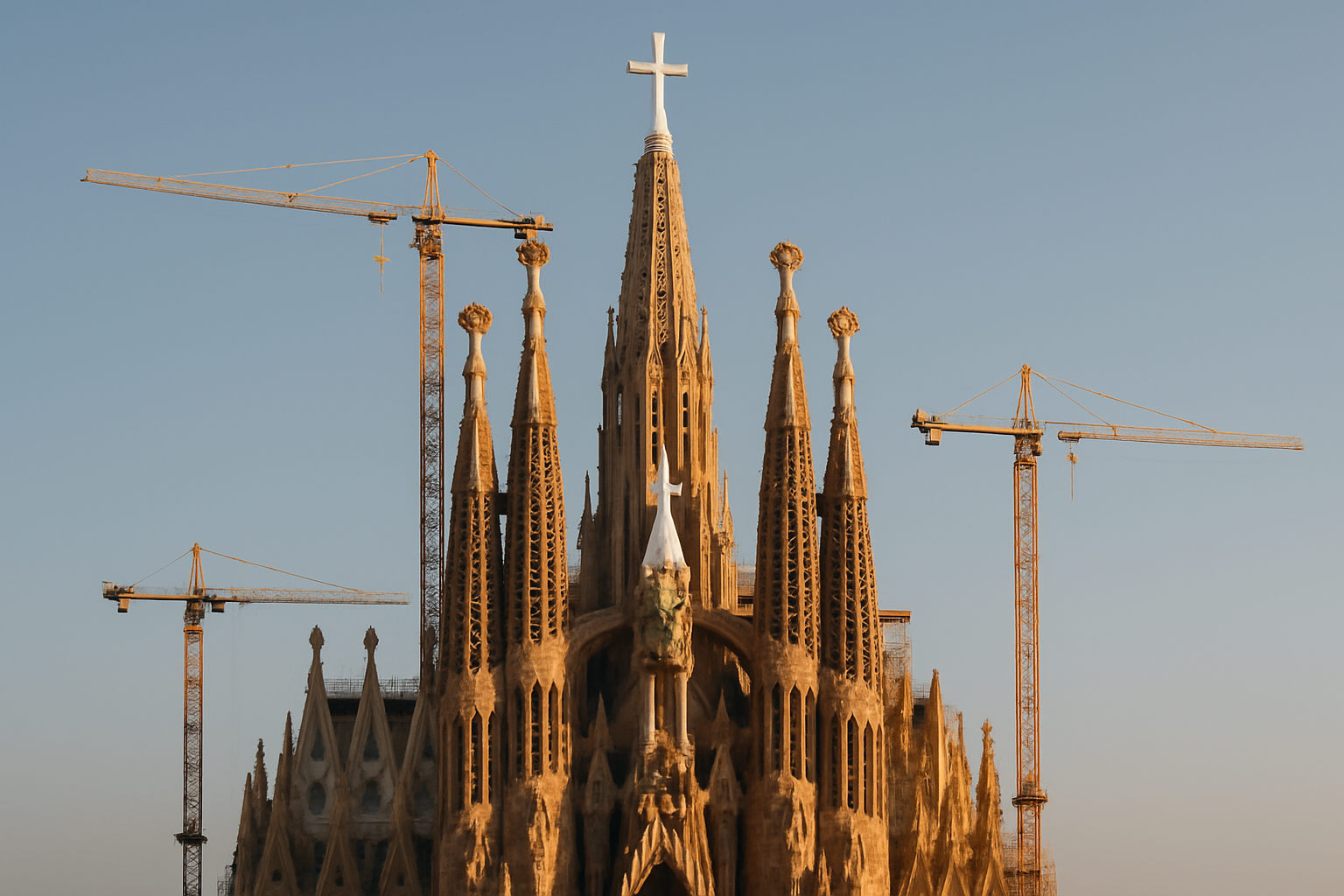
Barcelona's skyline was forever transformed on Friday as the iconic Sagrada Familia basilica reached its maximum planned height of 172.5 meters (566 feet), completing the installation of the final piece atop the Tower of Jesus Christ after 144 years of continuous construction.
In a moment that drew crowds of tourists and locals alike, construction workers carefully positioned the upper arm of a 7-meter-high white cross using cranes, completing the soaring central spire of Antoni Gaudi's architectural masterpiece. The installation marks the end of vertical construction for the basilica, though years of detailed work remain before the project's anticipated completion.
"A swarm of tourists craned their necks to see the installation," witnesses reported, as the cross's upper arm became visible amid the scaffolding and construction equipment that has surrounded the basilica for generations.
A Century and a Half in the Making
The Sagrada Familia's journey began in 1882 when the foundation stone was laid, making it one of the world's longest-running construction projects. The basilica now stands as the tallest church in the world, surpassing previous record holders and fulfilling Gaudi's ambitious vision for a structure that would reach toward the heavens.
The Tower of Jesus Christ, now crowned with its distinctive cross, represents the centerpiece of Gaudi's design philosophy that sought to harmonize religious symbolism with natural forms. The Catalan architect, who died in 1926 after being struck by a tram, devoted the final years of his life exclusively to this project, sleeping on-site and refusing other commissions.
This milestone achievement comes during a period of significant architectural and cultural developments in Barcelona, a city that has become synonymous with innovative design and ambitious construction projects. The completion of the basilica's maximum height represents not just an architectural triumph, but a testament to generational dedication and craftsmanship.
Engineering Marvel Meets Artistic Vision
The construction of the final tower required unprecedented precision and engineering expertise. Modern crane technology was essential for positioning the cross's components at such extreme heights, while maintaining the structural integrity of Gaudi's original design concepts.
The white cross that now crowns the Tower of Jesus Christ was carefully designed to be visible from multiple vantage points across Barcelona, serving as both a religious symbol and a navigational landmark for the city. The cross itself measures 7 meters in height, with the upper arm installed on Friday representing the final piece needed to complete the tower's silhouette.
Construction teams worked meticulously to ensure that every element aligned with Gaudi's detailed architectural plans, many of which were painstakingly reconstructed after being damaged during the Spanish Civil War. The project has employed cutting-edge technology including 3D modeling and computer-aided design to interpret and execute Gaudi's original vision with modern precision.
Global Recognition and Cultural Impact
The Sagrada Familia has long been recognized as a UNESCO World Heritage Site, attracting millions of visitors annually who come to witness Gaudi's unique fusion of Gothic and Art Nouveau architectural styles. The basilica's distinctive façades tell the story of Christ's life through intricate stone carvings and sculptural elements that continue to be completed according to Gaudi's designs.
Friday's milestone represents more than architectural achievement—it symbolizes Barcelona's commitment to preserving and completing one of the world's most ambitious artistic undertakings. The project has been funded entirely through private donations and entrance fees, making it a remarkable example of community-supported cultural heritage preservation.
The completion of the maximum height also positions Barcelona prominently on the global architectural stage, alongside other cities known for their iconic skylines and landmark buildings. Tourism officials expect the milestone to generate renewed international interest in visiting the basilica and exploring Barcelona's rich architectural heritage.
The Path to Final Completion
While reaching maximum height represents a crucial milestone, significant work remains before the Sagrada Familia can be considered complete. Construction teams continue working on detailed sculptural elements, interior finishing, and the remaining façades that will complete Gaudi's comprehensive vision for the basilica.
Current projections suggest the entire project could be finished within the next decade, though the timeline remains subject to funding availability and the complexity of executing Gaudi's intricate designs. Each remaining element requires the same meticulous attention to detail that has characterized the project since its inception.
The basilica's completion will mark the end of what many consider the world's most extraordinary architectural marathon—a project that has spanned multiple centuries, survived wars, and employed generations of craftsmen, architects, and engineers. When finished, it will stand as a testament to the power of visionary design and sustained dedication to artistic excellence.
Legacy of Generational Craftsmanship
The Sagrada Familia project has become a unique institution that has trained countless stonemasons, sculptors, and construction specialists in traditional building techniques combined with modern technology. Many workers have spent their entire careers on the project, following in the footsteps of parents and grandparents who also contributed to the basilica's construction.
This intergenerational continuity has ensured that Gaudi's original vision remains faithfully interpreted while incorporating necessary modern safety standards and construction techniques. The project serves as a living laboratory for architectural preservation and innovative construction methods.
As Barcelona celebrated this historic achievement on Friday, the moment represented not just the completion of a tower, but the fulfillment of a promise made nearly 150 years ago—to create something unprecedented in architectural history. The Sagrada Familia now stands at its full intended height, a testament to human ambition, artistic vision, and the enduring power of collaborative cultural achievement.