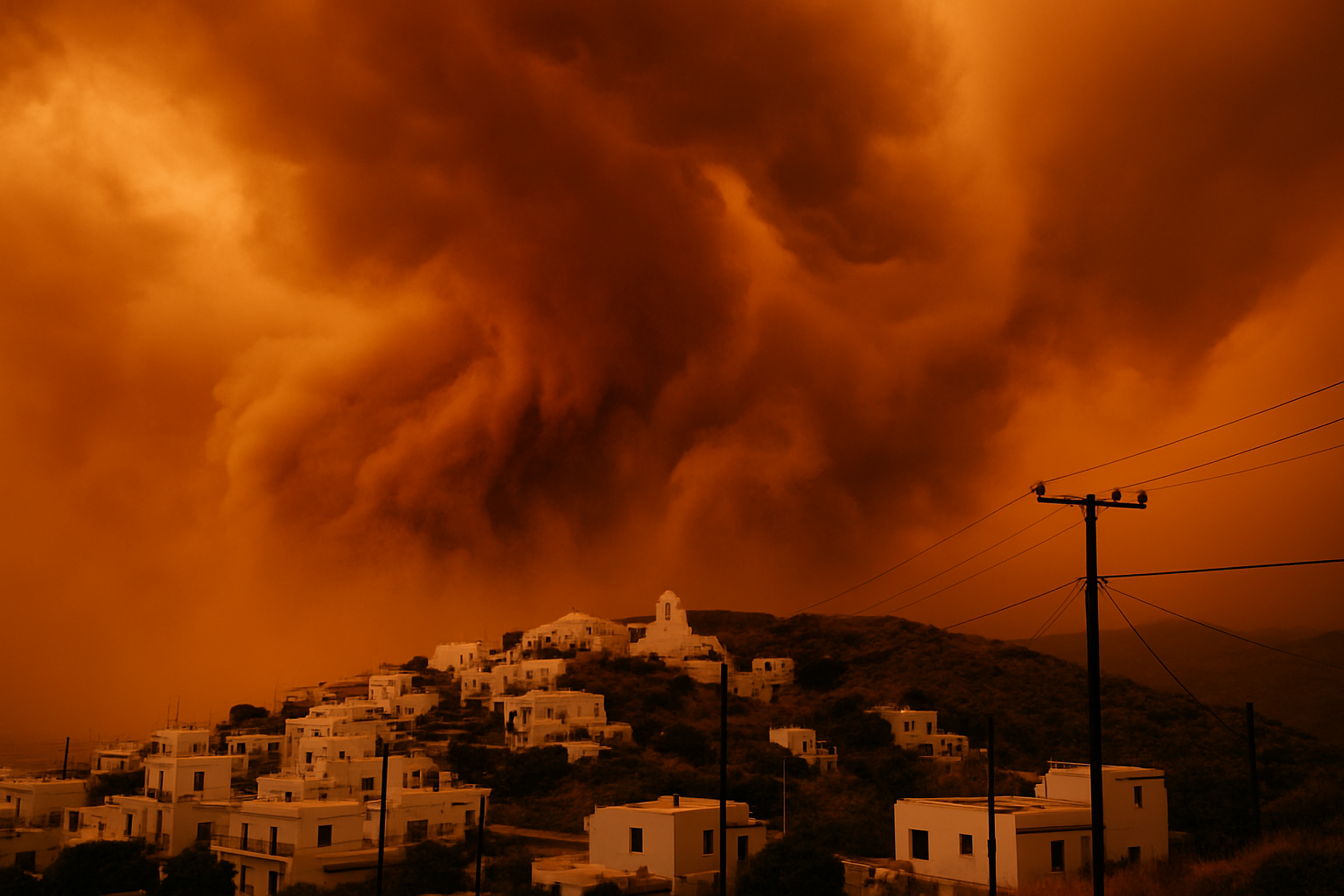
An unprecedented Saharan dust storm combined with Storm Erminio has created "apocalyptic scenes" across Greece and the broader Mediterranean region, turning skies an ominous orange-red while claiming at least one life and causing widespread infrastructure damage during the 22nd consecutive month of record-breaking global temperatures.
The crisis unfolded on April 2, 2026, as massive dust clouds from the Sahara Desert blanketed Crete and other Greek islands, while Storm Erminio brought hurricane-force winds, torrential rains, and unprecedented flooding. A man was found dead near Athens in the Nea Makri area, crushed under his vehicle during the severe weather conditions that emergency responders described as among the most dangerous they had ever encountered.
Dual Environmental Crisis Strikes Mediterranean
The convergence of two extreme weather phenomena created what meteorologists are calling an extraordinary environmental crisis. Saharan dust concentrations on Crete reached levels exceeding 1,000 micrograms per cubic meter – more than 20 times the World Health Organization's recommended safe limits. Visibility dropped below 500 meters in many areas, forcing authorities to divert flights from Nikos Kazantzakis Airport in Heraklion to Athens.
Nikos Syrigonakis, Deputy Governor of Heraklion, activated comprehensive civil protection mechanisms as the dust storm created what he described as "suffocating atmospheric conditions." Schools across Crete were ordered closed, and health advisories were issued for vulnerable populations, particularly those with respiratory conditions.
"The sky has taken on an otherworldly appearance, colored in deep orange and red hues that make it seem like we're living in a scene from an apocalyptic film."
— Local Crete resident, speaking to Greek media
Storm Erminio Brings Destruction and Death
While Saharan dust created hazardous air quality conditions in southern regions, Storm Erminio battered Greece with intense thunderstorms and heavy mountain snowfall in northern areas. The storm system, which meteorologists had been tracking across the Atlantic, delivered hurricane-force winds that toppled trees, damaged infrastructure, and triggered widespread power outages affecting hundreds of thousands of residents across the Attica region and Athens.
Rhodes was placed under heightened emergency status with the 112 alert system activated, while emergency services reported receiving an unprecedented volume of calls for assistance. The combination of extreme weather events exposed critical vulnerabilities in infrastructure systems designed for historical climate conditions rather than current extreme weather patterns.
Italy's Adriatic Coast Severely Impacted
The crisis extended beyond Greece as the same weather system devastated Italy's Adriatic coastline. The Osento River overflowed, completely flooding railway infrastructure and severing the critical Pescara-Foggia transportation corridor on both lines. The city of Termoli experienced significant flooding, effectively cutting the north-south Adriatic transportation route in half and stranding thousands of passengers while disrupting vital freight operations.
The railway disruption represents one of the most significant transportation infrastructure failures in recent Italian history, with recovery efforts expected to take weeks and potentially affecting the broader European logistics network during peak spring economic activity.
Record Climate Context Amplifies Crisis
This latest Mediterranean disaster occurs during the 22nd consecutive month that global temperatures have exceeded 1.5°C above pre-industrial levels – the longest sustained extreme warming period in recorded human history. January 2026 remains the hottest month ever recorded, with human-induced climate change completely overriding natural cooling mechanisms, including La Niña effects.
The World Meteorological Organization has indicated a 50-60% probability of El Niño conditions developing between July and September 2026, which could potentially drive global temperatures to unprecedented levels by combining baseline warming with natural climate amplification.
Infrastructure Overwhelmed by Climate Volatility
The crisis exemplifies what climate scientists describe as the "climate volatility paradox" – sustained global warming that enables both temperature extremes and severe regional weather events through disrupted atmospheric circulation patterns. Traditional emergency response systems designed for sequential regional disasters are proving inadequate for simultaneous multi-continental emergencies.
Emergency services across the Mediterranean region are operating at or beyond capacity limits, while transportation networks, power grids, and communication systems repeatedly fail when extreme weather conditions exceed their operational parameters. The EU Civil Protection Mechanism remains on standby, though previous responses, including the €246 million assistance package for Sweden and Denmark, have proven insufficient for the scale and simultaneity of current challenges.
Economic and Social Devastation Mounts
The immediate economic impact spans multiple sectors, with Greek commercial and manufacturing operations forced to close due to power outages and dangerous air quality. Italy's agricultural sector faces threats during a critical growing period, while tourism in both countries has suffered cancellations as visitors avoid the hazardous conditions.
Recovery timelines are expected to extend for weeks, emphasizing the importance of implementing "build back better" climate-resilient reconstruction approaches rather than simply replacing damaged infrastructure with systems designed for historical climate patterns.
International Response and Future Preparedness
Meteorological services are tracking the progression of additional Atlantic and Mediterranean storm systems, with the possibility that current extreme weather patterns could persist for extended periods. The crisis represents a continuation of the unprecedented Mediterranean weather patterns observed throughout 2026, with unusual April intensity and timing that exceeds infrastructure design parameters.
The events highlight the urgent need for fundamental restructuring of emergency response systems to address permanent climate volatility rather than treating extreme weather as exceptional events. International cooperation frameworks are being tested as traditional bilateral aid mechanisms prove inadequate when multiple regions face simultaneous disasters.
A Watershed Moment for Climate Adaptation
March and April 2026 represent a potential watershed moment in global climate preparedness, forcing a critical choice between reactive crisis management and transformative infrastructure adaptation. The convergence of extreme weather events, infrastructure vulnerabilities, and emergency response limitations underscores the urgent need for coordinated international action.
Environmental challenges increasingly transcend national boundaries as atmospheric and ocean systems transport climate effects globally, making unilateral adaptation efforts insufficient. The success of future climate resilience depends on unprecedented cooperation, enhanced coordination, and sustained financial commitments to environmental protection as essential infrastructure.
As additional weather systems develop across the Atlantic and Pacific regions, current crisis conditions may represent the establishment of a "new normal" characterized by extreme weather frequency and intensity that permanently challenges traditional emergency response frameworks. The window for effective climate action continues to narrow as ecological systems approach critical thresholds that could trigger irreversible changes affecting global food security, climate stability, and human settlements.
The question facing the international community is no longer whether transformative action is needed, but whether humanity can organize and implement solutions rapidly enough to maintain planetary habitability during what may be Earth's most environmentally challenging period in recorded history.