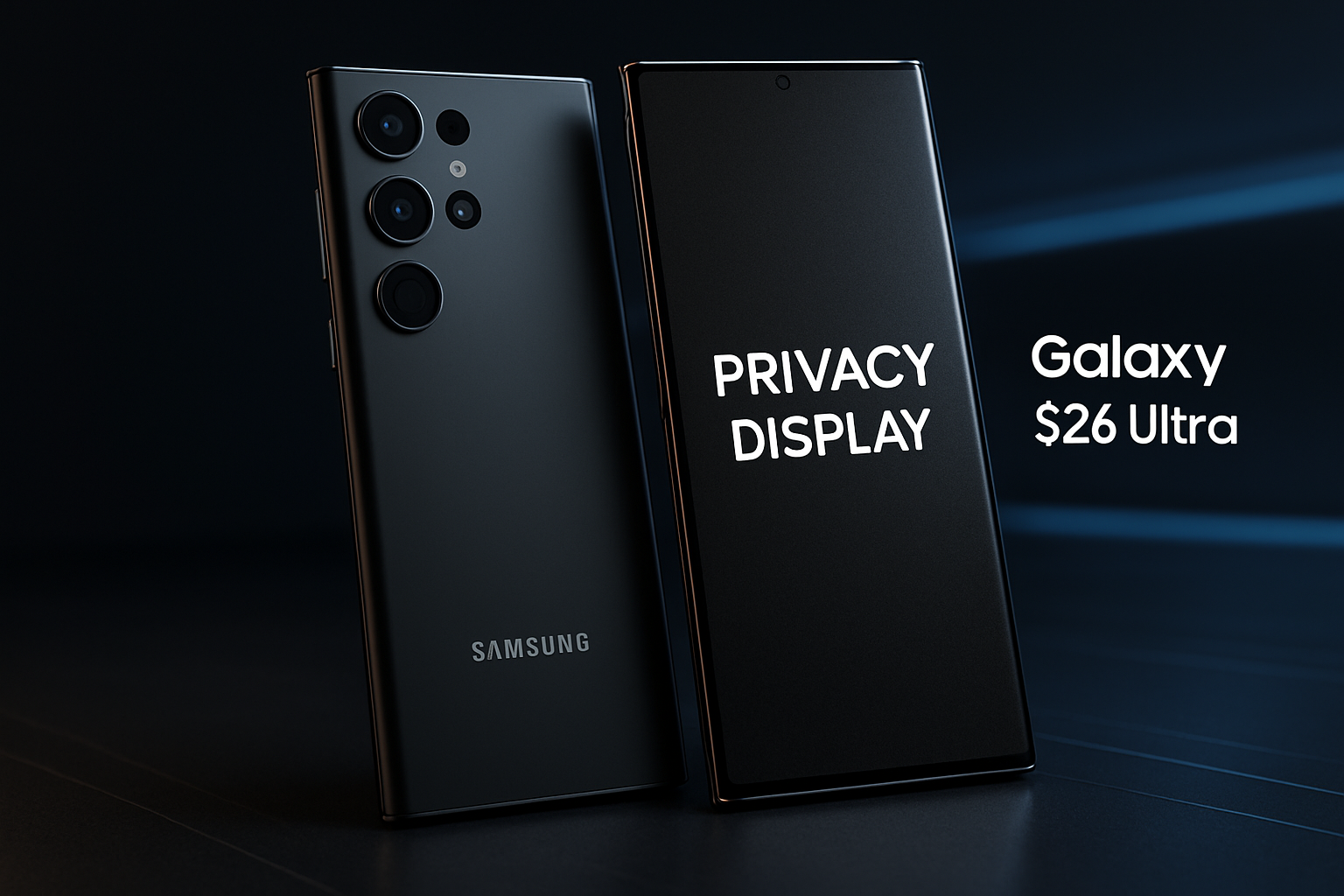
Samsung Electronics has officially unveiled its highly anticipated Galaxy S26 series at Galaxy Unpacked 2026, introducing groundbreaking Privacy Display technology alongside comprehensive AI enhancements that position the Korean tech giant at the forefront of mobile innovation.
The February 25, 2026 launch in San Francisco represents Samsung's most significant smartphone evolution in years, featuring three flagship models—Galaxy S26, S26+, and S26 Ultra—each incorporating next-generation artificial intelligence capabilities and revolutionary privacy features designed to address growing consumer concerns about digital security.
Industry-First Privacy Display Technology
The standout feature of the Galaxy S26 series is the innovative Privacy Display technology, available across all models but most advanced in the Ultra variant. This hardware-level privacy solution marks a revolutionary departure from traditional software-based privacy measures or third-party screen protectors.
The Privacy Display system works by controlling how individual pixels disperse light, utilizing selective pixel activation and strategic blockage to restrict viewing angles. While the display remains fully visible to the primary user, side angles show significantly obscured content, effectively preventing "shoulder surfing" and unauthorized viewing in public spaces.
"This feature is a huge leap forward in mobile privacy protection, addressing real-world concerns about digital privacy in public environments,"
— Samsung Electronics, Product Development Team
Unlike previous privacy solutions that required permanent screen protectors, Samsung's implementation allows users to activate Privacy Display on-demand, maintaining full display quality when privacy protection isn't needed. The technology achieves this through sophisticated pixel management that adjusts light dispersion patterns in real-time.
Enhanced AI Integration Across the Ecosystem
Building on February's confirmed Perplexity AI partnership, the Galaxy S26 series features comprehensive AI integration across core applications including Notes, Clock, Gallery, Reminders, and Calendar. The multi-agent Galaxy AI ecosystem extends beyond Samsung's native apps to selected third-party applications, creating a unified intelligent experience.
The AI implementation combines on-device processing using Samsung's enhanced neural processing units with secure cloud capabilities, maintaining user privacy through encrypted channels while enabling sophisticated AI functionalities. Key features include conversational search capabilities, intelligent content generation, predictive scheduling, and advanced image analysis.
Samsung's vertical integration strategy, spanning custom chips to software optimization, provides competitive advantages during the ongoing global memory crisis that has affected competitors dependent on external suppliers. This integrated approach enables more efficient AI processing while managing the industry-wide semiconductor constraints.
Design Evolution and Technical Specifications
The Galaxy S26 series showcases significant design improvements, featuring a thinner profile with a redesigned raised camera island that replaces the individual lens arrangement of previous generations. The devices incorporate center-aligned hole-punch displays and refined rounded corners for enhanced ergonomics and visual appeal.
Technical specifications vary across the series, with the Galaxy S26 Ultra featuring a QHD+ 6.9-inch display, a 200-megapixel main camera system, and advanced computational photography capabilities powered by the integrated AI systems. All models support the Privacy Display technology, though implementation varies by screen size and processing capabilities.
The series addresses growing consumer demand for flagship features at more accessible price points, though pricing reflects the ongoing global memory shortage that has increased semiconductor costs by 20-30% across the industry. The base Galaxy S26 model approaches the 1,000-euro threshold, while the Ultra variant reaches toward 2,000 euros, positioning Samsung competitively against Apple's iPhone 17 series and Google's Pixel 10 lineup.
Global Market Positioning and Competition
The Galaxy S26 launch occurs during a critical period for the smartphone industry, with major competitors including Google's Pixel 10 Pro XL and anticipated Apple iPhone 17 Pro Max positioning for market leadership. Samsung's strategy emphasizes differentiation through privacy innovation and AI integration rather than purely competing on specifications.
International rollout begins immediately, with telecommunications partners like Vivacom in Bulgaria already accepting pre-orders starting February 25, 2026, at 8:00 PM, continuing through March 10, 2026. Early adopters can save up to 200 euros and receive doubled storage capacity, along with discounts on Galaxy Buds4 and Buds4 Pro accessories.
The launch timing aligns with Samsung's strategic response to the evolving smartphone market, where consumers increasingly prioritize privacy, AI capabilities, and long-term value over incremental hardware improvements. This approach positions Samsung advantageously during a period when traditional smartphone differentiation has become increasingly challenging.
Industry Context and Supply Chain Challenges
Samsung's Galaxy S26 launch demonstrates the company's resilience amid the ongoing global memory crisis, where semiconductor prices have surged sixfold, affecting manufacturers like SK Hynix and Micron. Samsung's vertical integration across semiconductor manufacturing, display production, and device assembly provides strategic advantages during this constrained period.
The company's ability to maintain innovation momentum while managing supply chain pressures reflects broader industry adaptation strategies. Consumer electronics costs have increased 20-30% industry-wide, but Samsung's integrated manufacturing approach helps moderate price impacts compared to competitors relying entirely on external suppliers.
Industry analysts note that Samsung's timing capitalizes on market conditions where consumers are extending device replacement cycles, making premium features like Privacy Display and advanced AI particularly valuable for users seeking longer-term device investments.
Privacy and Security Focus
The emphasis on privacy technology reflects growing consumer awareness of digital security concerns, particularly in public and professional environments. Samsung's hardware-based approach addresses limitations of software-only privacy solutions, providing users with tangible, immediate privacy protection.
The Privacy Display technology represents Samsung's response to increasing workplace privacy concerns, public transportation security issues, and general digital privacy awareness. By implementing privacy protection at the hardware level, Samsung addresses fundamental user concerns while maintaining full device functionality.
This privacy-first approach aligns with broader industry trends toward enhanced user control over personal data and digital interactions, positioning Samsung as a leader in practical privacy implementation rather than merely policy-based approaches.
Future Implications and Market Impact
The Galaxy S26 series launch establishes new benchmarks for smartphone privacy technology and AI integration, potentially influencing competitor development strategies throughout 2026. Samsung's success with Privacy Display could accelerate industry adoption of similar hardware-based privacy solutions.
The comprehensive AI ecosystem approach, combined with privacy enhancements, positions Samsung favorably for the evolving smartphone market where users increasingly demand both intelligent capabilities and data protection. This dual focus addresses two primary consumer concerns driving purchasing decisions in the premium smartphone segment.
Market success will largely depend on consumer adoption of Privacy Display technology and the practical utility of AI integrations in daily use scenarios. Samsung's historical strength in display technology and recent AI partnerships provide a strong foundation for market penetration, though competition remains intense across all price segments.
The Galaxy S26 series represents Samsung's strategic evolution from traditional hardware manufacturer to AI-powered technology platform provider, reflecting the industry's broader transformation during this pivotal period for mobile computing and digital privacy.