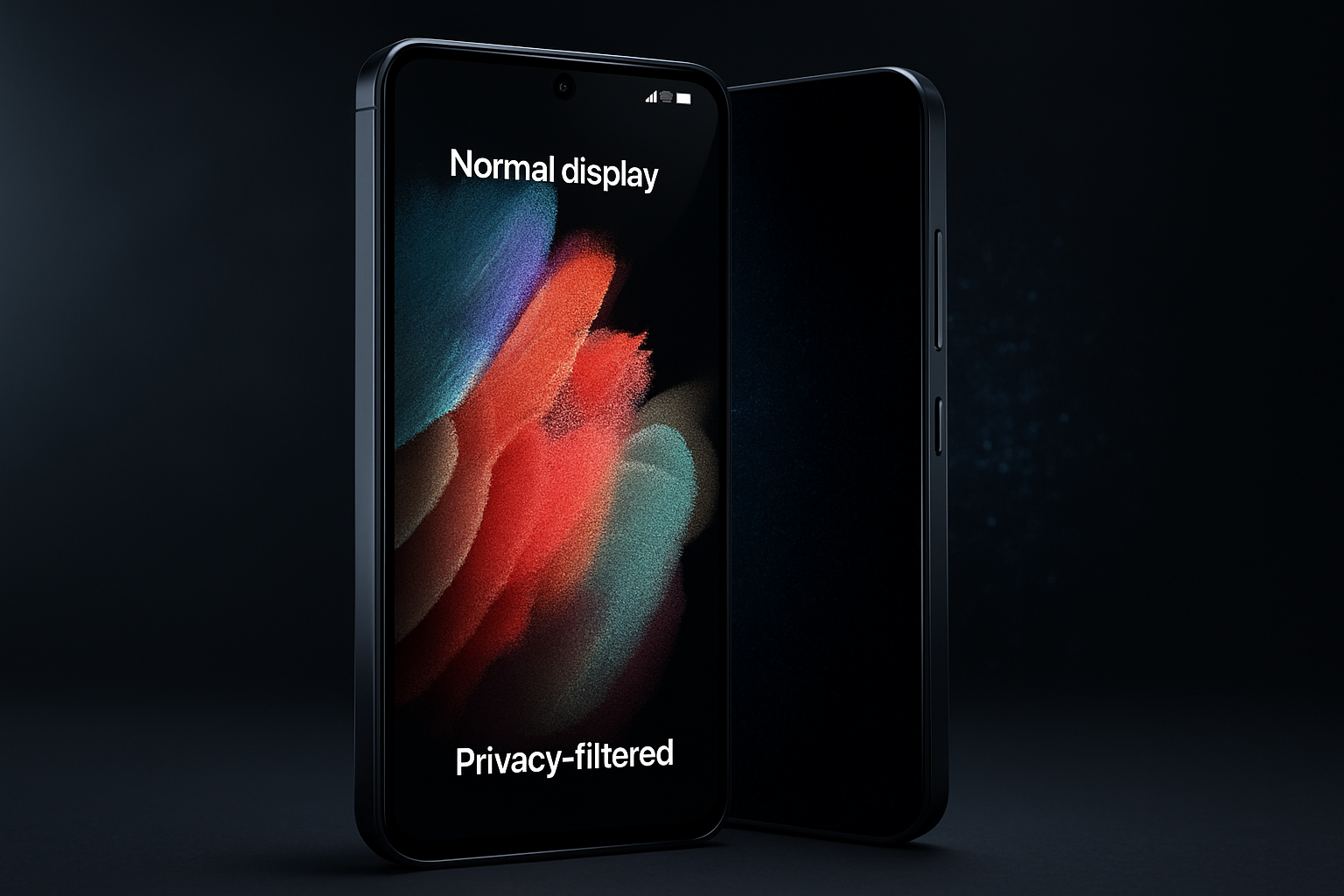
Samsung Electronics has unveiled the Galaxy S26 series with groundbreaking Privacy Display technology, introducing the first hardware-level privacy feature that controls pixel light dispersion to prevent side-angle viewing, revolutionizing smartphone security in an era of heightened digital privacy concerns.
The Privacy Display feature represents a fundamental leap beyond traditional screen protectors, utilizing sophisticated hardware-level controls to manage how each pixel disperses light. This innovative approach blocks viewing from angles while maintaining full display quality for the primary user, offering an on-demand privacy solution that can be activated when needed without permanent screen modifications.
Hardware Innovation Redefines Mobile Privacy
Samsung's Privacy Display technology works by controlling the light emission patterns of individual pixels, essentially reducing pixel density and creating strategic blockage points between them to restrict angled viewing. While not completely opaque from the side – some visual information remains discernible, particularly when viewing closer to front-on – the feature represents a significant advancement in preventing "shoulder surfing" and unauthorized screen viewing in public spaces.
The technology addresses growing workplace and public transportation privacy concerns, where sensitive information displayed on smartphones becomes vulnerable to prying eyes. Unlike aftermarket privacy screen protectors that permanently alter display clarity, Samsung's implementation allows users to toggle the feature on and off based on their current privacy needs.
"This feature is a huge leap forward for mobile privacy, offering users unprecedented control over who can see their screen content without compromising display quality when privacy isn't needed."
— Industry Technology Analyst
Galaxy S26 Series Specifications and Positioning
The Galaxy S26 series includes three models: Galaxy S26, Galaxy S26+, and Galaxy S26 Ultra, all featuring the Privacy Display technology with implementation varying by screen size. The Galaxy S26 Ultra showcases a QHD+ 6.9-inch display with 200MP main camera system enhanced by computational photography AI capabilities.
Design improvements across the series include a thinner profile with a raised camera island replacing individual lens housings, center-aligned hole-punch display, and rounded corners for enhanced ergonomics. The comprehensive AI integration spans Notes, Clock, Gallery, Reminders, Calendar, and third-party applications through confirmed partnerships including Perplexity AI.
The multi-agent Galaxy AI ecosystem combines on-device neural processing with secure cloud capabilities via encrypted channels, featuring conversational search, intelligent content generation, predictive scheduling, and advanced image analysis capabilities.
Premium Pricing Strategy Amid Market Challenges
The Galaxy S26 series pricing reflects significant market pressures, with the base model approaching the 1,000-euro threshold while the Ultra variant reaches toward 2,000 euros. This 20-30% increase from previous generations stems from the global memory crisis that has caused semiconductor costs to surge sixfold, affecting manufacturers Samsung, SK Hynix, and Micron.
Despite supply chain challenges, Samsung's vertical integration advantages – controlling semiconductors, displays, and manufacturing – provide competitive positioning against rivals. The company's ability to navigate the memory crisis while introducing advanced features like Privacy Display demonstrates strategic manufacturing capabilities.
International rollout began immediately with the February 25 launch, featuring pre-order campaigns such as Vivacom Bulgaria's offering savings up to 200 euros, doubled storage capacity, and Galaxy Buds4/Pro discounts for early adopters from February 25 through March 10.
Competitive Landscape and AI Integration
The Galaxy S26 launch occurs during a critical industry transformation period, positioning against Google Pixel 10 Pro XL and Apple iPhone 17 Pro Max through privacy innovation and AI differentiation rather than pure specifications competition. Samsung's approach emphasizes practical AI utility in daily scenarios combined with hardware privacy features.
The confirmed Perplexity AI integration represents Samsung's evolution from traditional hardware manufacturer to AI-powered technology platform. The partnership covers core applications and extends to third-party software, creating a comprehensive ecosystem for intelligent device interaction with conversational search capabilities and content generation.
This multi-agent approach suggests additional AI partnerships are planned, establishing benchmarks for mobile AI functionality that could influence competitor development strategies throughout 2026. The timing coincides with broader industry AI integration trends while maintaining Samsung's distinctive privacy-first hardware approach.
Global Market Context and Strategic Implications
The Privacy Display launch addresses increasing consumer concerns about digital security in workplace environments, public transportation, and general daily use scenarios. This hardware-focused privacy approach contrasts with software-only solutions, providing users with physical control over information visibility.
Samsung's positioning during the global memory crisis demonstrates adaptive strategy, leveraging vertical integration to maintain innovation momentum despite industry-wide supply constraints. The success of Privacy Display adoption and practical AI utility implementation will determine market reception and influence Samsung's competitive positioning through 2026.
Industry analysts view the Galaxy S26 series as establishing new benchmarks for privacy-enabled smartphones, potentially influencing competitor development priorities. The integration of advanced AI capabilities with hardware privacy features represents Samsung's comprehensive approach to addressing contemporary mobile computing challenges.
Technical Implementation and User Experience
The Privacy Display feature operates through sophisticated pixel-level light management, offering users granular control over when privacy protection is activated. This approach maintains the high-quality display experience users expect from flagship smartphones while providing security enhancement when needed.
The technology's effectiveness varies based on viewing angle proximity to front-on positioning, with closer angles revealing more screen content while maintaining significant privacy protection from typical "shoulder surfing" positions. Users can activate or deactivate the feature based on their immediate environment and privacy requirements.
Samsung's implementation considers both functionality and user experience, ensuring that privacy protection doesn't come at the expense of display quality during normal use. This balance represents a significant engineering achievement in developing practical privacy technology for consumer devices.
Future Implications for Mobile Privacy
The Galaxy S26 Privacy Display technology establishes precedent for hardware-level privacy features in consumer electronics, potentially influencing industry standards for mobile device security. As digital privacy concerns continue growing globally, Samsung's proactive approach positions the company as a leader in privacy-conscious technology development.
Success of the Privacy Display feature could accelerate adoption of similar technologies across the smartphone industry, fundamentally changing how manufacturers approach screen privacy in mobile devices. The technology represents a significant step toward giving users physical control over their digital privacy in public spaces.
The broader implications extend beyond Samsung's immediate product strategy, potentially reshaping consumer expectations for privacy features in flagship smartphones and influencing regulatory discussions about digital privacy rights and protections in mobile computing.