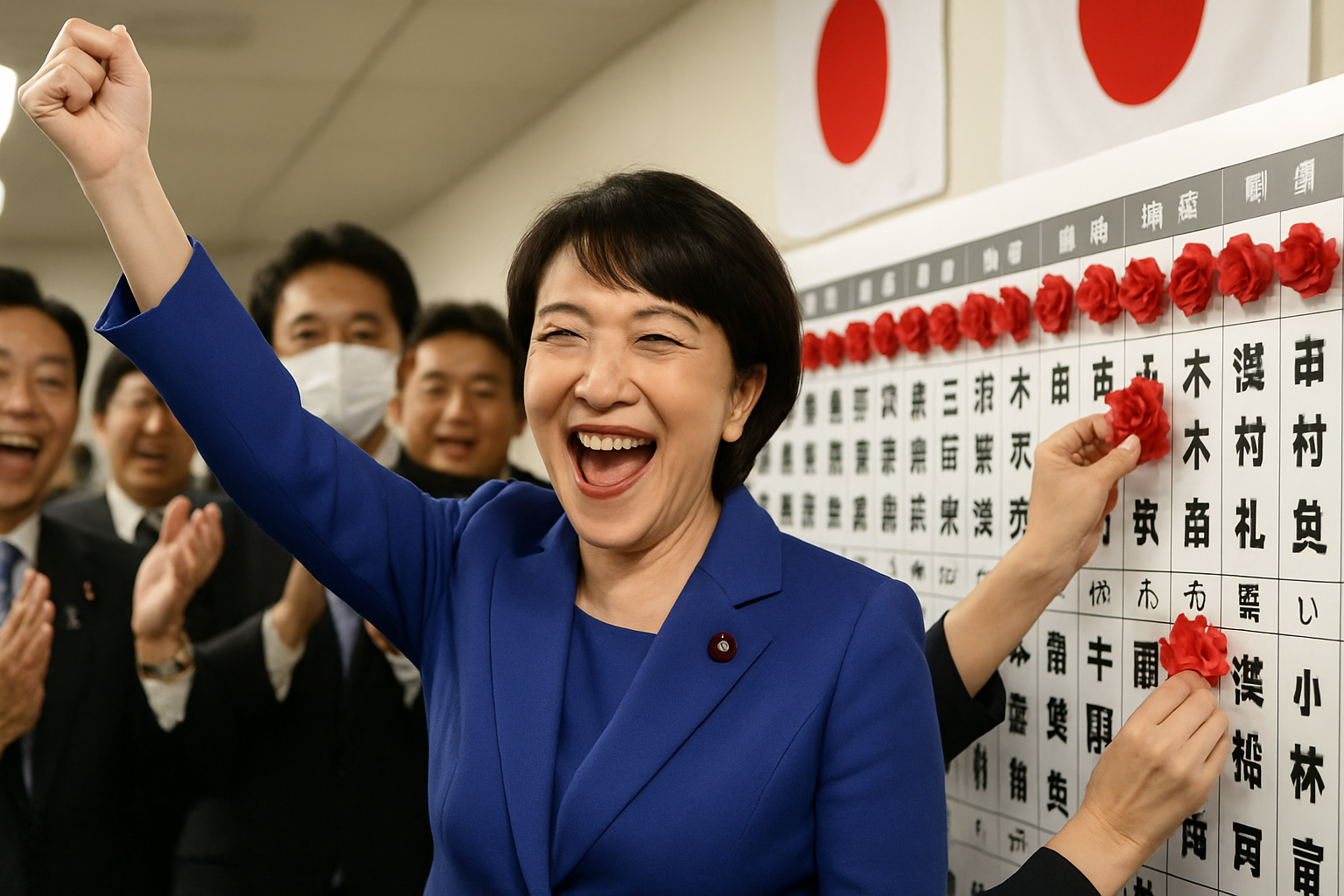
Japanese Prime Minister Sanae Takaichi's Liberal Democratic Party (LDP) achieved a historic landslide victory in Sunday's snap parliamentary election, securing 316 of 465 lower house seats—the first time a single party has won a two-thirds majority since Japan's parliament was established in its current form in 1947.
The resounding victory provides Japan's first female Prime Minister with an unprecedented mandate to advance her conservative agenda, including potential constitutional reforms and enhanced defense capabilities. Combined with coalition partner Japan Innovation Party's 36 seats, the governing coalition commands 352 seats, representing the most significant concentration of political power in modern Japanese democracy.
The election was conducted under extraordinary circumstances, taking place during Japan's worst winter storm crisis in decades that has claimed over 35 lives since late January. Despite heavy snowfall affecting multiple prefectures and challenging voter access, the democratic process proceeded successfully, demonstrating the resilience of Japan's electoral institutions.
Market Response and Economic Implications
Japanese financial markets responded enthusiastically to the decisive result. The Nikkei 225 index surged over 5% in early trading Monday, briefly crossing the 57,000 mark for the first time before settling at a record high of 56,363.94, up 3.9%. The index has gained more than 45% over the past year, reflecting investor confidence in political stability and policy continuity.
The victory comes as 54% of voters cited inflation as their primary concern, with household food spending reaching a 44-year high. Takaichi's campaign promises of tax cuts and economic revitalization resonated with cost-of-living pressured voters, despite initial market skepticism about stimulus spending.
Constitutional Reform Potential Unlocked
The two-thirds supermajority opens the possibility for Japan's first constitutional amendments since its adoption in 1947. Takaichi, a self-described admirer of Margaret Thatcher, has advocated for revising the pacifist constitution to enhance Japan's defense capabilities amid rising regional tensions.
The victory enables potential modifications to Article 9, which restricts Japan's military activities, as China's military aircraft activity around Taiwan increased 23% in 2025. The result strengthens Japan's position as a democratic anchor in the Asia-Pacific during intensifying great power competition.
Opposition Collapse and Political Realignment
The snap election gamble paid off dramatically for Takaichi, who had promised to resign if her party failed to achieve a majority. The opposition Centrist Reform Alliance, formed in January 2026 from a merger of the Constitutional Democratic Party and Komeito, suffered a crushing defeat that eliminates the complex coalition negotiations that have historically complicated Japanese governance.
This represents a fundamental political realignment, with voters decisively rejecting alternative visions in favor of Takaichi's promise to make Japan "more prosperous and safer." The result provides political stability after a pattern of frequent leadership changes that have plagued Japanese politics.
International Significance and Regional Impact
The victory has significant international implications, particularly for U.S.-Japan relations. President Donald Trump provided an unprecedented endorsement of Takaichi during the campaign, breaking conventional diplomatic practice by supporting an allied leader during active elections. Trump announced plans for a March 19 summit, signaling strengthened bilateral ties.
China's efforts to rally Southeast Asian support against Japan following Takaichi's November remarks on Taiwan gained little regional traction. ASEAN countries demonstrated their preference for multilateral approaches, balancing economic ties with China against security partnerships with Japan and the United States.
The election result strengthens the Quad partnership (U.S., Japan, India, Australia) and provides a template for democratic resilience facing natural disasters, technological disruption, and international pressures simultaneously.
Challenges Overcome: Weather, Disinformation, and Democracy
The election proceeded despite unprecedented challenges. Japan's winter storm crisis created the most severe voting conditions in decades, with some areas recording over 2 meters of snow accumulation. Aomori city reached 1.8-meter depths—the highest since 1945—requiring Self-Defense Forces deployment for emergency operations.
The campaign also faced an unprecedented AI-generated disinformation crisis, with fake political content created "in seconds" including fabricated party logos, candidate imagery, and false testimonials. Digital platforms implemented enhanced fact-checking and youth voter education successfully countered these technological threats to electoral integrity.
These challenges make the democratic success even more remarkable, demonstrating Japan's institutional resilience and providing a template for conducting elections under extreme conditions.
Female Leadership Milestone
Takaichi's victory represents a historic milestone as the first female Prime Minister to achieve electoral success in her own right, setting an important precedent for Asia-Pacific democratic leadership. Despite a slight decrease in overall female representation in the Lower House to 68 seats (14.6% of lawmakers), down from a record 73 in the previous election, Takaichi's personal success validates diverse political representation and challenges traditional leadership assumptions.
The former heavy metal drummer turned conservative politician has established herself as a significant regional leader through crisis management during the winter emergency while simultaneously conducting a successful national campaign.
Policy Implementation Framework
The supermajority eliminates opposition influence and enables long-term conservative agenda implementation. Key policy areas include enhanced military spending for China deterrence, tax reduction implementation, and addressing demographic challenges as Japan recorded its lowest birth rate in 2024 with 30% of the population over 65.
However, fiscal hawks within the LDP and bond market pressures are expected to constrain stimulus spending despite the electoral mandate. The challenge will be balancing economic nationalism with international cooperation while addressing persistent citizen concerns about cost-of-living pressures.
The March 2026 U.S.-Japan summit will focus on defense cooperation, trade relationships, and coordinated responses to China's regional assertiveness. The strengthened political mandate provides Takaichi with enhanced negotiating position in international forums.
Looking Forward: Democratic Template for the 21st Century
Takaichi's historic victory provides multiple templates for modern democratic governance: conducting successful elections during natural disasters, countering AI-generated disinformation, achieving female leadership in traditionally male-dominated politics, and maintaining democratic resilience under multiple simultaneous pressures.
The international community is closely monitoring how Takaichi utilizes this historic mandate to balance regional security concerns with democratic governance principles. The election success amid severe weather, technological challenges, and international pressures reinforces Japan's democratic stability during a period of global democratic stress.
The result establishes Japan as a stable democratic anchor in the Asia-Pacific, provides encouragement for regional democratic institutions facing similar challenges, and demonstrates that democratic processes can adapt to and overcome modern threats while maintaining constitutional continuity and popular legitimacy.
With the most significant concentration of political authority in modern Japanese democracy, Takaichi now faces the challenge of translating electoral success into effective governance that addresses citizen needs while strengthening democratic institutions and international cooperation for long-term regional stability.