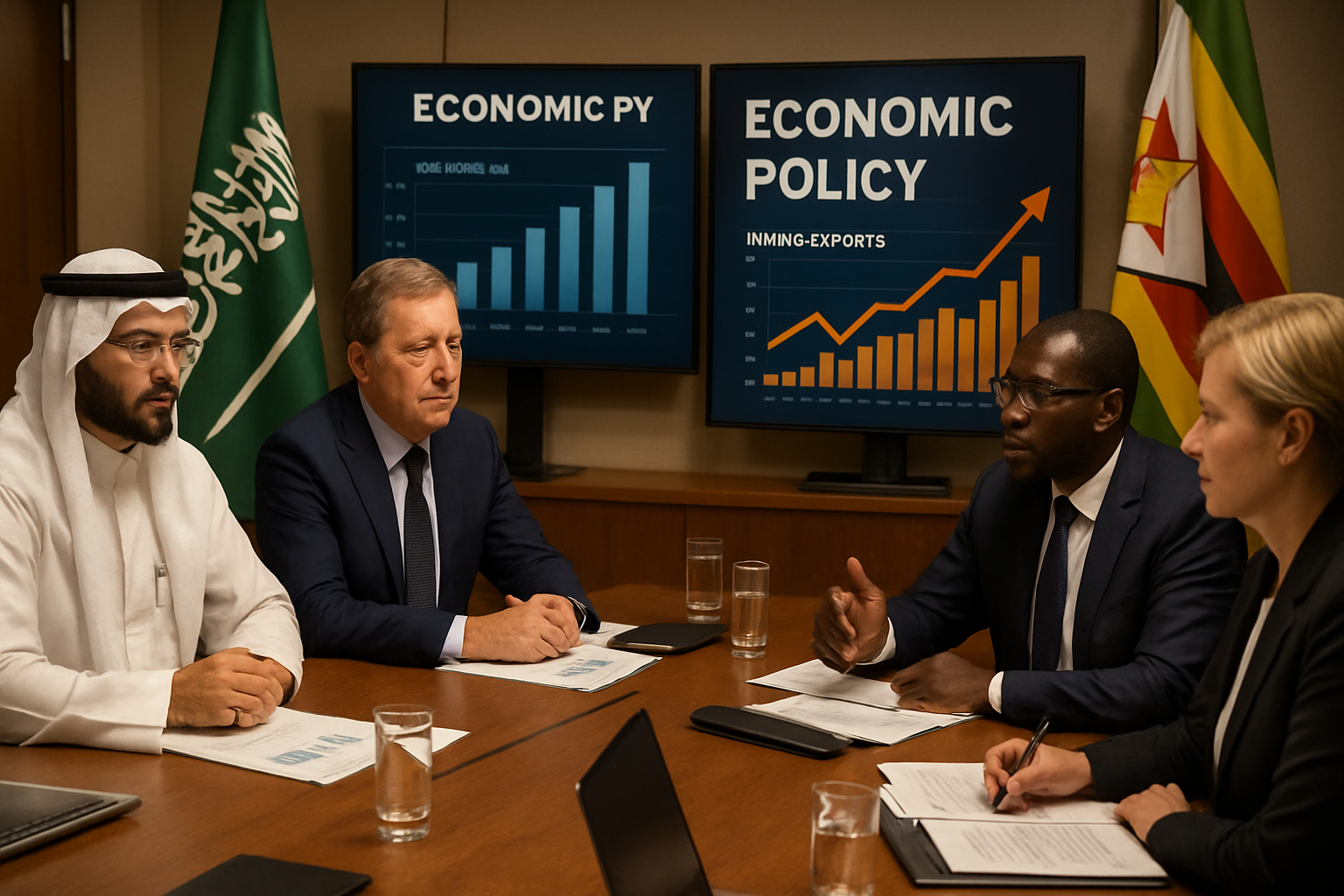
Two dramatically different economic policy approaches emerged this week as Saudi Arabia reported high resilience in confronting global challenges while Zimbabwe announced a complete suspension of lithium concentrates and raw mineral exports, underscoring divergent strategies for managing natural resources and economic development in an increasingly volatile global environment.
Saudi Arabia's Economic Stability Amid Global Turbulence
The Council of Economic and Development Affairs (CEDA) reviewed quarterly reports Wednesday highlighting the Saudi economy's exceptional performance during a period of unprecedented global economic uncertainty. According to the Ministry of Economy and Planning, various economic statistics and indicators point to remarkable growth that further cements the Kingdom's position among the fastest-growing and most stable economies worldwide.
The Saudi economy's resilience is particularly evident in its trade performance, with non-oil exports including re-exports recording an impressive 18.6 percent increase during the fourth quarter of 2025 compared to the same period in 2024. This growth was driven primarily by a 67.4 percent surge in re-exports, with machinery, electrical equipment, and their parts constituting 49.9 percent of total re-exports.
"The report addressed the latest developments related to the national economy and future projections through 2027, highlighting its high resilience in confronting global challenges."
— Ministry of Economy and Planning, Saudi Arabia
The diversification strategy appears to be yielding results, as petroleum exports' share of total exports declined from 70.4 percent in the fourth quarter of 2024 to 67.5 percent by the end of 2025. This shift reflects the Kingdom's successful implementation of Vision 2030 objectives aimed at reducing economic dependence on oil revenues.
Zimbabwe's Strategic Mineral Export Suspension
In stark contrast to Saudi Arabia's export expansion, Zimbabwe announced the immediate suspension of all lithium concentrates and raw mineral exports, representing a fundamental shift in the country's approach to resource management. The decision reflects intensifying efforts under the Second Republic to enhance mineral accountability and promote local beneficiation of the country's abundant natural resources.
Zimbabwe's move comes amid a global surge in demand for lithium, a critical component in electric vehicle batteries and renewable energy storage systems. The country possesses significant lithium reserves, making this export ban a potentially transformative policy with far-reaching implications for global supply chains and domestic economic development.
The suspension is part of broader efforts to move away from traditional extractive models toward comprehensive value addition within Zimbabwe's borders. This approach aligns with continental trends toward resource sovereignty, as evidenced by similar policy shifts across Africa where governments are increasingly asserting control over mineral resources while seeking to maximize domestic economic benefits.
Global Context of Resource Management Strategies
These divergent approaches emerge against the backdrop of intense global competition for critical minerals and energy resources. Historical context from recent months reveals a complex landscape where countries are reassessing their resource management strategies amid mounting geopolitical pressures and supply chain vulnerabilities.
China currently controls 60 percent of global critical mineral production and 90 percent of refining capacity for materials essential to renewable energy infrastructure, including lithium, cobalt, and rare earth elements. This dominance has prompted the formation of alternative partnerships, including the US-EU-Japan Critical Minerals Partnership involving 55 countries and seven African suppliers seeking to diversify global supply chains.
The African Continental Free Trade Area (AfCFTA) framework has enabled cross-border mining ventures and regional value chains, supporting Zimbabwe's strategy of enhancing mineral accountability while maintaining international market access. Recent developments across the continent, including major mining investments in Ivory Coast, South Africa, and Burkina Faso, demonstrate growing momentum toward resource sovereignty combined with strategic international partnerships.
Economic Implications and Development Models
Saudi Arabia's export-focused growth model has demonstrated remarkable stability, with the trade surplus growing by 26.3 percent despite global economic headwinds. The Kingdom's ability to maintain economic momentum while transitioning away from pure oil dependence provides a template for resource-rich nations seeking sustainable development pathways.
Zimbabwe's approach represents a more radical departure from traditional resource extraction models. By suspending raw mineral exports, the government aims to force development of domestic processing capabilities and value-addition industries. This strategy, while potentially disruptive in the short term, could yield significant long-term benefits if successfully implemented.
The contrast between these approaches reflects broader debates about optimal resource management strategies in developing economies. Saudi Arabia's gradual diversification has maintained economic stability while building new sectors, whereas Zimbabwe's more aggressive intervention seeks to accelerate industrial development through policy mandate.
Regional and Global Market Responses
Market reactions to these developments have been notably different. Saudi Arabia's consistent economic performance has reinforced investor confidence in the Kingdom's reform agenda, supporting continued foreign investment and economic partnerships. The government's transparent reporting through CEDA demonstrates institutional maturity and policy coherence that appeals to international markets.
Zimbabwe's export suspension has generated mixed responses, with some viewing it as a necessary step toward economic sovereignty while others express concern about potential supply chain disruptions. The global lithium market's dependence on diverse suppliers means that Zimbabwe's policy could influence pricing and availability of critical materials for renewable energy technologies.
The timing of these developments coincides with unprecedented global infrastructure investment, estimated at over $570 billion across various sectors. Countries implementing effective resource management strategies are positioned to benefit from this investment surge, while those facing policy uncertainty may struggle to attract sustained capital inflows.
Technology Integration and Modern Resource Management
Both countries are incorporating advanced technologies into their resource management approaches, though with different objectives. Saudi Arabia's focus on digital monitoring and smart systems supports efficiency improvements and market responsiveness, enabling rapid adaptation to global economic conditions.
Zimbabwe's emphasis on local beneficiation requires significant technology transfer and capacity building to develop domestic processing capabilities. Success will depend on attracting appropriate technology partnerships while maintaining policy control over strategic resources.
Modern resource management increasingly requires sophisticated integration of traditional knowledge with cutting-edge technology. Countries achieving this synthesis demonstrate greater economic resilience and attract sustainable investment, as evidenced by successful examples across Africa and the Middle East.
Future Implications for Economic Development
The Saudi-Zimbabwe contrast illustrates fundamental choices facing resource-rich developing economies in an era of accelerating technological change and geopolitical competition. Saudi Arabia's gradualist approach has delivered stability and growth while maintaining international partnerships, but may limit the pace of structural transformation.
Zimbabwe's interventionist strategy could accelerate domestic industrial development if successfully implemented, but carries higher risks of market disruption and investor uncertainty. The success or failure of this approach will influence similar policy discussions across resource-rich developing nations.
Both models require sustained political commitment, institutional capacity, and adaptive management capabilities to navigate complex global economic pressures while achieving domestic development objectives. The coming months will test whether these different approaches can deliver on their respective promises of sustainable economic growth and development.
As global demand for critical minerals continues growing amid the energy transition, the effectiveness of different resource management strategies will have implications extending far beyond individual national economies, potentially reshaping international trade patterns and development cooperation frameworks for years to come.