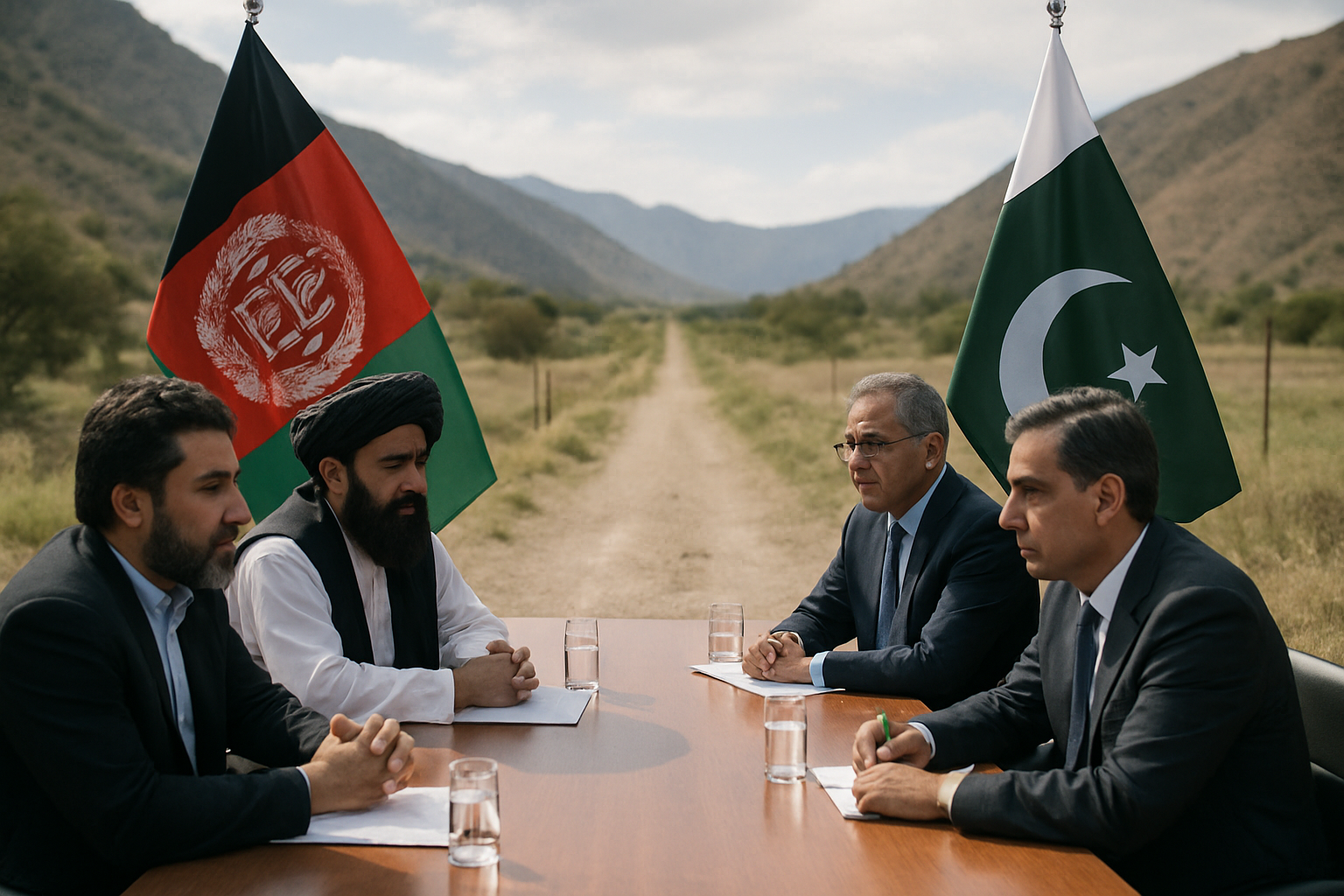
Saudi Arabia and Qatar have welcomed the announcement of a temporary ceasefire between Afghanistan and Pakistan for Eid al-Fitr, marking the first significant de-escalation in a month-long military confrontation that began with a deadly Taliban border attack.
The Gulf nations praised both sides for responding positively to international mediation efforts, with Saudi Arabia's Foreign Ministry describing the temporary truce as evidence that "dialogue and peaceful solutions remain the best approach for resolving disputes." Qatar's Ministry of Foreign Affairs similarly hailed the move as "a constructive gesture that could help de-escalate the situation."
Ceasefire Terms and International Response
The temporary suspension of hostilities, announced for March 18-23 to coincide with Eid al-Fitr celebrations, represents the first breakthrough in diplomatic efforts led by Saudi Arabia, Qatar, and Turkey. Pakistani Information Minister Attaullah Tarar confirmed the pause in Operation Ghazab lil-Haq, while Taliban spokesman Zabiullah Mujahid reciprocated by temporarily halting Afghanistan's "Rad al-Zulm" defensive operations.
However, the ceasefire's fragility became apparent almost immediately. Despite the truce announcement, Pakistani military forces fired more than 70 artillery shells into Afghanistan's Kunar province on March 19, according to local officials. Zia-ur-Rahman Spin Ghar, head of information at Kunar's Department of Information and Culture, reported that 35 shells struck areas including Dokalam, Barikot and Tsongalai in Narai district, with another 37 shells hitting parts of Manogai district.
Month of Unprecedented Military Confrontation
The temporary ceasefire comes after the most serious military confrontation between the neighboring nations since the Taliban's return to power in August 2021. The crisis began on February 16, 2026, when a Tehreek-e-Taliban Pakistan (TTP) attack in Bajaur killed 11 Pakistani soldiers using a vehicle-borne improvised explosive device.
Pakistan's retaliation came on February 22 with airstrikes targeting seven alleged terrorist camps in Afghanistan's Nangarhar and Paktika provinces. While Pakistan claimed to have eliminated 80+ militants, the strikes resulted in civilian casualties, including eight schoolchildren in Behsud district. The situation escalated dramatically on February 27 when Pakistani Defense Minister Khawaja Asif made the unprecedented declaration of "open war" against the Taliban government.
"This is a historic moment for diplomatic engagement in the region. The temporary ceasefire provides a crucial window for sustained dialogue."
— Saudi Foreign Ministry Statement
Humanitarian Crisis Deepens
The month-long conflict has created a severe humanitarian catastrophe, with the UN Office for the Coordination of Humanitarian Affairs (OCHA) reporting 16,370 families newly displaced across 10 Afghan provinces. The UN Assistance Mission in Afghanistan (UNAMA) has documented 185 civilian casualties since late February, with 56 killed and 129 wounded, the majority being women and children.
The World Health Organization has been forced to deliver emergency medical oxygen to only 23 hospitals, while hundreds of health centers have closed due to the ongoing violence. The economic impact has been equally devastating, with bilateral trade collapsing by 59% as Pakistan exports dropped from $550 million to $228 million over seven months, severely affecting border communities.
The Durand Line Dispute at the Heart of Tensions
At the core of the Afghanistan-Pakistan conflict lies the disputed 2,640-kilometer Durand Line, the colonial border established by Britain in 1893 that has never been recognized by any Afghan government. Pakistan maintains that TTP militants operate "with impunity from Afghan soil," using the porous mountainous terrain as sanctuary for cross-border attacks. The Taliban categorically denies providing sanctuary to militant groups or allowing Afghan territory to be used against neighboring countries.
The disputed border has become a flashpoint for broader issues of territorial sovereignty versus transnational terrorism management, testing the effectiveness of post-2021 South Asian security architecture. Pakistan acknowledges its diminished influence in Afghanistan compared to wealthier regional powers including Turkey, the UAE, Qatar, Saudi Arabia, and China, which has increasingly forced Islamabad to rely on military solutions.
Faith-Based Diplomacy Breakthrough
The successful negotiation of the Eid ceasefire represents a significant achievement for faith-based diplomacy during the holy month of Ramadan. Islamic scholars, including Ali al-Qaradaghi, president of the International Union of Muslim Scholars, issued fatwas calling for an immediate ceasefire between the Muslim nations, emphasizing that fighting during Ramadan contradicts Islamic teachings.
Chinese Foreign Minister Wang Yi has also been actively involved in mediation efforts, with special envoys shuttling between Kabul and Islamabad to promote dialogue and reconciliation. The breakthrough demonstrates the effectiveness of religious and cultural diplomacy in providing leverage for peace initiatives, particularly during religiously significant periods.
Previous Mediation Failures
The current ceasefire success stands in stark contrast to previous failed mediation attempts. A Saudi-mediated prisoner exchange in February 2026, which resulted in the release of three Pakistani soldiers, proved insufficient to address underlying security challenges. Turkish Foreign Minister Hakan Fidan's initiatives, along with Iranian and Russian mediation offers, had similarly fallen short of preventing military escalation.
The persistence of violence despite these diplomatic efforts highlights the complexity of managing conflicts where terrorism concerns intersect with territorial sovereignty disputes. The involvement of nuclear-armed Pakistan adds an additional dimension of concern, requiring careful international monitoring to prevent escalation beyond conventional operations.
Nuclear Implications and Regional Security
The Afghanistan-Pakistan crisis represents the most serious confrontation involving a nuclear-armed nation since the Taliban's return to power, testing the resilience of regional security frameworks. Chinese warnings at the UN about the presence of ISIS-K, al-Qaeda, and ETIM militants in Afghanistan contradict Taliban claims of having defeated terrorism, adding complexity to regional security calculations.
The conflict has broader implications for 21st-century conflict resolution mechanisms, serving as a potential template for managing territorial sovereignty versus transnational terrorism challenges. The success or failure of current diplomatic containment efforts could influence approaches to similar conflicts globally, particularly those involving nuclear-armed neighbors.
Fragile Peace and Future Prospects
While the Eid ceasefire represents a diplomatic breakthrough, its immediate violation through continued Pakistani shelling underscores the fragility of the truce. Taliban officials maintain that "the path of talks remains open" and continue to seek resolution through "mutual understanding and respect." However, Pakistan has indicated there is "no rush" to end its military campaign without concrete anti-militant measures from the Taliban.
The five-day ceasefire window provides a crucial opportunity for intensive diplomatic engagement to address underlying issues including cross-border terrorism, disputed borders, and competing sovereignty claims. The success of this temporary truce in transforming into a sustainable peace framework will determine whether the region returns to military confrontation after Eid celebrations or moves toward lasting diplomatic resolution.
International Stakes and Global Template
The Afghanistan-Pakistan crisis extends beyond bilateral relations, affecting broader international security architecture and conflict prevention mechanisms. The outcome will influence how the international community approaches similar challenges where religious and cultural considerations intersect with security concerns and territorial disputes.
The current situation provides a test case for innovative diplomatic frameworks that balance security concerns with territorial integrity, civilian protection, and international law compliance. As regional powers including Saudi Arabia, Qatar, Turkey, and China demonstrate their mediation capabilities, the crisis may establish new paradigms for conflict resolution in the multipolar era.
The stakes are particularly high given the humanitarian catastrophe, with 88% of female-headed households in Afghanistan unable to meet minimum living requirements. The international community faces pressure to develop effective mechanisms that can prevent broader regional confrontations while addressing legitimate security concerns from all parties involved.