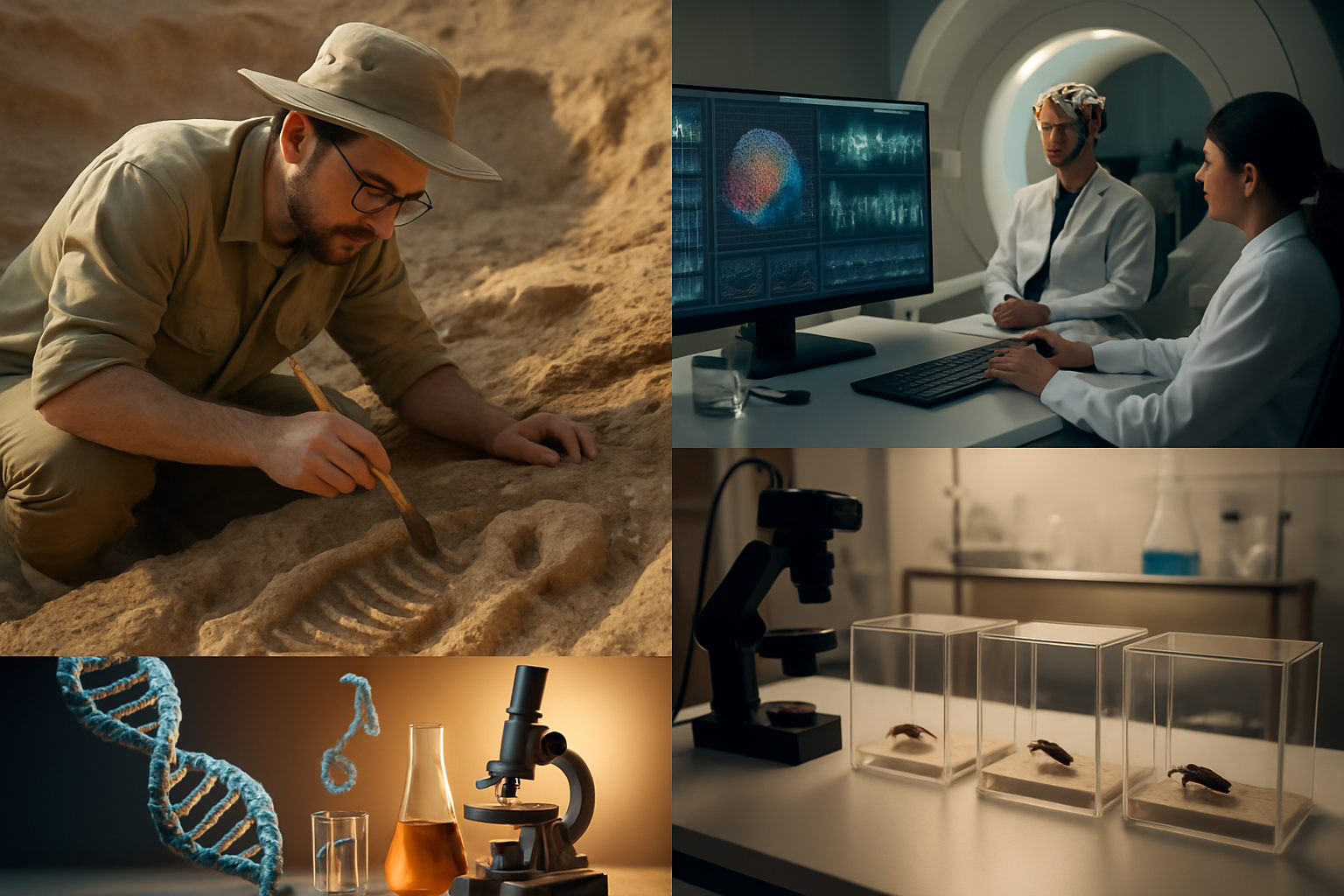
March 2026 has emerged as a watershed moment in scientific discovery, with researchers across multiple continents unveiling groundbreaking findings that fundamentally challenge our understanding of prehistoric life, human brain function, and animal behavior. From Brazilian dinosaur discoveries to revolutionary insights into brain aging and remarkable cockroach social dynamics, the global scientific community is experiencing an unprecedented renaissance of discovery.
Brazilian Dinosaur Discovery Rewrites Ancient History
Brazilian scientists have made a remarkable paleontological breakthrough, discovering a new species of giant dinosaur that provides fresh evidence of ancient land connections between South America, Africa, and Europe around 120 million years ago. The discovery, closely related to similar dinosaur species previously found in Spain, offers compelling proof of the continental configurations that existed during the Cretaceous period.
This finding represents more than an isolated discovery—it's part of the broader "2026 Archaeological Renaissance" that has been reshaping our understanding of prehistoric life. The Brazilian discovery joins a growing catalog of remarkable finds, including Austrian researchers' confirmation of 14,000-year-old mammoth ivory tools in Alaska that predate established American settlement theories by 600 years, and Romanian scientists' extraction of 5,000-year-old bacterial strains that demonstrate natural antibiotic resistance predating modern medicine.
The sophisticated analytical techniques now available to researchers—including advanced chemical analysis, genetic sequencing, and environmental reconstruction—are revealing previously invisible aspects of ancient life. International cooperation has become essential for these breakthrough discoveries, requiring diverse expertise spanning geology, archaeology, environmental science, and genetics.
Brain Aging Research Offers New Hope
Simultaneously, groundbreaking research into brain aging has emerged from multiple international laboratories, offering hope for millions facing cognitive decline. Russian research facilities have been investigating simple methods to slow brain aging, while comprehensive studies from across the globe demonstrate that physical and mental decline after age 65 is not an inevitable one-way process.
Cyprus researchers have made particularly significant discoveries, showing that a substantial percentage of older adults can experience improvements in memory function and physical mobility through targeted interventions. Their findings reveal that neuroplasticity—the brain's ability to form new neural connections throughout life—can be enhanced through targeted cognitive training, physical exercise that increases brain blood flow, social engagement, and nutritional interventions.
These discoveries align with Kuwait research showing that mental activities such as reading, writing, and learning languages can reduce Alzheimer's risk by up to 40% and delay onset for years. The research, which analyzed over 7,000 women, found that pregnancy and breastfeeding are associated with better memory and cognitive function in later life, providing long-term brain protection that persists decades after menopause.
The implications extend far beyond individual health outcomes. Countries implementing prevention-first healthcare approaches, which these brain health discoveries support, are reporting substantial cost reductions through decreased crisis interventions while achieving superior population health outcomes.
Animal Behavior Revelations
Perhaps one of the most surprising scientific discoveries of March 2026 comes from the realm of animal behavior research. American scientists studying the wood-feeding cockroach Salganea taiwanensis have documented evidence of what appears to be pair bonding—a behavior previously unknown in cockroaches and rare among insects.
The research, published in the journal Royal Society Open Science, reveals that these cockroaches may engage in exclusive long-term relationships that include the remarkable behavior of eating each other's wings. This wing-eating appears to be part of a bonding ritual that leads to monogamous partnerships, fundamentally challenging our understanding of insect social behavior and cognitive capabilities.
This discovery represents a broader trend in animal behavior research that's revealing sophisticated social structures across species previously thought to operate on simple instinctual patterns. Japanese researchers recently solved the mystery of cats' legendary ability to always land on their feet, discovering that the feline spine functions as multiple independent rotation mechanisms working in harmony—a biological gyroscope operating with precision that challenges human engineering capabilities.
The cockroach pair bonding discovery also has implications for understanding evolution and adaptation. The research suggests that even insects, traditionally viewed as operating primarily on instinct, may possess cognitive and emotional capacities that enable complex social behaviors and long-term relationship formation.
International Scientific Cooperation
What makes March 2026 particularly remarkable is not just the individual discoveries, but the unprecedented level of international scientific cooperation enabling these breakthroughs. Despite funding challenges facing traditional multilateral organizations, bilateral partnerships and regional collaboration networks are driving innovation through peer-to-peer knowledge sharing.
The Brazilian dinosaur research involved collaboration with Spanish paleontologists who had previously discovered related species. The brain aging research represents a convergence of studies from Cyprus, Kuwait, Romania, and multiple other nations. Even the cockroach behavior study builds on decades of international entomological research.
This distributed cooperation model allows for culturally responsive approaches while maintaining evidence-based standards. Countries are increasingly developing specialized scientific capabilities that complement rather than compete with international partners. The result is an acceleration of discovery that no single nation could achieve independently.
Technology Meets Traditional Science
The remarkable pace of discovery in 2026 is powered by the integration of advanced technology with traditional scientific methods. DNA analysis, sophisticated imaging techniques, AI-powered data processing, and international data sharing are enabling unprecedented insights from both new samples and historical specimens.
In paleontology, researchers are using advanced spectroscopic analysis on Apollo moon rock samples collected over 50 years ago to solve long-standing scientific debates about the Moon's ancient magnetism. Similar techniques are being applied to prehistoric remains, revealing sophisticated early human capabilities that challenge linear progression models of human development.
The brain aging research relies heavily on advanced neuroimaging techniques that can detect changes at the cellular level, while the animal behavior studies employ sophisticated motion capture and behavioral analysis systems that reveal patterns invisible to traditional observation methods.
Climate Urgency Drives Preservation
Adding urgency to these scientific endeavors is the recognition that climate change threatens many research sites and specimens. January 2026 marked the 18th consecutive month with global temperatures exceeding 1.5°C above pre-industrial levels, creating immediate threats to archaeological sites, biological specimens, and research environments.
The Romanian bacterial discovery, for example, comes from ice cores that are increasingly threatened by permafrost thawing. Many archaeological sites containing ancient treasures face similar environmental threats, necessitating urgent documentation and preservation efforts that require sustained international cooperation.
Economic and Social Implications
These scientific breakthroughs carry significant economic and social implications beyond their immediate research value. Prevention-focused health strategies supported by the brain aging research demonstrate superior cost-effectiveness through decreased crisis interventions and improved community resilience.
Archaeological tourism benefits from major discoveries, while advanced materials research and medical technologies generate economic returns through reduced healthcare costs and enhanced international competitiveness. Countries investing in fundamental scientific research are positioning themselves as leaders in high-value markets while contributing to humanity's collective knowledge base.
The animal behavior research, while appearing less immediately practical, contributes to our understanding of evolution, adaptation, and biodiversity—knowledge that becomes increasingly crucial as climate change puts pressure on ecosystems worldwide.
Future Research Directions
The discoveries of March 2026 establish foundations for continued breakthroughs across multiple scientific domains. The Brazilian dinosaur findings will inform continued excavations throughout South America, potentially revealing additional evidence of ancient continental connections and prehistoric ecosystem dynamics.
Brain aging research is moving toward personalized interventions based on individual genetic variations and lifestyle factors, potentially revolutionizing how we approach cognitive health throughout the human lifespan. The integration of AI-powered analysis with traditional therapeutic approaches promises to make cognitive enhancement interventions more accessible and effective.
Animal behavior research is expanding to investigate similar complex social behaviors in other species, potentially revealing a broader spectrum of cognitive and emotional capabilities across the animal kingdom than previously recognized.
March 2026 represents a convergence of scientific excellence with environmental urgency, technological capability, and international cooperation frameworks. The pattern suggests that coordinated global research can achieve transformative breakthroughs even under resource constraints, provided there is sustained political commitment, adequate funding, and authentic community engagement in the scientific process.
As we look toward the future, these discoveries remind us that much of Earth's history—both ancient and recent—remains hidden, requiring continued investment in archaeological, paleontological, and biological research. The scientific renaissance of 2026 demonstrates that international cooperation in pursuit of knowledge continues to be one of humanity's most powerful tools for understanding and adapting to our complex and changing world.