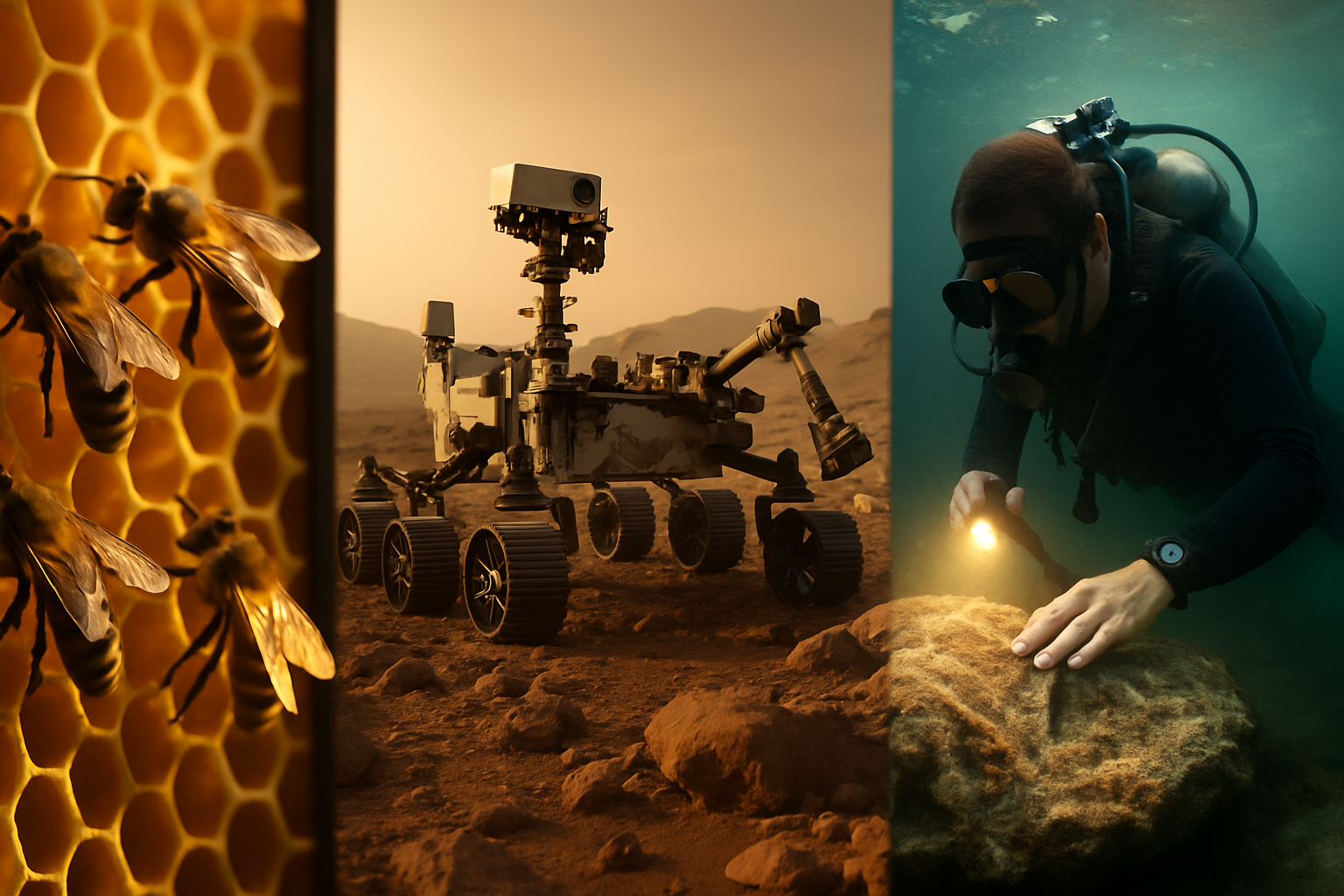
Three groundbreaking scientific discoveries spanning cognitive behavior in bees, dynamic geological activity on Mars, and ancient marine life are reshaping our understanding of intelligence, planetary evolution, and prehistoric ecosystems, marking another significant chapter in what researchers are calling the "2026 Scientific Renaissance."
The discoveries, emerging from research teams in Australia, Austria, and the United Kingdom, demonstrate the extraordinary breadth of scientific advancement occurring across multiple disciplines simultaneously, building upon months of unprecedented international cooperation and technological integration that have characterized this remarkable year for human knowledge.
Bees Demonstrate Mathematical Sophistication
Australian researchers have unveiled perhaps the most surprising discovery of the three: honeybees possess sophisticated mathematical capabilities, including the ability to count up to six and understand the concept of zero. This breakthrough, reported by the Sydney Morning Herald, fundamentally challenges assumptions about the relationship between mathematics and human culture.
"Scientists are in a buzz over the discovery that bees can understand numbers," the research team noted, describing how their experiments revealed cognitive sophistication far beyond what was previously attributed to these essential pollinators. The ability to comprehend zero—a concept that eluded human civilizations for millennia—suggests that mathematical understanding may be more widespread in nature than ever imagined.
This discovery builds upon previous 2026 research documenting remarkable behavioral adaptations in marine life, including tomato clownfish adjusting their stripe patterns based on social cues, and sophisticated communication systems in sperm whales that mirror human language structures. The pattern suggests that complex cognitive abilities may be fundamental features of life rather than unique human achievements.
Mars Reveals Dynamic Geological Activity
Meanwhile, Austrian scientists have documented extraordinary geological phenomena on Mars through analysis of Mars Express satellite imagery, revealing rapidly expanding dark shadows across the planet's surface. The discovery challenges long-held assumptions about Mars as a geologically static world.
According to Der Standard, Mars Express images document "überraschend schnell" (surprisingly rapid) growth of dark surface areas, while NASA's Curiosity rover has simultaneously discovered organic molecules in the Gale Crater that closely resemble Earth-based building blocks of life. This dual discovery suggests Mars remains far more geologically and potentially biologically active than previously understood.
The findings complement recent breakthroughs in Mars exploration, including NASA's fully AI-planned rover missions that achieved autonomous navigation capabilities in December 2025. The convergence of dynamic surface activity and organic chemistry detection provides compelling evidence for continued geological processes that could support or preserve signs of ancient Martian life.
Ancient Marine Giant Discovered
The third breakthrough comes from British researchers who uncovered a rare chunk of the oldest known sea crocodile during a guided fossil walk. The BBC reports that the Thalassosuchian jawbone represents a chance find that provides unprecedented insights into ancient marine ecosystems.
This discovery contributes to the broader "2026 Archaeological Renaissance" that has yielded remarkable prehistoric findings throughout the year. Previous discoveries include 250-million-year-old mammalian ancestor eggs in South Africa, sophisticated early human fire control evidence from 350,000 years ago, and a 15-meter prehistoric snake that potentially surpassed Titanoboa as the largest serpent ever documented.
The marine crocodile fossil joins recent paleontological breakthroughs including Argentina's intact dinosaur nest containing 10 perfectly preserved eggs, Costa Rica's giant sloth and mastodon fossils, and Canada's 290-million-year-old fossilized predator vomit—all representing extraordinary preservation of ancient life forms.
International Cooperation and Technology Integration
These discoveries exemplify the remarkable international scientific cooperation that has characterized 2026 research advances. From Austrian Mars analysis to Australian bee cognition studies to British paleontological investigations, the breakthroughs demonstrate how diverse expertise and advanced analytical techniques create unprecedented research capabilities.
The success reflects sophisticated integration of artificial intelligence, advanced imaging technology, and traditional scientific methods. Previous 2026 achievements include Chinese AI analysis of Moon samples revealing far-side chemical composition, Romanian analysis of 5,000-year-old bacterial strains with natural antibiotic resistance, and European space research documenting organic molecules in interstellar space.
Climate Change Context and Research Urgency
These scientific advances occur during a critical environmental period, with recent months marking the longest sustained warming streak in recorded history. Climate change adds urgency to research preservation efforts, as archaeological sites face environmental threats requiring rapid documentation and analysis.
The bee cognition research carries particular relevance given pollinator population pressures worldwide. Understanding bee intelligence and mathematical capabilities may inform conservation strategies essential for maintaining agricultural systems and ecosystem stability during environmental change.
Broader Implications for Science
Together, these discoveries challenge fundamental assumptions about intelligence, planetary activity, and ancient life complexity. Bee mathematical abilities suggest cognitive sophistication exists across species barriers. Mars geological activity indicates planetary systems remain dynamic far longer than expected. Ancient marine life demonstrates prehistoric ecosystem complexity exceeding current models.
The pattern reflects broader themes emerging from 2026 scientific research: life demonstrates greater sophistication than traditionally recognized, planetary systems exhibit more dynamic behavior than assumed, and ancient life achieved remarkable complexity. These insights inform contemporary understanding of intelligence, planetary evolution, and ecosystem resilience.
Future Research Directions
The bee cognition breakthrough opens new research avenues investigating mathematical abilities in other species, potentially revealing widespread cognitive sophistication across the animal kingdom. The Mars geological discoveries inform future mission planning, including sample return programs and potential landing site selection for human exploration.
The ancient marine crocodile fossil contributes to broader paleontological research mapping prehistoric marine ecosystem evolution, particularly relevant as current marine environments face unprecedented changes. Combined with other 2026 discoveries, these findings provide templates for understanding how life adapts to environmental change across geological timescales.
As 2026 continues to yield extraordinary scientific breakthroughs across disciplines, these three discoveries represent the collaborative international research effort that characterizes this remarkable year for human knowledge. From the mathematical minds of bees to the dynamic geology of Mars to the ancient giants of prehistoric seas, science continues revealing the extraordinary complexity and intelligence woven throughout nature and the cosmos.