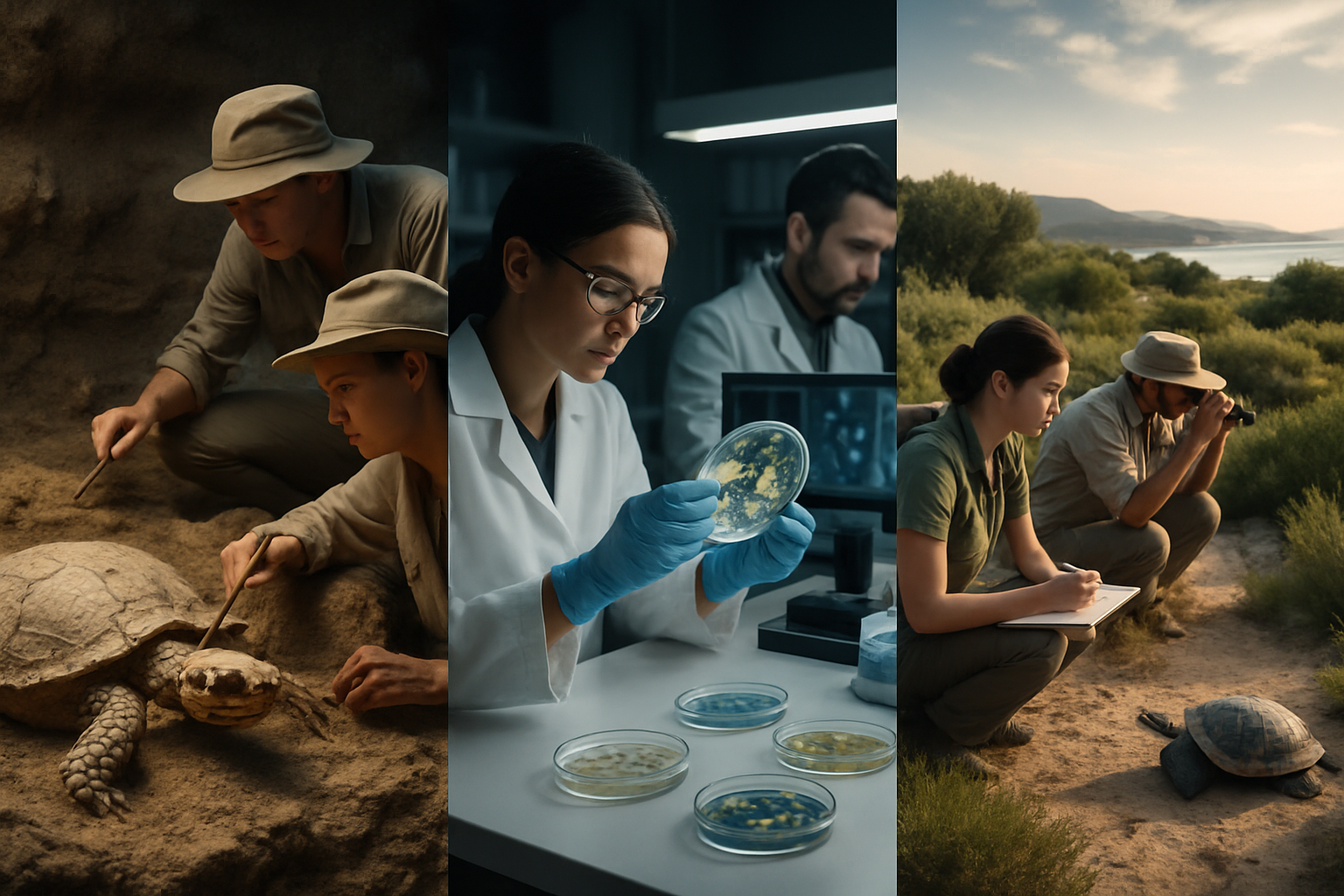
Three remarkable scientific breakthroughs this week have fundamentally challenged our understanding of evolutionary biology, ancient microbial life, and animal behavior, spanning discoveries from prehistoric turtle fossils to millennia-old superbacteria and extreme ecological adaptations.
Revolutionary Turtle Fossil Links Ancient and Modern Species
Researchers have identified what may be the crucial evolutionary "missing link" connecting ancient and modern turtle species, particularly those found across Asian ecosystems. This groundbreaking paleontological discovery, announced by international research teams, represents a significant advancement in understanding turtle evolution and dispersal patterns across continents.
The ancient turtle fossil discovery provides unprecedented insights into how contemporary Asian turtle species originated and spread throughout the region. Scientists believe this ancestral species serves as the evolutionary bridge explaining the remarkable diversity of turtle populations found across Asia today, from the tropical regions of Southeast Asia to the temperate zones of East Asia.
According to the research findings, this discovery fundamentally alters our understanding of turtle evolution timeline and geographical distribution patterns. The fossil evidence suggests that turtle species diversification occurred through more complex pathways than previously theorized, with this ancestral form playing a central role in the evolutionary branching that led to multiple modern species.
5,000-Year-Old Superbacteria Emerges from Romanian Permafrost
In a discovery that has sent shockwaves through the global medical community, Romanian scientists have unearthed a 5,000-year-old bacterial strain from permafrost that demonstrates complete resistance to modern antibiotics. The superbacteria, scientifically identified as Psychrobacter SC65A.3, was isolated from a 25-meter ice core extracted from Romania's Scărișoara Ice Cave.
This ancient microorganism presents a dual threat and opportunity for modern medicine. While the bacteria shows alarming resistance to the most commonly used antibiotics today, raising serious concerns about potential pandemic risks if climate change releases such organisms through widespread permafrost melting, it also offers unexpected therapeutic possibilities.
"This discovery poses a serious risk for global health if climate change helps these organisms to be released through thawing," warned researchers, who noted that the next global pandemic could have a bacterial origin resistant to known treatments.
— Romanian Research Team
The implications extend far beyond immediate health concerns. Climate scientists emphasize that continued global warming and permafrost thawing could release numerous ancient microbial strains that have been frozen for millennia, potentially creating a cascade of antibiotic-resistant infections for which modern medicine has no immediate solutions.
However, this bacterial strain also presents intriguing research opportunities. Scientists are investigating whether the mechanisms that allowed these ancient bacteria to survive in extreme conditions for thousands of years might be harnessed for medical applications, potentially leading to new approaches in treating antibiotic-resistant infections.
Behavioral Ecology Crisis: When Mating Aggression Becomes Lethal
Meanwhile, ecological researchers in North Macedonia have documented an extraordinary and tragic example of extreme animal behavior that threatens species survival. On a small island ecosystem, turtle populations face extinction due to aggressive male mating behaviors so intense that females are literally driven to death, including instances where females leap from cliffs to escape persistent male harassment.
This behavioral study reveals the dark side of reproductive strategies in the animal kingdom, where natural mating behaviors have evolved to become counterproductive for species survival. The research demonstrates how environmental pressures and population dynamics can create scenarios where reproductive instincts become self-destructive for the species as a whole.
The ecological implications are profound. Scientists studying this population have observed that the small island environment has intensified competitive mating behaviors to such an extreme degree that the very survival of the species is threatened. This represents a fascinating yet troubling example of how isolated ecosystems can produce evolutionary dead ends.
Connecting Ancient Discovery to Modern Understanding
These three discoveries, while seemingly unrelated, collectively illustrate the complex interconnections between past and present life on Earth. The ancient turtle fossil demonstrates how species evolution unfolds over millions of years through gradual adaptation and geographical dispersal. The 5,000-year-old superbacteria reveals how microorganisms can survive in extreme conditions while maintaining genetic characteristics that prove both beneficial and threatening to contemporary life.
The behavioral ecology research on North Macedonian turtles shows how evolutionary pressures in confined environments can lead to maladaptive behaviors that threaten species survival, providing crucial insights for conservation biology and endangered species management.
Scientific Method and Interdisciplinary Collaboration
These breakthroughs exemplify the power of modern scientific methodology and international collaboration. The turtle fossil research required expertise in paleontology, evolutionary biology, and comparative anatomy across multiple institutions. The Romanian permafrost bacteria discovery demanded coordination between microbiology, climate science, and medical research teams. The behavioral ecology study necessitated long-term field observation, population dynamics analysis, and conservation biology expertise.
Each discovery employed cutting-edge analytical techniques, from advanced fossil dating and morphological analysis to sophisticated genetic sequencing and behavioral pattern recognition. The interdisciplinary approach has become essential for addressing complex scientific questions that span multiple fields of expertise.
Implications for Climate Change and Medical Research
The permafrost bacteria discovery carries particular urgency given accelerating climate change. As global temperatures continue rising and permafrost regions experience unprecedented thawing, scientists warn that numerous ancient microbial strains could be released into modern ecosystems. This represents both a significant health threat and an unexpected source of potential medical breakthroughs.
Research institutions worldwide are now racing to study similar permafrost deposits before they thaw completely, hoping to catalog and understand ancient microbial life before it either vanishes or creates public health crises. The Romanian discovery serves as a model for this urgent scientific priority.
Conservation Biology and Ecological Understanding
The North Macedonian turtle behavior study highlights critical challenges in conservation biology, particularly for species in isolated or fragmented habitats. Understanding when natural behaviors become threats to species survival requires sophisticated ecological research and innovative conservation strategies.
These findings inform broader conservation efforts, suggesting that some endangered species may require intervention not just to protect habitat or prevent external threats, but to modify or manage problematic behaviors that evolution has not yet corrected. This represents a new frontier in conservation science.
Future Research Directions and Global Significance
These discoveries open numerous avenues for future scientific investigation. Paleontologists will continue analyzing the ancient turtle fossil to understand evolutionary relationships and migration patterns across Asian turtle species. Microbiologists will focus on understanding the genetic mechanisms that allowed the Romanian bacteria to survive millennia while developing resistance to modern antibiotics.
Behavioral ecologists will investigate whether similar patterns of self-destructive mating behaviors exist in other isolated animal populations and develop intervention strategies to prevent species extinction due to maladaptive behaviors.
The convergence of these discoveries in February 2026 reflects the accelerating pace of scientific discovery enabled by international collaboration, advanced analytical techniques, and interdisciplinary research approaches. Each breakthrough contributes to humanity's expanding understanding of life's complexity across temporal scales, from ancient evolutionary processes to contemporary ecological challenges.
As climate change continues altering global ecosystems and exposing previously frozen environments, scientific research becomes increasingly critical for understanding both the threats and opportunities emerging from our changing planet. These discoveries demonstrate that scientific investigation remains humanity's most powerful tool for comprehending and addressing the complex biological realities of our interconnected world.