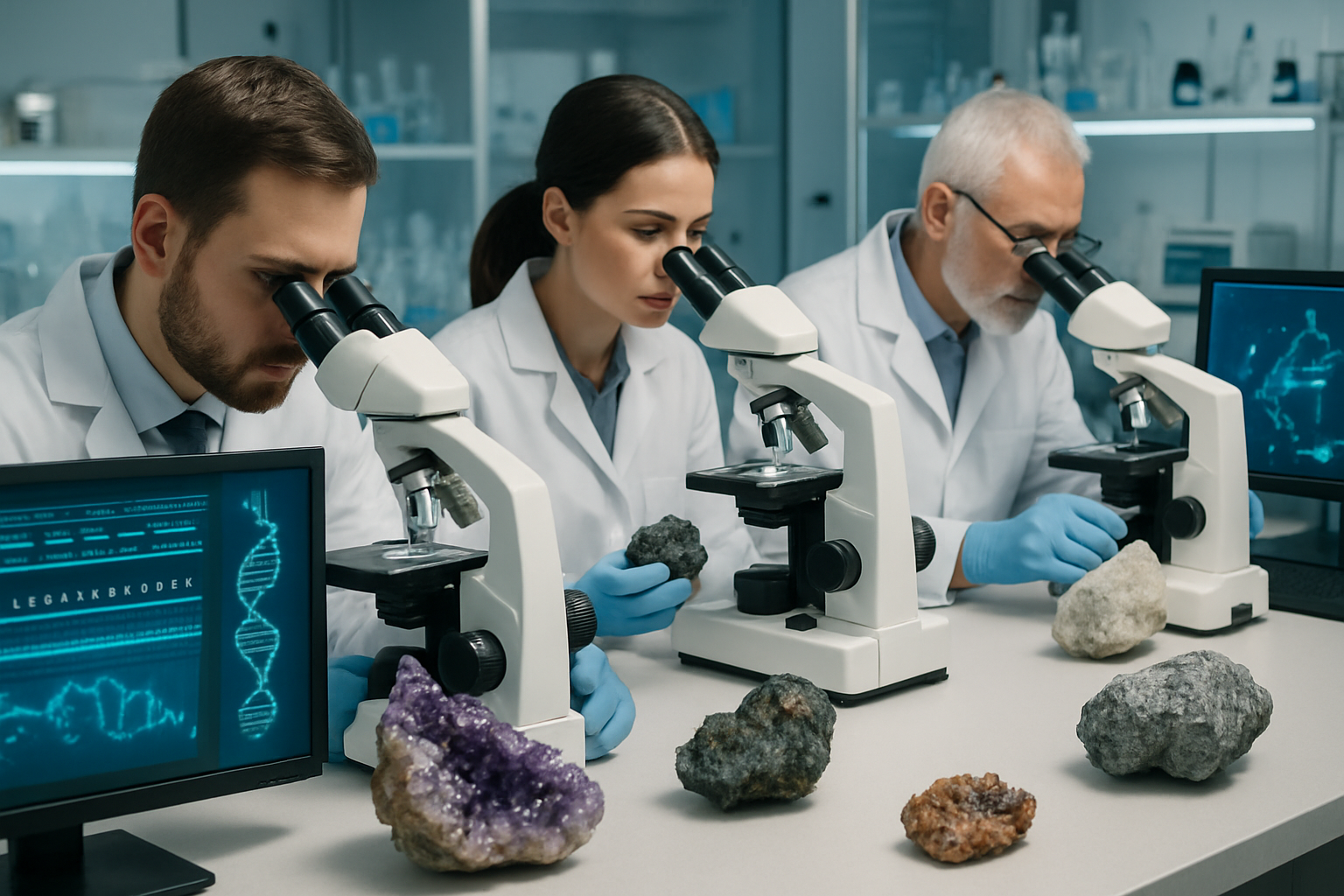
From the depths of Earth's mantle to the sophisticated mating behaviors of marine life, April 2026 has delivered an unprecedented array of scientific discoveries that demonstrate the remarkable breadth and international scope of modern research collaboration.
The month has been marked by groundbreaking findings across multiple scientific disciplines, reinforcing what researchers are calling the "Scientific Renaissance of 2026" - a period characterized by extraordinary international cooperation and breakthrough discoveries spanning geology, biology, mathematics, and behavioral science.
Deep-Earth Diamond Yields New Mineral Named for Alberta Researcher
In a remarkable geological discovery, a new mineral found inside deep-Earth diamonds has been officially named "pearsonite" in honor of Dr. Graham Pearson, a distinguished mantle geochemist at the University of Alberta. The mineral, discovered within diamonds formed in Earth's mantle hundreds of kilometers below the surface, represents a significant addition to our understanding of the planet's deep interior composition.
Dr. Pearson, whose career has taken him from the coalfields of northern England to the Arctic snows and the steaming jungles of Brazil, has established himself as one of the world's leading diamond hunters and scholars. His work has been instrumental in advancing our knowledge of how diamonds form and what they can tell us about Earth's deepest layers.
"Finding a new mineral is always exciting, but having one named after you is truly humbling," Pearson commented. "These diamonds are like time capsules that preserve minerals from conditions we can never directly access - hundreds of kilometers below our feet, at temperatures exceeding 1,000 degrees Celsius and pressures more than 50,000 times greater than atmospheric pressure."
The discovery adds to the growing catalog of minerals found within diamonds, each providing unique insights into the chemical and physical conditions that exist in Earth's mantle. These findings are particularly significant as they help scientists understand the processes that have shaped our planet over billions of years.
Octopus Reproduction Reveals Surprising Behavioral Complexity
Meanwhile, marine biologists have made fascinating discoveries about octopus reproduction that challenge previous assumptions about cephalopod behavior. Research published this month reveals that male octopuses possess remarkably sophisticated abilities to detect hormonal signals from potential mates, specifically progesterone produced by females.
The study found that male octopuses utilize a specialized tentacle equipped with highly sensitive chemoreceptors to identify and respond to these hormonal cues. This discovery highlights the complex biochemical communication systems that exist in marine environments and demonstrates that octopus reproduction involves far more sophisticated behaviors than previously understood.
"What we're seeing is an incredibly refined sensory system that allows male octopuses to detect the reproductive status of females from considerable distances," explained Dr. Marina Rodriguez, a marine biologist who contributed to the research. "This specialized tentacle essentially functions as a highly advanced chemical detection system."
The findings contribute to our growing understanding of cephalopod intelligence and behavioral complexity. Octopuses have long been recognized for their problem-solving abilities and sophisticated nervous systems, but these reproductive behaviors demonstrate an additional layer of biological sophistication that continues to surprise researchers.
Mathematical Model Confirms Fashion's 20-Year Cycle
In an unexpected intersection of mathematics and cultural studies, researchers at Northwestern University have developed a mathematical model that scientifically confirms what fashion industry observers have long suspected: women's fashion trends follow predictable cyclical patterns of approximately 20 years.
The study, which analyzed decades of fashion data using advanced computational techniques, provides the first rigorous mathematical validation of fashion's cyclical nature. The model demonstrates that trends in women's clothing, accessories, and style preferences exhibit regular patterns of revival and reinvention over two-decade periods.
"What's fascinating is that this isn't just anecdotal observation anymore," noted Dr. Sarah Chen, lead researcher on the project. "We can now quantify and predict these patterns with remarkable accuracy. The mathematics reveal underlying social and psychological forces that drive collective aesthetic preferences."
The research has implications beyond academic curiosity. Fashion industry analysts suggest that mathematical modeling of trend cycles could help retailers and designers make more informed decisions about product development, inventory management, and marketing strategies.
The study also raises intriguing questions about the intersection of individual choice and collective behavior. While personal fashion preferences may feel entirely individual, the mathematical model suggests that broader social forces create predictable patterns across entire populations.
International Scientific Cooperation Drives Discovery
What unites these diverse discoveries is the remarkable level of international cooperation that made them possible. The mineral discovery involved collaboration between Canadian and international geological institutions. The octopus research drew on marine biology expertise from multiple countries and research stations. The fashion mathematics study required interdisciplinary cooperation between mathematicians, sociologists, and cultural historians.
This collaborative approach reflects a broader trend in 2026 scientific research, where complex questions increasingly require diverse expertise and resources that transcend national boundaries. Advanced analytical techniques, shared databases, and international research networks have created unprecedented opportunities for breakthrough discoveries.
"The days of lone-wolf scientific discovery are largely behind us," observed Dr. Elena Vasquez, director of international research coordination at the Global Science Foundation. "Today's biggest breakthroughs come from bringing together diverse perspectives, technologies, and expertise from around the world."
Technology Integration Accelerates Research
Each of these discoveries was enabled by cutting-edge technology that would have been unimaginable just decades ago. The mineral analysis relied on sophisticated spectroscopic techniques and computer modeling. The octopus research utilized advanced underwater observation systems and biochemical analysis equipment. The fashion mathematics study processed vast datasets using artificial intelligence and complex statistical models.
This technological integration represents a fundamental shift in how scientific research is conducted. Modern discoveries increasingly depend on the interplay between traditional observational science and advanced computational capabilities, creating opportunities for insights that would be impossible through either approach alone.
Looking Ahead: The Future of Scientific Discovery
As April 2026 draws to a close, these discoveries point toward an exciting future for scientific research. The combination of international cooperation, technological advancement, and interdisciplinary approaches is creating unprecedented opportunities for understanding our world.
From the deepest layers of our planet to the complex behaviors of marine life to the mathematical patterns underlying human culture, science continues to reveal the remarkable sophistication and interconnectedness of natural systems. As researchers build on these foundations, the coming months promise even more extraordinary discoveries that will expand our understanding of the world around us.
The "Scientific Renaissance of 2026" shows no signs of slowing down, with research institutions worldwide reporting record levels of collaboration and discovery. These achievements demonstrate that when brilliant minds work together across disciplines and borders, the potential for transformative scientific breakthroughs becomes virtually limitless.