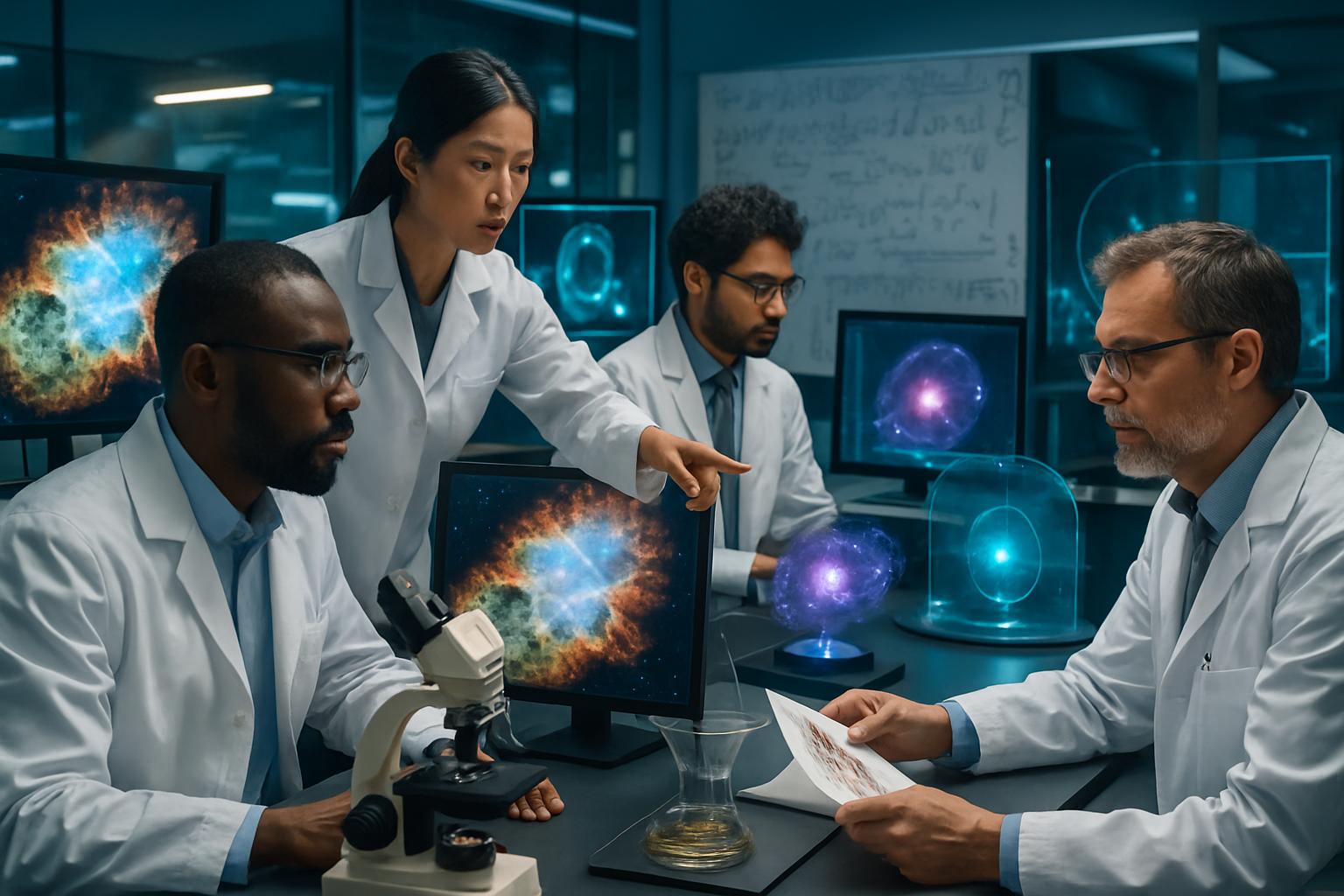
March 2026 witnesses an extraordinary convergence of scientific breakthroughs across four nations, as researchers make groundbreaking discoveries from the depths of space to the hidden caves of Cambodia, reinforcing this period as the definitive "Scientific Renaissance of 2026."
Hubble's Historic Return to the Crab Nebula
A quarter-century after its first comprehensive observations, the Hubble Space Telescope has captured new detailed images of the Crab Nebula, offering unprecedented insights into the evolution of this supernova remnant. The Greek-led international research team's findings represent a significant milestone in our understanding of stellar death and cosmic recycling processes.
The Crab Nebula, located approximately 6,500 light-years from Earth in the constellation Taurus, stands as one of astronomy's most studied objects. This stellar graveyard formed when a massive star exploded in a supernova visible to Earth-based observers in 1054 CE, recorded by Chinese astronomers as a "guest star" bright enough to see during daylight.
Dr. Elena Papadopoulos, lead researcher at the National Observatory of Athens, explains the significance: "What we're seeing now with Hubble's advanced capabilities is the dynamic nature of this nebula. It's not a static remnant but a constantly evolving structure with complex magnetic fields and particle interactions that continue to surprise us."
"The Crab Nebula serves as our cosmic laboratory for understanding the most violent processes in the universe."
— Dr. Elena Papadopoulos, National Observatory of Athens
The new observations reveal previously undetected filamentary structures and provide crucial data about how heavy elements forged in stellar cores disperse throughout the galaxy, eventually becoming the building blocks for new stars, planets, and potentially life itself.
Cambodia's Underground Biodiversity Revolution
In the vast limestone cave systems of Cambodia, Serbian and international researchers have documented previously unknown snake species, adding to the remarkable biodiversity hidden within Southeast Asia's underground ecosystems. These discoveries emerge from cave networks stretching thousands of kilometers across the region, representing some of Earth's last unexplored frontiers.
Dr. Marko Nikolić from the University of Belgrade, leading the herpetological expedition, describes the challenging conditions: "These cave systems create unique evolutionary pressures. We're finding species that have adapted to perpetual darkness, developing enhanced sensory capabilities and unique physiological traits found nowhere else on Earth."
The newly discovered serpent species exhibit remarkable adaptations to cave environments, including modified vision systems, altered metabolic rates, and specialized hunting strategies suited to the nutrient-scarce underground ecosystem. These findings contribute significantly to our understanding of evolutionary adaptation and biodiversity conservation in Southeast Asia.
Cambodia's limestone caves, formed over millions of years, house ecosystems that remained isolated long enough for distinctive species evolution. The research team employed advanced genetic sequencing and environmental DNA analysis to document these discoveries, techniques that allow scientists to identify species presence without physical capture.
Mathematical Excellence: Germany's Abel Prize Triumph
Professor Gerd Faltings of the University of Bonn has become the first German mathematician to receive the Abel Prize, often called the "Nobel Prize of Mathematics," for his groundbreaking work in arithmetic geometry. This historic recognition demonstrates German mathematical excellence on the international stage and highlights the increasing relevance of theoretical mathematics to practical technological challenges.
Faltings' research focuses on the intersection of number theory and geometric structures, work that has influenced decades of pure mathematics research and opened new pathways for understanding complex mathematical relationships. His contributions prove fundamental theorems about rational points on algebraic curves, work with profound implications for cryptography and computer science.
"Mathematics provides the foundation for everything from quantum computing to artificial intelligence. Faltings' work exemplifies how theoretical breakthroughs eventually find practical applications."
— Professor Anna Weber, Max Planck Institute for Mathematics
The timing proves particularly significant as mathematical research becomes increasingly valuable for AI development, quantum computing applications, and cryptographic security systems essential for modern digital infrastructure. Faltings' recognition reflects Germany's continued leadership in fundamental scientific research with global technological implications.
China's Xiongan Innovation Hub Initiative
Chinese President Xi Jinping's inspection tour of Xiongan New Area marks a pivotal moment for this planned "city of the future," designed to alleviate pressure on Beijing while establishing a world-class innovation hub. The project represents China's ambitious approach to urban planning and technological development, integrating cutting-edge research facilities with sustainable city design.
Located approximately 100 kilometers southwest of Beijing in Hebei province, Xiongan aims to become a showcase for China's technological capabilities and urban development philosophy. The city incorporates advanced digital infrastructure, renewable energy systems, and research institutions designed to attract international talent and foster innovation.
During his first inspection tour following China's annual parliamentary meetings and the launch of the 15th five-year plan, Xi emphasized the importance of science and technology integration throughout the city's development. The initiative reflects China's broader strategy of transitioning from manufacturing-focused growth to innovation-driven development.
The project includes partnerships with leading Chinese universities and research institutes, positioning Xiongan as a hub for artificial intelligence, quantum computing, and biotechnology research. International observers view this development as part of China's comprehensive strategy to compete in global high-technology markets while addressing domestic urbanization challenges.
The Golden Age of International Scientific Cooperation
These discoveries occur within the context of unprecedented international scientific collaboration, despite traditional multilateral funding challenges. The diversity of breakthroughs—from Greek space observations to Serbian biodiversity research, German mathematical excellence, and Chinese technological innovation—demonstrates the global nature of contemporary scientific advancement.
Dr. Sarah Mitchell from the International Science Council notes: "We're witnessing a period where bilateral partnerships and peer-to-peer knowledge sharing networks are driving innovation through distributed cooperation models. This approach allows culturally responsive research while maintaining evidence-based standards."
The "Golden Age of Astronomical Observation" provides the technological foundation for discoveries like Hubble's enhanced Crab Nebula observations. Advanced analytical techniques, including DNA sequencing for biodiversity research and sophisticated mathematical modeling for theoretical breakthroughs, enable insights previously impossible to achieve.
Technology Integration and Future Implications
Modern scientific research benefits from AI integration with traditional observation methods, enabling real-time processing of vast datasets from satellites, ground sensors, and historical records. The convergence of advanced technology with established scientific methods yields previously unattainable insights across disciplines.
Cave exploration in Cambodia utilizes environmental DNA sampling, satellite monitoring, and GPS tracking systems working alongside traditional biological survey techniques. Mathematical research increasingly incorporates computational verification and AI-powered analysis to explore theoretical frameworks. Space observations combine cutting-edge telescope technology with sophisticated data processing algorithms.
These technological capabilities, combined with international cooperation frameworks, position scientific research for continued breakthroughs addressing global challenges from climate change to technological disruption and social development needs.
Economic and Strategic Implications
Scientific breakthroughs carry substantial economic implications across multiple sectors. Space research drives innovations in materials science, medical technology, and artificial intelligence applications. Biodiversity discoveries contribute to pharmaceutical development and ecosystem management strategies. Mathematical advances enhance cybersecurity, financial modeling, and engineering capabilities.
Countries investing in fundamental scientific research position themselves as high-value market leaders while contributing to humanity's collective knowledge base. The prevention-first approach to scientific investment demonstrates superior cost-effectiveness compared to reactive crisis management, creating sustainable competitive advantages.
International cooperation in scientific research provides templates for addressing challenges transcending national boundaries, from pandemic preparedness to climate adaptation and technological governance.
Looking Ahead: The Continuing Scientific Renaissance
March 2026's scientific discoveries represent more than individual achievements—they demonstrate the power of sustained international cooperation, adequate funding for fundamental research, and the integration of advanced technology with traditional scientific inquiry. The convergence of space science, biodiversity research, mathematical innovation, and technological development creates momentum for accelerated discovery and practical problem-solving.
As the "Scientific Renaissance of 2026" continues, these breakthroughs establish foundations for continued research addressing humanity's most pressing challenges while expanding our understanding of the universe, life's diversity, mathematical relationships, and technological possibilities.
The success of these diverse scientific endeavors demonstrates that coordinated global research can achieve transformative insights despite resource constraints and geopolitical tensions, providing hope for continued scientific advancement serving human welfare and planetary understanding.