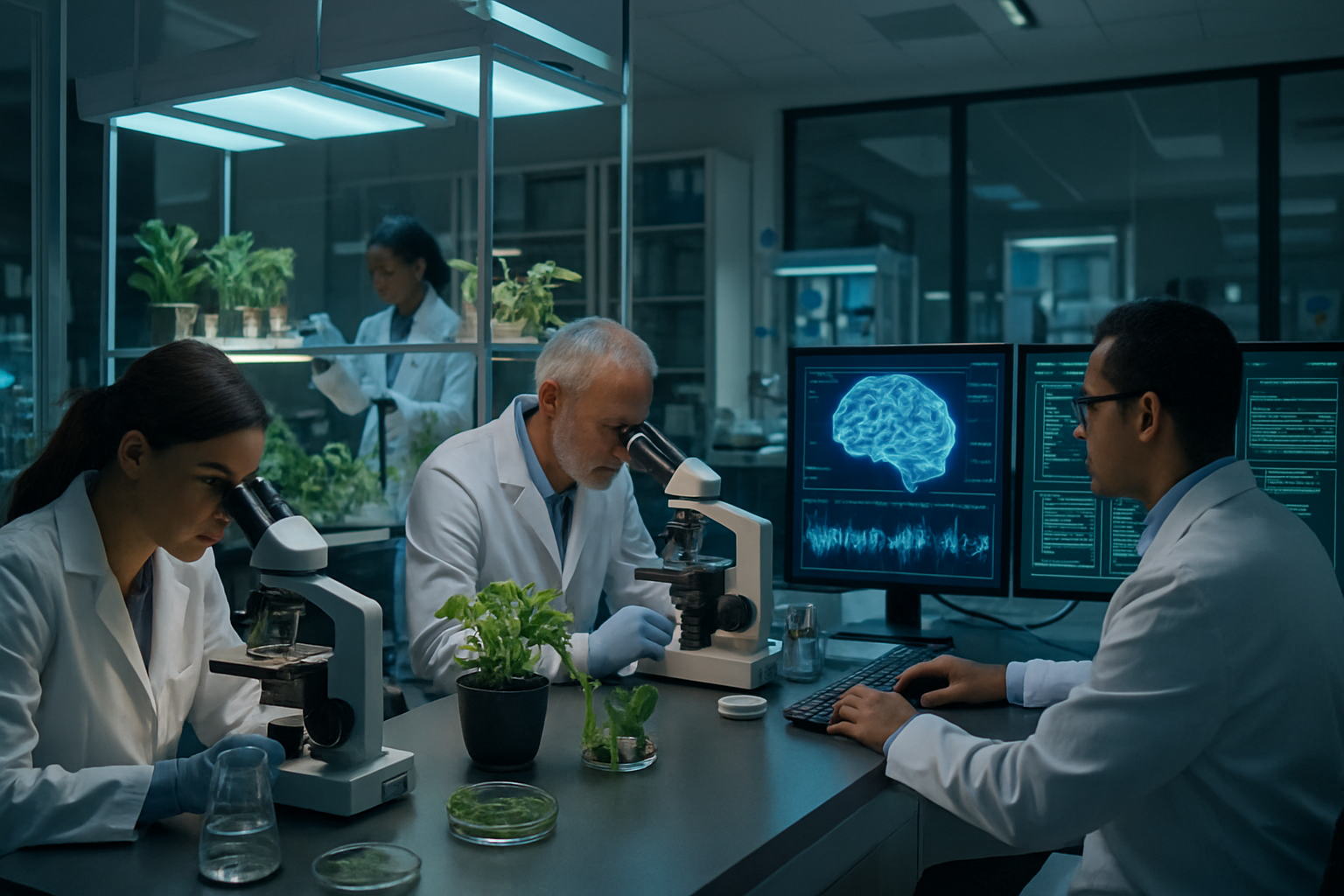
A revolutionary convergence of scientific discoveries spanning plant communication networks, AI-powered medical diagnostics, and biomedical innovations has emerged from recent research across Lithuania, Sweden, and South Korea, marking what experts are calling the pinnacle of the "Scientific Renaissance of 2026."
Plant Biology Breakthrough: Nature's Hidden Communication Networks
Lithuanian researchers have uncovered extraordinary evidence that plants possess sophisticated biological communication systems previously unknown to science. The groundbreaking study reveals that when plant leaves physically touch each other, they create intricate signaling networks that enable them to warn neighboring plants about impending environmental stress.
This remarkable discovery challenges fundamental assumptions about plant behavior and intelligence. The research demonstrates that plants can actively communicate threats related to intense lighting conditions—a common environmental challenge that can severely damage plant tissues and reduce survival rates.
"This incredible technology will help us greatly improve our understanding of how ecosystems function and adapt to environmental pressures."
— Research team member, Lithuanian botanical institute
The implications extend far beyond basic botany. This biological communication system could revolutionize agricultural practices, offering new strategies for crop protection and yield optimization. The discovery joins a growing body of evidence suggesting that plant intelligence operates on levels far more complex than previously imagined.
Healthcare AI Revolution: Swedish and Korean Medical Innovations
Meanwhile, transformative healthcare applications are emerging from artificial intelligence research in Sweden and South Korea. These developments represent a critical advancement in precision medicine and diagnostic accuracy, potentially revolutionizing how medical professionals approach patient care.
Swedish research institutions have been at the forefront of AI-powered breast cancer detection systems, achieving unprecedented accuracy rates in early-stage tumor identification. The technology enhances rather than replaces clinical judgment, providing medical professionals with powerful diagnostic tools that can detect subtle patterns invisible to human observation alone.
South Korean Medical Technology Partnership
In South Korea, medical institutions have developed revolutionary AI systems that can identify serious hormonal diseases from single hand photographs. This non-invasive diagnostic approach represents a major advancement particularly beneficial for underserved populations with limited access to traditional medical testing.
The Korean innovation builds on growing evidence that diseases manifest visual markers detectable by trained AI systems with remarkable accuracy. Such technology could democratize medical diagnosis, making sophisticated healthcare assessment available in remote or resource-limited settings.
The Therapeutic Revolution of 2026
These breakthroughs occur within what medical experts term the "Therapeutic Revolution of 2026"—a global healthcare transformation emphasizing prevention-first strategies over traditional reactive treatment models. This paradigm shift has generated measurable improvements in population health outcomes while reducing healthcare costs through early intervention approaches.

Countries implementing comprehensive prevention programs report substantial benefits including enhanced community resilience, reduced emergency care demands, and improved workforce productivity. The economic implications extend beyond immediate healthcare savings to broader societal advantages through decreased crisis interventions and enhanced international competitiveness.
International Scientific Cooperation
Despite traditional funding challenges affecting multilateral organizations, remarkable international cooperation continues driving medical and scientific innovation through bilateral partnerships and peer-to-peer knowledge sharing networks. This distributed cooperation model allows flexible, culturally responsive approaches while maintaining rigorous evidence-based standards.
The success factors emerging from this global collaboration include sustained political commitment beyond electoral cycles, comprehensive stakeholder engagement, and balanced integration of technological advancement with fundamental human development priorities.
Technology-Human Integration
Successful 2026 innovations demonstrate sophisticated integration of advanced technology with human-centered care approaches. Rather than replacing clinical judgment or human relationships, these technologies serve as amplification tools enhancing human capabilities while preserving the creativity, empathy, and cultural understanding that define human potential.
This balanced approach avoids what experts call the "wellness paradox"—where technological solutions create healthcare inequality rather than improving access and outcomes across diverse populations regardless of geographic or economic constraints.
Climate Change and Scientific Urgency
The scientific breakthroughs emerge during a critical environmental period, with January 2026 marking the 18th consecutive month of global temperatures exceeding 1.5°C above pre-industrial levels. This unprecedented sustained warming creates additional urgency for scientific solutions addressing both immediate health needs and long-term environmental resilience challenges.
Prevention-first approaches prove particularly valuable for managing evolving environmental health impacts through proactive intervention rather than reactive crisis management. The plant communication research offers insights into ecosystem adaptation strategies, while medical AI systems provide analytical capabilities valuable for climate-related health impact assessment.
Economic and Strategic Implications
The scientific advances carry substantial economic implications across multiple sectors. Plant biology discoveries could revolutionize agricultural productivity and environmental management. Healthcare AI innovations promise cost efficiency improvements and enhanced medical tourism positioning for leading countries.
Countries developing these breakthrough technologies position themselves as leaders in emerging high-value markets while contributing innovations to global knowledge bases. The expertise gained implementing cutting-edge scientific research creates economic multiplier effects extending far beyond direct research benefits.
Future Research Directions
The March 2026 discoveries establish foundations for continued scientific breakthroughs across multiple disciplines. Plant communication research opens new avenues for understanding ecosystem resilience and agricultural sustainability. Medical AI development promises expanded diagnostic capabilities and personalized treatment approaches.
Future investigations will likely focus on scaling these innovations globally while adapting them to diverse cultural and economic contexts. The international cooperation frameworks demonstrated in 2026 provide templates for addressing complex scientific challenges requiring coordinated responses across national boundaries.
Global Scientific Renaissance
March 2026 represents a critical juncture in human scientific capability, where breakthrough discoveries across multiple disciplines demonstrate the power of coordinated global research. The convergence of plant biology insights, medical AI applications, and international cooperation frameworks offers unprecedented opportunities for addressing 21st-century challenges.
Success in scaling these innovations requires continued commitment to scientific excellence balanced with practical implementation strategies that respect local contexts while leveraging international expertise. The window for effective coordinated action on global challenges continues narrowing, but the tools, knowledge, and cooperation frameworks developed in 2026 provide both hope and practical guidance for the massive efforts required.
"The Scientific Renaissance of 2026 demonstrates that coordinated international research can achieve transformative breakthroughs even amid resource constraints and complex global pressures."
— International research coordination expert
The discoveries spanning plant communication, healthcare AI, and international scientific cooperation suggest that 2026 may be remembered as a watershed year when human scientific capabilities truly matured to address multiple simultaneous civilization-scale challenges through sustained international collaboration and innovative approaches to fundamental research.