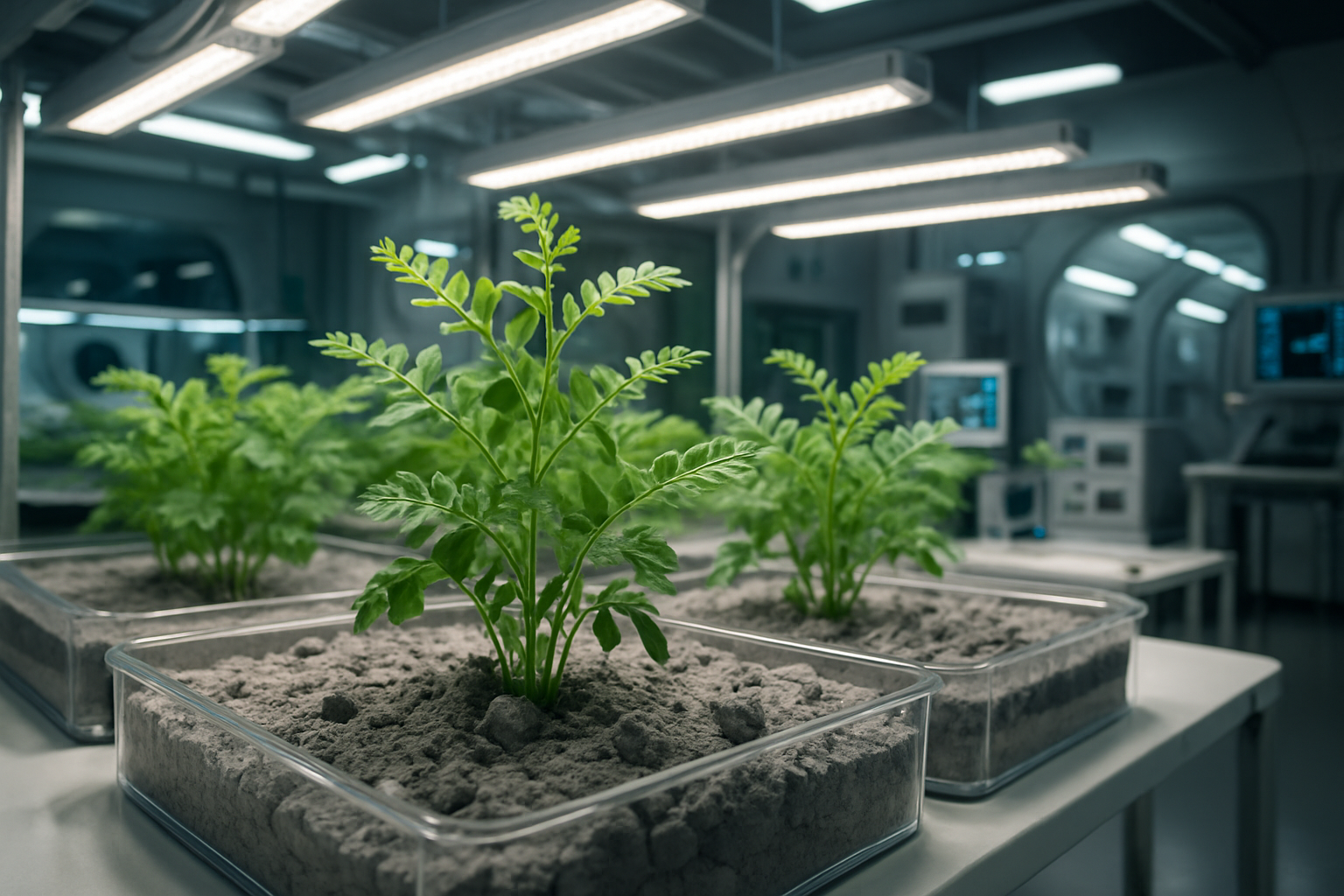
Scientists have achieved a groundbreaking milestone in space agriculture by successfully growing chickpeas in simulated lunar soil, marking a critical advancement toward enabling astronauts to produce their own food during long-term moon missions.
The development represents a pivotal step in humanity's quest to establish sustainable lunar settlements and extend human presence beyond Earth. As NASA's Artemis program prepares to return humans to the Moon for the first time since Apollo 17 in 1972, the ability to grow food in lunar environments becomes increasingly crucial for mission success and long-term colonization efforts.
Revolutionary Agricultural Breakthrough
The successful cultivation of chickpeas in moon dust simulant addresses one of the most challenging aspects of future lunar missions: food security. Traditional space missions have relied entirely on pre-packaged meals shipped from Earth at enormous cost—hundreds of thousands of dollars per kilogram. The breakthrough opens the possibility of dramatically reducing these costs while improving operational independence for lunar settlements.
Chickpeas were specifically selected for this pioneering research due to their exceptional characteristics for space agriculture. As nitrogen-fixing legumes, they can improve soil quality while providing high nutritional value, including essential proteins, carbohydrates, and vitamins. Their drought tolerance and compact growth habit make them ideally suited for the constrained environments of lunar habitats.
Technical Innovation and Methodology
The research team developed innovative techniques to transform inhospitable lunar regolith into viable growing medium. The breakthrough method involves using specialized fungi combined with processed human waste through vermiculture composting—creating a closed-loop life support system essential for long-duration space missions.
This approach represents a fundamental shift from traditional Earth-based agriculture. The worm compost system converts what would otherwise be waste into valuable fertilizer, while the fungi help break down the rocky lunar soil simulant and make nutrients available to plants. The entire system operates within pressurized growing environments featuring temperature and humidity control, LED lighting systems, automated irrigation, and radiation shielding using regolith-based materials.
"This development marks a step toward enabling astronauts on long-term moon missions to produce their own food," according to the research findings.
— Scientific Research Team
Broader Space Agriculture Context
This achievement builds upon a growing body of space agriculture research that has gained momentum during what experts describe as the current "space economy golden age." Previous successes include Wageningen University's Netherlands research developing crop varieties capable of growing in Mars-like soil conditions, and ongoing International Space Station experiments cultivating lettuce, radishes, and tomatoes in microgravity.
The timing coincides with renewed international focus on lunar exploration. NASA's Artemis II mission, despite facing technical delays with hydrogen leak issues, represents humanity's first crewed lunar mission in over five decades. Meanwhile, SpaceX has strategically pivoted from Mars colonization to lunar settlement development, targeting self-sustaining Moon cities within a decade.
International Collaboration and Research
The lunar agriculture breakthrough represents part of broader international cooperation in space research. The European Space Agency (ESA) has been developing advanced life support systems, while China's expanding lunar program includes agricultural experiments. Private sector investment has also accelerated, with the commercial space economy preparing for unprecedented growth—SpaceX alone is preparing for a potential trillion-dollar IPO in June 2026.
Ongoing ISS research continues to provide crucial data for space agriculture. French astronaut Sophie Adenot's record-breaking eight-month mission includes lung tissue cultivation and Space-Associated Neuro-Ocular Syndrome (SANS) studies that inform both medical protocols and agricultural systems for future lunar settlements.
Challenges and Solutions
Despite this breakthrough, significant challenges remain for implementing lunar agriculture at scale. The Moon's harsh environment presents unique obstacles including extreme temperature variations, radiation exposure, low gravity, and the absence of atmosphere. However, the research team's innovative solutions address many of these concerns.
The radiation shielding incorporated into the growing systems uses lunar regolith itself as protective material, turning the Moon's abundant surface material into a resource rather than merely an obstacle. The closed-loop system design minimizes resource requirements while maximizing efficiency—crucial factors for missions where every kilogram of equipment must be transported from Earth at enormous cost.
Economic and Strategic Implications
The economic significance of successful lunar agriculture cannot be overstated. Current food shipment costs to space run into hundreds of thousands of dollars per kilogram. A functioning agricultural system on the Moon would dramatically reduce mission costs while enabling longer-duration missions and permanent settlements.
This technology also positions participating nations at the forefront of space colonization capabilities. As international competition intensifies in space exploration—with China advancing its Shenlong program and Pakistan preparing astronauts for the Chinese Tiangong station—agricultural self-sufficiency represents a crucial strategic advantage for sustained lunar presence.
Applications Beyond Space
The innovations developed for lunar agriculture have significant terrestrial applications. The techniques for growing crops in extreme environments could revolutionize agriculture in Earth's most challenging regions, including deserts, polar areas, and regions affected by climate change. The closed-loop systems and resource efficiency principles could contribute to sustainable farming practices worldwide.
The research demonstrates how space exploration drives innovation that benefits life on Earth—a pattern evident throughout the history of space programs where technologies developed for space missions find widespread civilian applications.
Future Lunar Settlement Infrastructure
The successful chickpea cultivation integrates with broader lunar settlement infrastructure being developed through NASA's Artemis program and commercial space initiatives. Future lunar bases will require integrated systems combining life support, agriculture, manufacturing, and habitation modules. The agricultural component represents a crucial element in making such settlements truly self-sustaining.
The research team's approach to using local materials—transforming lunar regolith into growing medium—exemplifies the in-situ resource utilization (ISRU) philosophy essential for sustainable space settlement. Rather than transporting everything from Earth, successful lunar colonies must learn to live off the land, using local materials for construction, life support, and now food production.
Mars Mission Applications
While focused on lunar applications, this research has direct relevance for eventual Mars colonization efforts. Mars presents similar challenges for agriculture, though with different soil composition and environmental conditions. The techniques developed for transforming lunar regolith could be adapted for Martian soil, providing a foundation for agricultural systems supporting Mars colonies.
The closed-loop life support principles demonstrated in this research become even more critical for Mars missions, where the vast distances make emergency resupply from Earth impossible. A self-sustaining agricultural system represents the difference between temporary exploration and permanent settlement.
Looking Forward
This breakthrough in lunar agriculture represents more than a scientific achievement—it symbolizes humanity's growing capability to thrive beyond Earth. As we stand on the threshold of returning to the Moon and eventually reaching Mars, the ability to grow food in extraterrestrial environments becomes fundamental to our success as a spacefaring civilization.
The research continues as teams work to expand the variety of crops capable of growth in lunar conditions, improve yield efficiency, and develop fully integrated agricultural systems for lunar bases. With NASA targeting the late 2020s for sustained lunar presence and SpaceX pushing for lunar settlements within the decade, the timeline for implementing these agricultural systems in actual lunar environments may be shorter than previously imagined.
The successful cultivation of chickpeas in simulated moon soil represents a crucial milestone in humanity's journey toward becoming a truly interplanetary species, capable of sustaining life wherever our exploration takes us throughout the solar system.