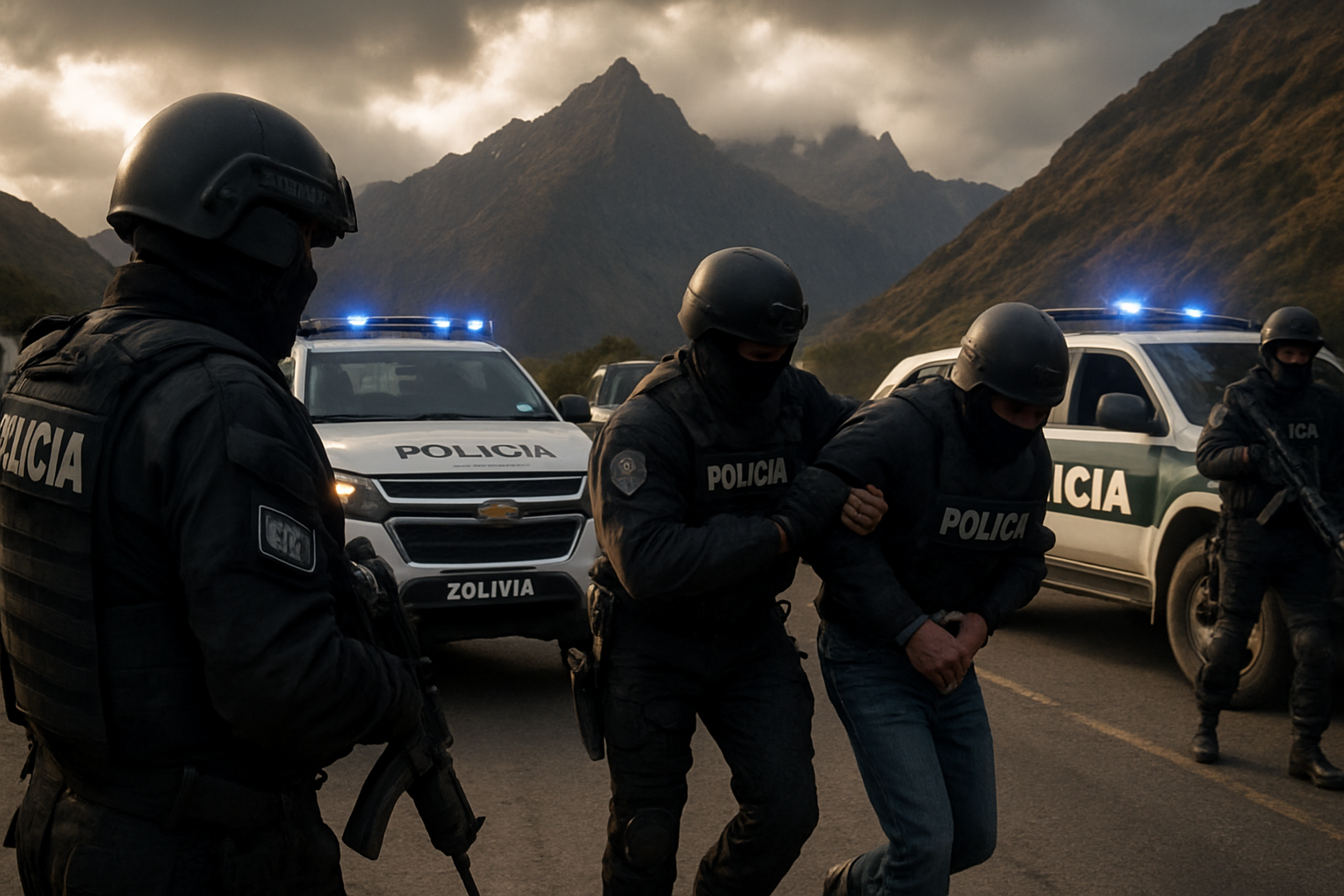
Uruguayan drug cartel leader Sebastian Marset, ranked as the third most wanted narcotics trafficker by the United States Drug Enforcement Administration, was captured in a massive police operation in Santa Cruz, Bolivia, on Friday March 13, 2026, ending a three-year manhunt for one of South America's most powerful criminal figures.
The 34-year-old Marset was detained in the Las Palmas neighborhood of Santa Cruz de la Sierra alongside three accomplices, including a woman, during an operation that began at 2:00 AM local time and concluded around 7:30 AM, according to Jalil Rachid, head of Paraguay's National Anti-Drug Secretariat.
"Recibimos las informaciones de nuestros pares de Bolivia, hay un operativo que se desplegó en la madrugada de hoy, desde las 2 de la mañana, para acorralarle a él y a su estructura," Rachid confirmed to media outlets, describing the large-scale deployment of armored vehicles and specialized personnel that led to Marset's capture.
International Cooperation Leads to Historic Arrest
The operation represents a significant victory for regional law enforcement cooperation, particularly in the context of the recently launched "Shield of the Americas" anti-cartel coalition. President Rodrigo Paz celebrated the arrest as a "surgical action" by Bolivian police that demonstrated the country's capacity to confront organized crime without casualties.
"Resaltar que no hubo ni una baja institucional de nuestra Policía Boliviana, ni un civil, ni un vecino afectado. Fue una acción quirúrgica de la Policía para quitar un mal de la patria," Paz stated during a press conference, emphasizing the professional execution of the operation.
"The reign of terror and chaos of Sebastian Marset has ended. Thanks to the leadership of President Rodrigo Paz and the rapid strengthening of police cooperation between the United States and Bolivia."
— U.S. State Department International Narcotics and Law Enforcement Office
The U.S. State Department's International Narcotics and Law Enforcement Office immediately praised the operation, posting on social media that "the Shield of the Americas is making our region safer and stronger." The arrest comes just days after the March 8, 2026 launch of the Trump administration's 17-nation anti-cartel military coalition, which specifically targets criminal organizations with state-like capabilities.
The Criminal Empire of Sebastian Marset
Marset had been one of the world's most wanted drug traffickers, with the DEA offering a $2 million reward for information leading to his capture. He faces charges in multiple countries: drug trafficking in Paraguay and Bolivia, and money laundering in the United States, where the Department of Justice has formal accusations against him for moving narcotics proceeds through U.S. financial institutions.
President Paz characterized Marset as "one of the four biggest criminals on the continent" linked to narcotics trafficking, highlighting the continental scope of his criminal network. The Uruguayan's organization was connected to the seizure of more than 16 tons of cocaine in Europe, including an 11-ton seizure that demonstrated the international reach of his operations.
In Paraguay, Marset was the central figure in "Operation A Ultranza Py," the country's largest anti-narcotics investigation. His network's sophistication included encrypted communications, compartmentalized structures spanning multiple countries, and operational capabilities that rivaled those of state actors.
Regional Impact and Extradition Battle
The arrest immediately triggered an international legal battle over Marset's extradition. Paraguay's Interior Minister Enrique Riera confirmed that his country would request extradition, while acknowledging that the United States has formal charges and is likely to take precedence.
"Esta es la información que manejamos," Riera stated, referring to expectations that Marset would ultimately be transferred to U.S. custody. Attorney General Emiliano Rolón confirmed Paraguay would submit formal extradition documents despite the competing U.S. claim.
The capture occurs within the broader context of unprecedented regional cooperation against transnational criminal organizations. Following the February 22, 2026 elimination of El Mencho, leader of Mexico's Jalisco New Generation Cartel, and the establishment of the Shield of the Americas coalition, Marset's arrest represents another significant blow to criminal networks that have demonstrated state-like operational capabilities.
The Broader War Against Cartels
Marset's arrest comes as part of an escalating campaign against South American drug trafficking organizations. The Shield of the Americas coalition, launched by President Trump with 17 Latin American and Caribbean nations, commits participating countries to using "lethal military force" against cartel leadership under terrorist organization designations.
The coalition builds on Operation Southern Spear, which has resulted in over 145 deaths since September 2025, representing a shift from traditional law enforcement approaches to military-style elimination operations. Bolivia's successful capture of Marset without casualties demonstrates the effectiveness of surgical operations that avoid the widespread violence that has characterized anti-cartel efforts in other regions.
Intelligence sources indicate that Marset's organization possessed advanced surveillance capabilities, encrypted communications systems, and international networks spanning from South America to Europe and Asia. The sophistication of these criminal enterprises has forced law enforcement agencies to adopt new approaches that match the technological and operational capabilities of modern drug cartels.
Strategic Implications for Regional Security
The successful operation against Marset represents a critical test of the new hemispheric security architecture. Unlike the violent aftermath following El Mencho's death in Mexico, which led to massive retaliation killing 25 National Guard members, Marset's capture was achieved through precision intelligence work and coordinated enforcement without triggering widespread violence.
This operational success validates the approach emphasized by the Shield of the Americas coalition: enhanced intelligence sharing, coordinated operations, and surgical strikes against criminal leadership. The arrest also demonstrates Bolivia's emergence as a reliable partner in regional security cooperation under President Paz's administration.
For the United States, Marset's capture represents validation of its bilateral approach to anti-cartel operations. The Trump administration's emphasis on working with individual countries rather than multilateral frameworks has shown concrete results, with Bolivia joining Argentina, Paraguay, and other nations in successful operations against high-value targets.
The End of a Criminal Dynasty
Marset's arrest marks the potential end of one of South America's most sophisticated criminal enterprises. Unlike traditional cartel structures, his organization operated more like a multinational corporation, with specialized divisions for logistics, finance, security, and international operations.
Law enforcement officials across the region expressed satisfaction that the operation concluded without the organizational splintering that often follows the elimination of major cartel leaders. The precise nature of the arrest, combined with simultaneous operations against key lieutenants, appears to have prevented the kind of succession battles that can lead to increased violence.
As Marset awaits extradition proceedings, his capture serves as a powerful symbol of enhanced regional cooperation against transnational organized crime. The operation demonstrates that even the most sophisticated criminal organizations can be successfully targeted through coordinated intelligence work and surgical law enforcement operations.
The arrest of Sebastian Marset represents more than the capture of a single criminal—it marks a turning point in the hemisphere's approach to combating drug trafficking organizations that have evolved to challenge state authority across multiple countries. As the Shield of the Americas coalition continues its operations, Marset's downfall provides a template for future successes in the ongoing war against transnational organized crime.