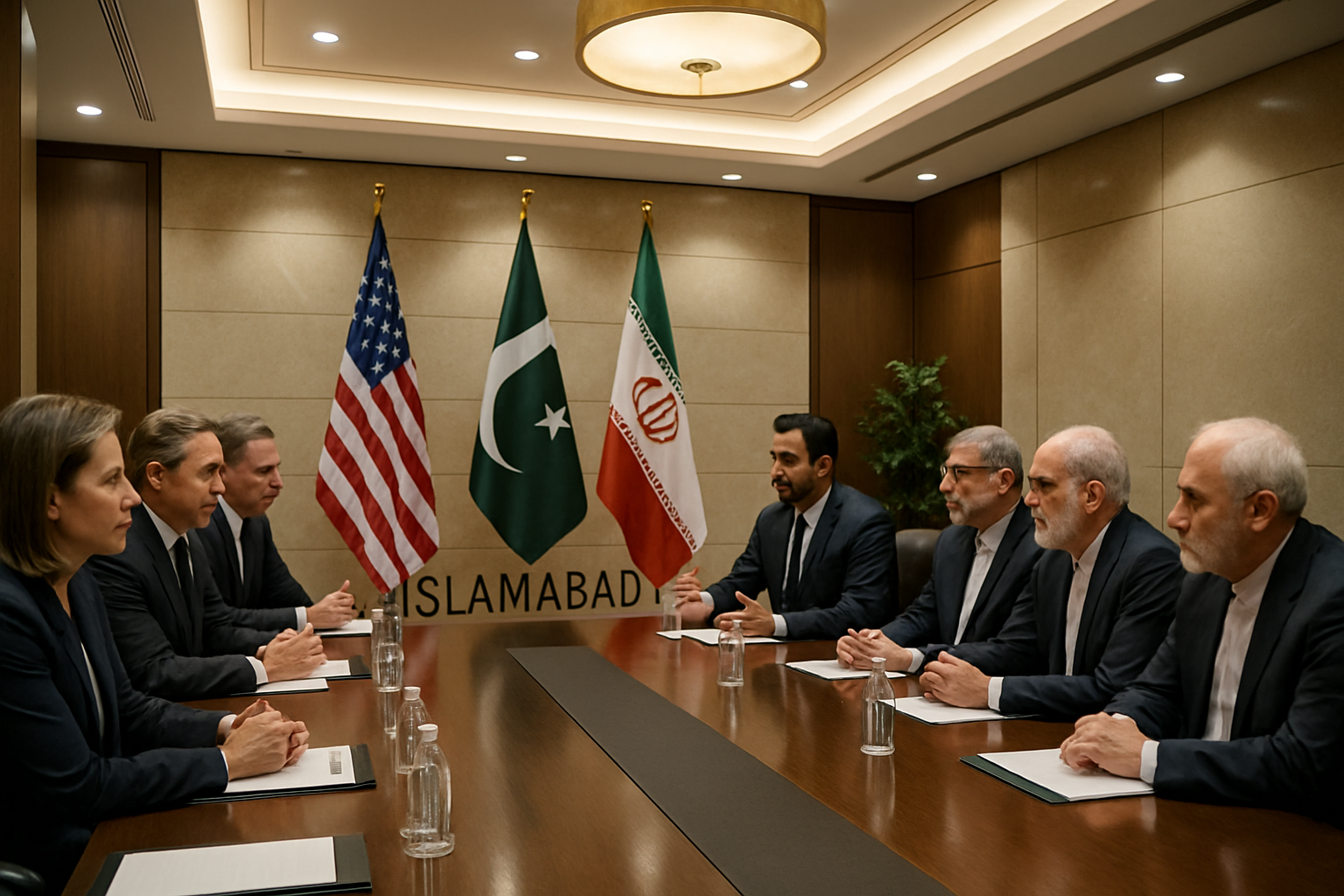
Heavy security measures have been imposed across Islamabad as a second round of indirect talks between the United States and Iran begins under Pakistani mediation, following months of escalating nuclear tensions that brought the world closer to conflict than at any time since the Cuban Missile Crisis.
The US delegation, led by Steve Witkoff and Jared Kushner, arrived in Islamabad on Saturday amid extraordinary security arrangements that saw over 10,000 personnel deployed throughout Pakistan's capital. Iranian Foreign Minister Abbas Araghchi arrived Friday evening for what Tehran insists will be discussions with Pakistani officials only, categorically ruling out direct negotiations with American representatives.
The talks come against the backdrop of an indefinite ceasefire that has paused most fighting but failed to resolve the fundamental nuclear crisis that sparked the worst international confrontation in decades. Oil markets remain volatile despite the ceasefire, with global energy shipments still disrupted by restrictions in the Strait of Hormuz, which handles 40% of the world's oil transit.
Pakistan's Unprecedented Mediation Role
Pakistan has emerged as the crucial mediator in what many observers describe as the most dangerous international crisis since the Cold War ended. Prime Minister Shehbaz Sharif and Field Marshal Asim Munir successfully facilitated the "Islamabad Accord" framework that prevented catastrophic escalation in early April, when President Trump's ultimatum brought the world within 88 minutes of what he called "whole civilization" destruction.
The innovative "message relay system" developed by Pakistani officials has proven essential for maintaining communication between Washington and Tehran when direct dialogue proved impossible. This middle-power diplomacy represents a new template for international crisis management in an era when traditional great-power mechanisms have repeatedly failed.
"Pakistan's Foreign Ministry said the Iranian delegation will hold talks with Pakistan's senior leadership," according to Pakistani officials, emphasizing the indirect nature of the current negotiations.
— Irish Breaking News Report
The talks are taking place at an undisclosed location within Islamabad's heavily fortified Red Zone, with the Serena Hotel reportedly serving as the exclusive venue for diplomatic delegations. Local authorities have declared two public holidays and implemented special traffic arrangements to ensure security for what many consider the most consequential diplomatic engagement of the 21st century.
Iran's Contradictory Signals
Tehran's position reflects the complex dynamics at play in these negotiations. While Iranian officials have publicly stated that "no meeting is planned between Iran and the United States," with Pakistan serving as mediator, the White House maintains that American envoys will meet with "representatives of the Iranian delegation" in the Pakistani capital.
This contradiction highlights the delicate diplomatic dance required to bring these historical adversaries to the negotiating table. Iran's Foreign Ministry spokesman has emphasized that any discussions will focus on Iran presenting its demands through Pakistani intermediaries, while maintaining that ballistic missiles and regional proxy activities remain "red lines" excluded from nuclear-only talks.
The Iranian position has hardened significantly since February's Geneva negotiations, where despite achieving "broad agreement on guiding principles," fundamental scope disagreements proved insurmountable. Iran continues uranium enrichment at 60% purity—approaching the 90% weapons-grade threshold—with intelligence assessments confirming sufficient material for multiple nuclear weapons if weaponized.
Historical Context and Stakes
The current crisis stems from the complete breakdown of nuclear diplomacy earlier this year. Despite months of negotiations that began in Oman in February and continued through multiple rounds in Geneva, the fundamental disagreement over scope has remained unchanged for over a decade since the JCPOA collapse in 2018.
Iran maintains that ballistic missiles and regional proxy relationships are sovereign rights that cannot be included in nuclear negotiations. The United States, coordinating closely with Israel, insists that any comprehensive agreement must address Iran's missile program, support for armed groups across the Middle East, and human rights violations.
The stakes could not be higher. The recent crisis saw oil prices peak at $119.50 per barrel, forcing the International Energy Agency to authorize its largest strategic reserve release in 50 years. Over 18,000 flights were cancelled worldwide, and for the first time since World War II, European territory came under direct attack when Iranian drones struck RAF Akrotiri in Cyprus.
Regional Coalition Under Strain
The unprecedented regional coalition of Saudi Arabia, UAE, Qatar, and Egypt that has backed diplomatic solutions faced severe testing during the recent escalation. Iranian retaliatory attacks targeted these countries' territories—killing one person in the UAE, injuring 32 at Kuwait's airports, and wounding 8 in Qatar—yet the coalition maintained its support for diplomatic engagement rather than military confrontation.
This extraordinary Middle Eastern consensus represents a dramatic shift in regional dynamics, with traditional rivals uniting around the recognition that military solutions would destabilize the entire Persian Gulf energy architecture that underpins the global economy.
Nuclear Governance Crisis
The Iran nuclear crisis unfolds against a broader breakdown in international nuclear governance. The New START treaty between the United States and Russia expired in February 2026—the first time in over 50 years that the world's two largest nuclear powers operate without bilateral constraints. China's nuclear arsenal expansion and the collapse of multilateral arms control frameworks have created what UN Secretary-General António Guterres calls the highest nuclear risks "in decades."
Success in the Islamabad talks could provide a template for 21st-century nuclear crisis resolution, demonstrating that diplomatic innovation can prevent catastrophic escalation even in the most dangerous circumstances. Failure, however, might accelerate military solutions that could reshape Middle Eastern geopolitics for decades while encouraging nuclear proliferation globally.
Economic and Energy Implications
The ongoing crisis has exposed critical vulnerabilities in global energy architecture. The 21-mile-wide Strait of Hormuz serves as a catastrophic single-point failure for modern logistics, with Iran's ability to disrupt this crucial waterway giving Tehran enormous leverage over the world economy.
Despite the current ceasefire, Iran continues to implement its innovative cryptocurrency payment system requiring $1 per barrel for oil tankers transiting the strait. While some vessels have successfully navigated these requirements, many ship owners remain reluctant to commit valuable assets for fear of being stranded if the diplomatic framework collapses.
Consumer relief has begun in countries most affected by the crisis. Bangladesh is reviewing fuel rationing policies that affected 170 million people, while Pakistan considers reversing wartime austerity measures. However, complete normalization is expected to take months, with aviation industry sources planning gradual resumption of Middle East routes over an extended timeline.
Verification Challenges
Any potential agreement faces unprecedented technical challenges. Iran's nuclear infrastructure has advanced significantly since the 2018 JCPOA collapse, with sophisticated centrifuge technology and 60% enrichment capabilities requiring monitoring mechanisms far exceeding the original nuclear deal's complexity.
International Atomic Energy Agency inspections have been suspended since November 2025, leaving the international community with limited insight into Iran's nuclear activities. Former IAEA inspector Dr. Yusri Abu Shadi has confirmed that Iran's current uranium stockpile makes weapons development "easily achievable" if a weaponization decision is made.
Looking Ahead
The coming days in Islamabad represent perhaps the last diplomatic window before this nuclear crisis either finds resolution through innovative compromise or escalates toward military confrontation that could destabilize the global economy. The success of Pakistan's mediation effort will be measured not just by immediate agreements, but by the framework's ability to convert temporary ceasefire arrangements into lasting regional stability.
As the world watches these crucial negotiations unfold under Pakistan's diplomatic umbrella, the precedent being set extends far beyond US-Iran relations. The outcome will influence international approaches to nuclear proliferation, energy security, and territorial sovereignty disputes for decades to come, making Islamabad the center of what may prove to be the most consequential diplomatic engagement of the modern era.
The talks continue under the shadow of Trump's warning that all options remain on the table if diplomatic efforts fail, while Iran maintains its position that nuclear capabilities represent sovereign rights that cannot be surrendered under external pressure. Between these irreconcilable positions, Pakistani mediators seek the innovative compromise solutions that could prevent a return to the most dangerous international crisis since the Cold War ended.