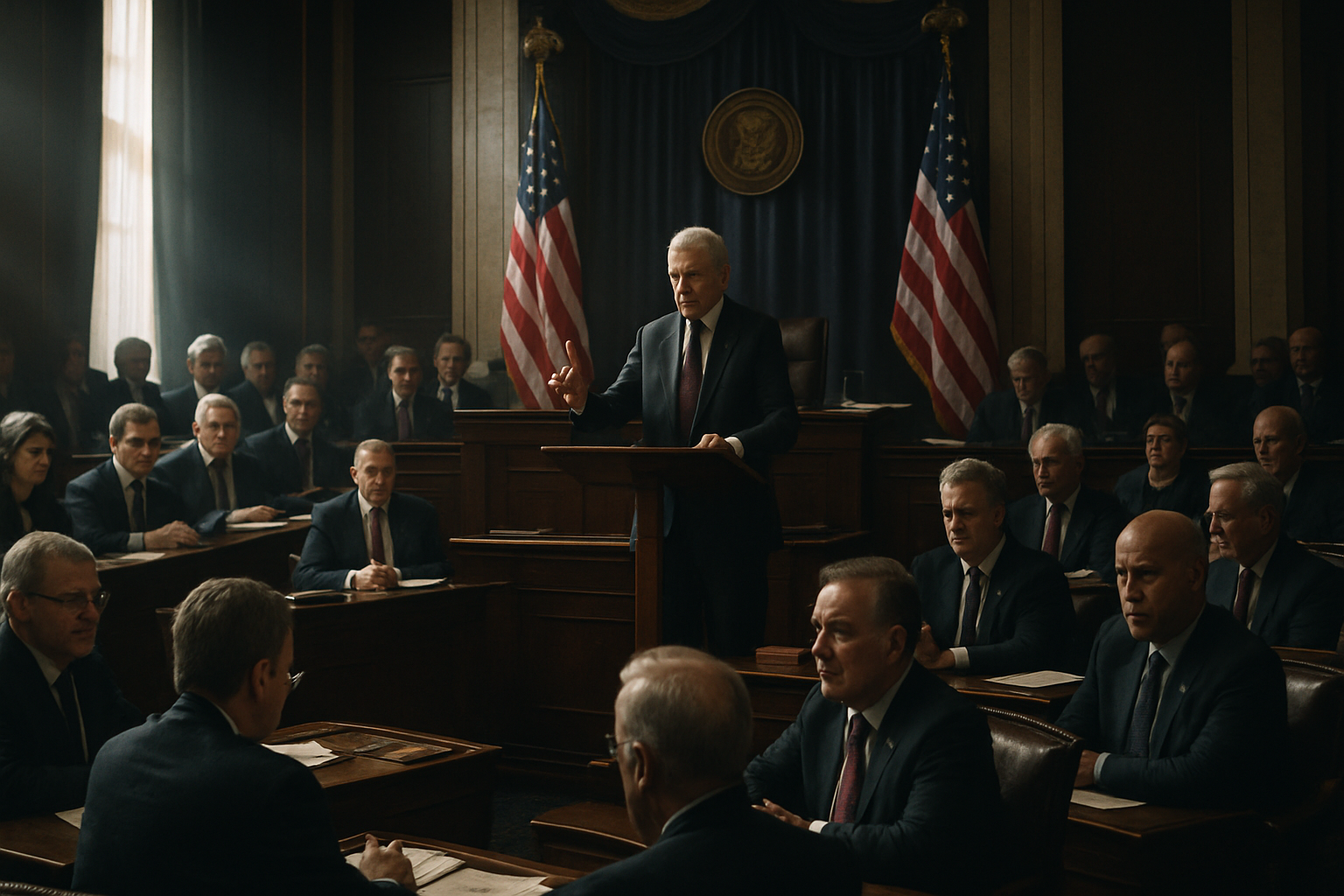
The United States Senate voted 53-47 on Wednesday to block a bipartisan resolution aimed at restricting President Donald Trump's military actions against Iran, delivering crucial congressional backing for ongoing military operations amid escalating tensions in the Middle East.
The vote fell largely along party lines, with all but one Republican opposing the procedural motion to advance the war powers resolution, while all but one Democrat supported efforts to limit presidential authority in the Iran conflict. The resolution, sponsored by Democrats and a handful of Republicans, was characterized as an attempt to restore Congress's constitutional responsibility to declare war.
"This is about taking back Congress's responsibility to declare war, as spelled out in the US Constitution," said sponsors of the resolution, emphasizing the fundamental constitutional questions at stake in the ongoing conflict.
Constitutional Crisis Unfolds
The legislative battle represents the latest effort by Democrats and some Republicans to rein in Trump's repeated foreign troop deployments, highlighting tensions between executive and legislative branches over war powers. Republican opponents rejected the constitutional arguments, insisting that Trump's actions remain legal and within his rights as commander-in-chief to protect the United States through limited strikes.
"The President's actions are legal and within his rights as commander in chief to protect the United States by ordering limited strikes."
— Senate Republicans defending Trump's authority
The vote comes as military operations continue in what has been described as the largest US Middle East operation since the 2003 Iraq invasion, with unprecedented dual-carrier deployment featuring the USS Gerald R. Ford and USS Abraham Lincoln representing approximately one-third of the active US Navy fleet positioned 800 kilometers from Iran's coast.
Capitol Hill Violence Mars Proceedings
The Senate vote occurred against the backdrop of dramatic confrontations on Capitol Hill, where anti-Iran war protester Brian McGinnis, a Green Party Senate candidate and former US Marine from North Carolina, was injured during a scuffle with police and Senator Tim Sheehy.
McGinnis interrupted a Senate Armed Services subcommittee hearing featuring testimony from members of the Joint Chiefs of Staff, shouting slogans before being forcibly removed. Video footage shows McGinnis's right arm appearing to snap during the altercation while he grabbed at the door frame, with a bystander heard screaming as the incident unfolded.
"No one wants to fight for Israel," McGinnis yelled as three police officers and Senator Sheehy attempted to remove him from the hearing room, highlighting the domestic opposition to military involvement in the Middle East conflict.
Historical Context of War Powers
The War Powers Resolution of 1973 was designed to check presidential power after the Vietnam War, requiring congressional approval for military actions extending beyond 60 days. However, the Iran operations have raised questions about these constitutional limits, with military activities potentially extending for "weeks-long operations" according to Pentagon sources, all without formal congressional consultation.
The failure to advance the resolution represents a template-setting moment for 21st-century war powers and democratic governance, as constitutional scholars debate the balance between executive authority and legislative oversight in modern military operations.
Nuclear Diplomacy's Complete Collapse
The military escalation follows the dramatic breakdown of what had been the most promising nuclear negotiations in years. Despite achieving a "broad agreement on guiding principles" during Geneva talks in February 2026—the most significant diplomatic progress since the JCPOA collapse in 2018—fundamental disagreements proved insurmountable.
Iran had maintained ballistic missiles and regional proxy activities as "red lines" excluded from nuclear-only talks, while US Secretary Marco Rubio insisted on comprehensive agreements addressing missiles, armed groups, and human rights. This scope disagreement, unchanged from decade-old diplomatic challenges, ultimately led to the current military confrontation.
Regional and Global Implications
The Senate's backing of Trump's military authority comes as Iran has closed the Strait of Hormuz, affecting 40 percent of global oil transit and causing worldwide economic disruption. Oil prices have surged past $80 per barrel, with natural gas prices increasing 24 percent in Europe and 78 percent in the United States.
The unprecedented regional coalition of Saudi Arabia, UAE, Qatar, and Egypt that had previously supported diplomatic efforts has been severely strained as Iranian retaliation targets member territories. Egyptian President Abdel Fattah el-Sisi condemned attacks on "sisterly Arab countries," warning of "comprehensive chaos" spreading throughout the region.

International Response and Concerns
The vote has drawn international attention amid a broader nuclear governance crisis. The New START treaty expired on February 5, 2026, marking the first time in over 50 years without US-Russia nuclear constraints, while China continues its nuclear expansion. UN Secretary-General António Guterres has warned that nuclear risks are at their "highest in decades."
Multiple countries have issued evacuation warnings for the Middle East, with Sweden and Serbia urging citizens to leave Iran immediately, citing "extremely uncertain" security conditions. The global aviation industry faces its worst crisis since COVID-19, with over 18,000 flights cancelled worldwide due to simultaneous airspace closures across Iran, Iraq, Israel, UAE, Qatar, Syria, Kuwait, and Bahrain.
Domestic Political Ramifications
The Senate vote exposes deep divisions within American politics over military intervention. Recent polling shows only 25 percent of Americans support strikes against Iran, with 56 percent believing Trump is too willing to use military force—including 23 percent of Republicans, highlighting potential electoral consequences for the administration.
The congressional resistance represents the latest attempt to challenge Trump's broad interpretation of executive war powers, following similar efforts during previous foreign interventions. The debate reflects fundamental questions about democratic oversight of military operations and the balance of power between branches of government.
Looking Forward
As military operations continue with no clear end in sight, the Senate's decision to block war powers restrictions ensures that executive authority remains largely unchecked. The vote establishes important precedents for presidential war-making authority in the 21st century, particularly regarding nuclear crises and regional conflicts.
The collapse of diplomatic engagement after Geneva breakthrough negotiations demonstrates the fragility of modern crisis management in a multipolar era. Success or failure in containing the current escalation will influence international approaches to nuclear disputes and territorial conflicts for decades beyond the current administration.
The template-setting nature of these events—from rapid diplomatic-to-military escalation to congressional responses—will affect global governance mechanisms, territorial sovereignty enforcement, and international law credibility far beyond the immediate Middle Eastern context.