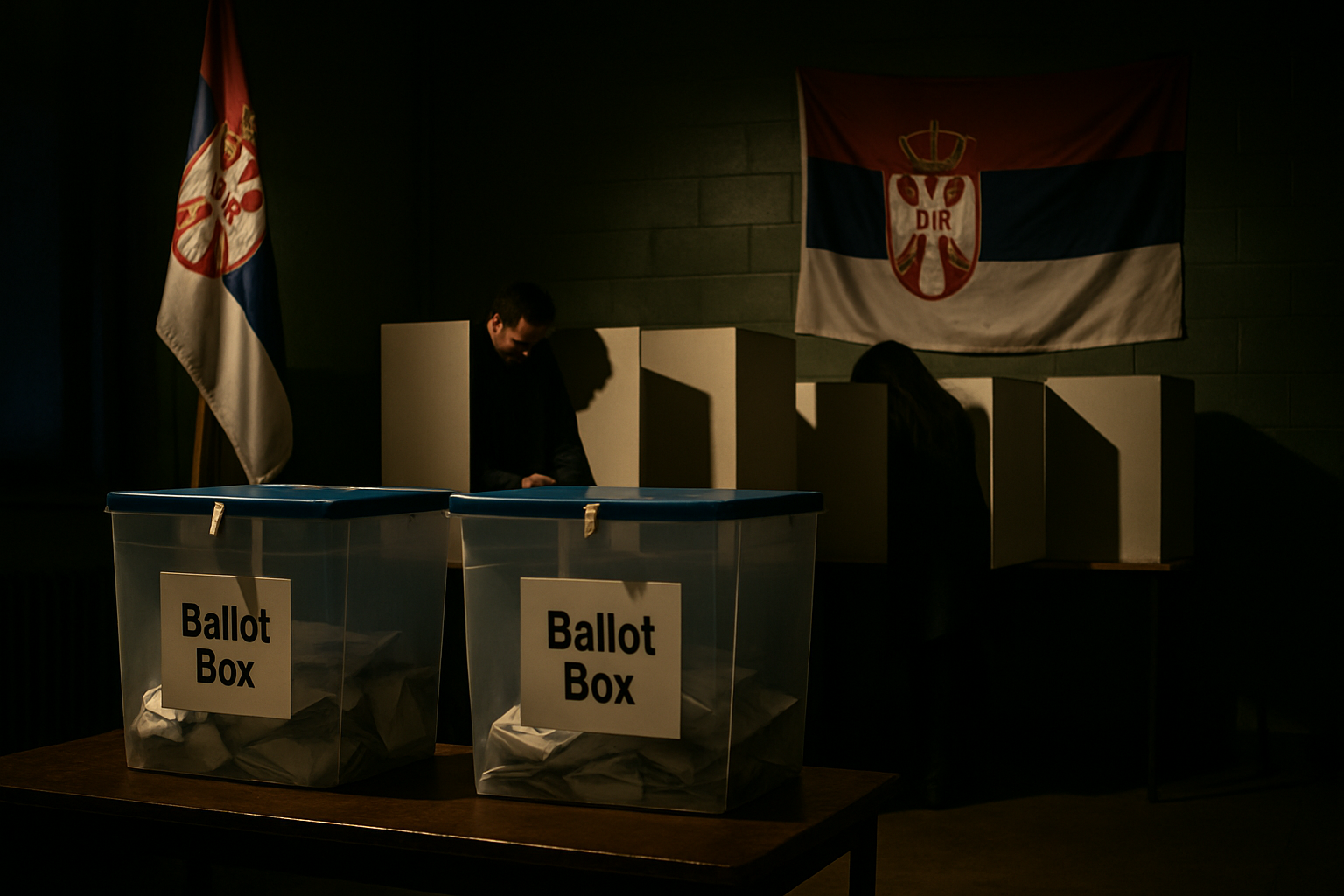
Serbian President Aleksandar Vučić proclaimed victory in all 10 local elections held across Serbia on Sunday, but the electoral process was overshadowed by unprecedented violence against opposition supporters, coordinated police raids, and mounting international concerns about the country's democratic trajectory.
The elections, affecting only 3.8% of Serbia's electorate, have taken on outsized significance as a test of the country's democratic institutions and the growing influence of student-led opposition movements that have emerged from recent protests demanding government accountability.
Violence Erupts at Polling Stations
Election observers from the Center for Research, Transparency and Accountability (CRTA) documented systematic violence against opposition supporters throughout election day. In what CRTA described as a "terrifying" development, citizens identified employees from public institutions among the perpetrators of violence, raising serious questions about the weaponization of state resources against political opponents.
The monitoring organization reported that among the "thugs and other operatives for dirty work in the field," observers and citizens recognized individuals employed in public institutions. This revelation points to a disturbing pattern of state-sponsored intimidation that has characterized Serbian politics in recent years.
"Citizens among the thugs recognized employees in public institutions"
— CRTA Election Monitoring Mission
The violence was not limited to anonymous actors. Opposition politician Marinika Tepić, Vice President of the Party of Freedom and Justice (SSP), publicly identified Gorski Matović among the attackers targeting students in Novi Sad, claiming this was "not his first time defending SNS" - referring to Vučić's Serbian Progressive Party.
Student Movement Gains Political Ground
Despite the challenging environment, student-backed candidates made significant inroads in several municipalities. The most notable success came in Palanka, where Zoran Maričić of the "Young for Palanka - Alone Against All" list secured approximately 30% of the vote according to preliminary results, while the ruling party's support dropped by around 20%.
Maričić announced to gathered supporters that he would serve as a council member in the Palanka Municipal Assembly, representing a breakthrough for the student movement that has been organizing across Serbia since recent protests demanding government accountability and democratic reforms.
The students' political transition from street protests to electoral politics reflects a broader generational shift in Serbian politics. Following the conclusion of voting, students in blockade issued a statement declaring that "local areas are awakening, big cities are ready - change is coming."
Police Raids Target Opposition
In a move that opposition parties condemned as "state terrorism," police from the Criminal Investigation Directorate, headed by Marko Kričak, conducted raids on the offices of the People's Movement of Serbia (NPS) during election day. The timing of these operations, coinciding with the electoral process, drew sharp criticism from opposition groups and civil society organizations.
The Serbia Center party (SRCE) issued a scathing condemnation of the police raids, characterizing them as an "attempt to divert attention from the elections through state terrorism." The party argued that the timing was deliberately calculated to intimidate opposition supporters and create a climate of fear around the electoral process.
Pavle Grbović, President of the Movement of Free Citizens (PSG), described the police actions as a "classic example of political repression." The coordinated nature of these raids, occurring simultaneously across multiple locations while citizens were voting, raised serious questions about the independence of law enforcement institutions.
Opposition Demands Police Reform
The Ecological Uprising movement issued a direct challenge to police leadership, declaring: "You are paid to arrest thugs, not to persecute opposition politicians." This statement reflects growing frustration with law enforcement's perceived bias in favor of the ruling party and against opposition voices.
The movement's criticism highlights a central concern among Serbian civil society groups: the transformation of police forces from neutral law enforcement into instruments of political control. This pattern has been documented by international observers as part of a broader democratic backsliding in the country.
International Implications
These developments occur against the backdrop of Serbia's stated ambitions for European Union membership. The European Union has repeatedly emphasized that progress toward membership requires demonstrable improvements in democratic governance, rule of law, and respect for political pluralism.
The violence and repression witnessed during these local elections provide fresh evidence for EU officials who have expressed concerns about Serbia's democratic trajectory under President Vučić. The targeting of students - who have been at the forefront of pro-democracy movements across the region - is particularly concerning for international observers.
France's Le Monde newspaper reported on the elections, noting that despite affecting only a small percentage of Serbian voters, the contests were "important for both the student movement, which proposed its own lists, and for the power that has been in place since 2014."
Historical Context of Violence
Sunday's violence continues a troubling pattern that has emerged in Serbian politics since early 2026. In February, student Inas Hodžić was attacked in the head by an assailant in Novi Sad while police watched without intervening. The Academic Network Free University condemned what they termed "brutal attacks by thugs on students of University of Novi Sad" during commemorative events.
International journalists' organizations, including the Independent Association of Journalists of Vojvodina (NDNV), have warned that the systematic beating of students, female students, and journalists represents Serbia's adoption of a "Belarusian model of governance" - referring to the authoritarian crackdowns that have characterized Alexander Lukashenko's regime.
Vučić's Victory Claims
Despite the controversies surrounding the electoral process, President Vučić moved quickly to declare victory across all 10 municipalities where elections were held. Speaking to supporters, he announced preliminary results showing that "lists bearing his name" had won in all contested areas.
However, the president's victory claims have been overshadowed by the broader questions raised about the legitimacy of the electoral process. Opposition parties and civil society groups have argued that the combination of violence, police intimidation, and systematic pressure on state employees created conditions that cannot be considered free or fair by international standards.
Democratic Institutions Under Pressure
The events of March 29 represent more than a local electoral contest - they serve as a critical test of Serbia's democratic institutions and their capacity to withstand authoritarian pressures. The systematic nature of the violence and intimidation suggests a coordinated effort to suppress opposition voices and maintain political control through fear rather than democratic legitimacy.
For the student movement, the elections represent both a challenge and an opportunity. While they faced unprecedented violence and intimidation, their ability to secure electoral victories in some municipalities demonstrates the potential for translating street protests into political power through democratic institutions.
Looking Forward
As Serbia continues its stated pursuit of EU membership, the international community will be closely watching how the government responds to reports of electoral violence and whether meaningful reforms are implemented to ensure genuinely free and fair elections in the future.
The students and opposition groups have made clear their intention to continue their struggle for democratic accountability through both electoral and civic means. Their declaration that "change is coming" reflects a determination to persist despite the challenges and intimidation they have faced.
The success or failure of this democratic movement in Serbia has implications that extend far beyond the country's borders, serving as a test case for democratic resilience in a region where authoritarian tendencies have been gaining ground. The international community's response to these developments will be crucial in determining whether democratic norms can be restored and strengthened, or whether Serbia continues down a path toward increasingly authoritarian governance.