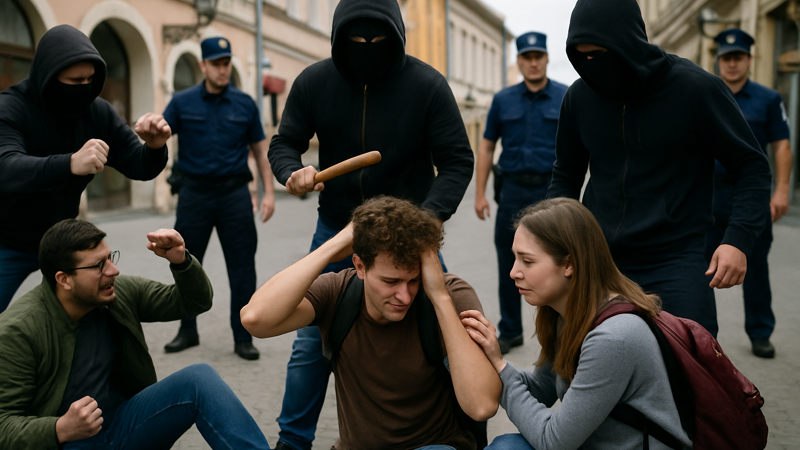
Serbian student protesters faced brutal attacks from government supporters in Novi Sad on February 16, 2026, while police officers stood by without intervening, marking a dangerous escalation in ongoing demonstrations following recent national tragedies.
The most serious incident occurred when a man struck student Inas Hodžić in the head in full view of police officers, who made no attempt to stop the assault, according to reports from the portal Mašina on social media. The attack on Hodžić represents the latest in a series of violent confrontations targeting student demonstrators who have been peacefully protesting for democratic reforms and government accountability.
Academic Networks Condemn "Brutal Attacks"
The Academic Network Free University (Akademska mreža Slobodan univerzitet) issued a strong condemnation of what they described as "brutal attacks by thugs on students of the University of Novi Sad" during commemorative events. The academic organization's statement reflects growing concern within Serbia's educational community about the deteriorating safety of student protesters.
These attacks occurred during what should have been peaceful memorial activities, highlighting the extent to which political tensions have infiltrated even solemn commemorative events. The targeting of university students has particularly alarmed academic institutions across Serbia, who view the violence as an assault on fundamental democratic principles and academic freedom.
Media and Opposition Sound Alarm
The Independent Association of Journalists of Vojvodina (NDNV) issued a stark warning to both domestic and international audiences, stating that images of students, female students, and journalists being beaten demonstrate that "the regime is introducing a Belarusian model of governance." This comparison to Belarus, known for its authoritarian crackdown on protesters, signals the gravity with which media organizations view the current situation.
"The images of beatings of students, female students and journalists show that the regime is introducing a Belarusian model of governance."
— Independent Association of Journalists of Vojvodina (NDNV)
Opposition politician Marinika Tepić, Vice President of the Party of Freedom and Justice (SSP), publicly identified specific individuals allegedly involved in the attacks. In a post on the social network X, Tepić claimed that Gorski Matović was among the attackers on Novi Sad students, adding that "this is not his first time defending the SNS [Serbian Progressive Party]."
Systematic Pattern of Violence
The February 16 incidents represent more than isolated confrontations. The coordinated nature of the attacks, combined with apparent police inaction, suggests a systematic approach to intimidating student protesters. Academic observers note that the violence follows a pattern of escalating pressure on civil society organizations and protesters who challenge government policies.
The presence of what witnesses describe as government supporters or "thugs" at student events, combined with police failure to intervene, has created an atmosphere of impunity that concerns international observers. The NDNV's reference to a "Belarusian model" specifically alludes to the systematic suppression of civil society that characterized Belarus following its disputed 2020 elections.
Context of Ongoing Protests
The current wave of student protests and the violent response they have encountered must be understood within the broader context of recent tragedies that have galvanized Serbian civil society. Students have been demonstrating to demand accountability and systemic changes following incidents that have shaken public confidence in governmental institutions.
The University of Novi Sad has become a focal point for these demonstrations, with students organizing both memorial events and protests calling for broader democratic reforms. The fact that attacks are occurring even during commemorative activities suggests that government supporters view any form of student organization as a threat worthy of violent suppression.
International Implications
The NDNV's appeal to international attention reflects growing concern that Serbia may be following the authoritarian trajectory of other countries in the region. The comparison to Belarus is particularly significant, as that country's crackdown on protesters became a defining moment in its isolation from European democratic institutions.
For Serbia, which maintains aspirations for European Union membership, the violent suppression of student protesters raises serious questions about the country's commitment to democratic values and rule of law. International observers have consistently emphasized that respect for peaceful protest and academic freedom are fundamental prerequisites for EU accession.
Police Inaction Raises Questions
Perhaps most troubling for many observers is the apparent unwillingness of police to intervene in attacks on students. The incident involving Inas Hodžić, where officers reportedly watched as he was assaulted, represents a fundamental breakdown in law enforcement's duty to protect citizens regardless of their political views.
This police inaction has broader implications for the rule of law in Serbia. When law enforcement selectively chooses which citizens to protect based on political considerations, it undermines the basic social contract between government and citizens. Academic networks have expressed particular concern about this development, viewing it as evidence of state capture by partisan political interests.
Student Resilience and Determination
Despite facing violence and intimidation, Serbian students have shown remarkable resilience in continuing their protests and commemorative activities. The courage demonstrated by young people like Inas Hodžić, who continued participating in demonstrations despite personal risk, reflects a generation determined to hold their government accountable.
The involvement of multiple universities and academic networks in condemning the violence demonstrates that student activism has broad institutional support within Serbia's educational community. This solidarity between different academic institutions strengthens the protesters' legitimacy and makes it more difficult for authorities to dismiss them as fringe elements.
Looking Forward
The events of February 16 in Novi Sad represent a critical moment for Serbian democracy. The international community's response, the Serbian government's willingness to ensure police protection for all citizens, and the continued solidarity of academic institutions will all play crucial roles in determining whether Serbia moves toward greater democratic accountability or follows the authoritarian path that has characterized some of its regional neighbors.
For now, Serbian students continue to face the dual challenge of advocating for democratic reforms while protecting themselves from violence that their own government appears unwilling to prevent. Their determination in the face of such intimidation reflects both the depth of their commitment to change and the severity of the challenges facing Serbian democracy.