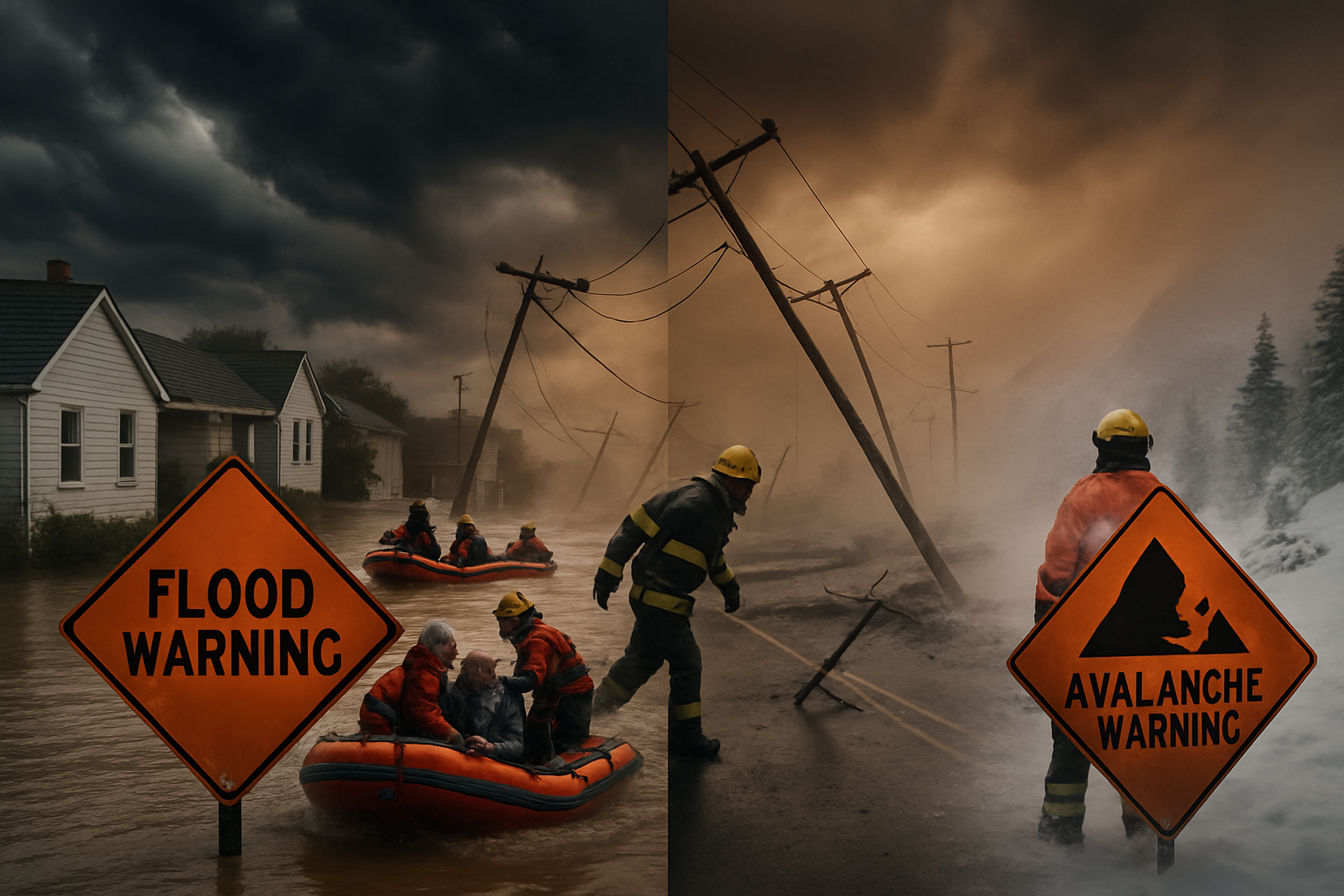
Seven nations across four continents are battling simultaneous extreme weather disasters in April 2026, marking an unprecedented global crisis that continues humanity's longest streak of extreme warming on record—now extending to 23 consecutive months above critical climate thresholds.
The crisis encompasses tropical cyclones threatening Australia and New Zealand, record snowfall paralyzing Canada, severe storms across Baltic Europe, and a complex web of interconnected climate emergencies that have pushed global emergency response systems beyond their operational limits.
Tropical Cyclone Maila Threatens Pacific Region
Australia's Bureau of Meteorology is tracking severe Tropical Cyclone Maila, a Category 3 storm with sustained winds of 120 km/h and gusts reaching 165 km/h, as it approaches Far North Queensland. The system could deliver another devastating blow to communities still recovering from Tropical Cyclone Narelle, which ravaged multiple states just weeks earlier.
Papua New Guinea has issued warnings for Milne Bay and Bougainville provinces, while New Zealand's MetService reports that Category 2 Cyclone Vaianu, located east of Vanuatu, is "gaining in speed and power" as it tracks toward New Zealand waters.
"This represents an unusual level of simultaneous cyclone activity across the Southwest Pacific," explained meteorologist Dr. Sarah Chen of the European Centre for Medium-Range Weather Forecasts. "We're seeing systems develop and intensify at rates that challenge our traditional forecasting models."
European Winter Weather Chaos
Across Northern Europe, Storm Dave—the fourth named storm of 2026—has unleashed hurricane-force winds exceeding 90 mph across Scotland, Northern Ireland, Wales, and northern England during what should be spring conditions. The timing represents a dramatic departure from traditional seasonal patterns that have guided infrastructure design and emergency planning for centuries.
Sweden's SMHI meteorological service issued warnings as the storm system moved inland, with forecaster Nitzan Cohen warning of "risk for stormbyar" (severe squalls). Norway reported 8,000 households without power across southern regions, while authorities urged residents to avoid parks and wooded areas due to falling trees.
In the Baltic states, Lithuania and Latvia are experiencing severe weather conditions with strong winds and heavy precipitation that meteorologists describe as unprecedented for this time of year. The pattern reflects broader atmospheric disruption linked to sustained global warming effects.
North American Extreme Snowfall
Calgary, Canada, recorded more than 160 vehicle crashes in a single day as dangerous snowfall conditions overwhelmed the city's transportation networks. Environment Canada issued snowfall warnings as yet another round of extreme winter weather struck areas still recovering from previous storms.
The Canadian crisis exemplifies what emergency management experts identify as a shift from isolated regional disasters to "compound disasters"—multiple emergency types occurring simultaneously across vast geographic areas, fundamentally challenging traditional resource allocation and mutual aid mechanisms.
Global Climate Context: 23 Months of Extreme Warming
These simultaneous disasters occur during what climate scientists confirm is the longest sustained period of extreme warming in recorded human history. April 2026 marks the 23rd consecutive month that global temperatures have exceeded 1.5°C above pre-industrial levels—the critical threshold identified by the Intergovernmental Panel on Climate Change as a dangerous tipping point for irreversible climate impacts.
January 2026 remains the hottest month ever recorded, with human-induced climate change now completely overriding natural cooling mechanisms, including La Niña effects. The World Meteorological Organization estimates a 50-60% probability of El Niño development during July-September 2026, which could drive global temperatures to unprecedented territory by combining baseline warming with natural cycle amplification.
"We're witnessing a 'climate volatility paradox' where sustained global warming enables both heat records and devastating regional extremes through disrupted atmospheric circulation and polar vortex patterns."
— Dr. Sarah Chen, European Centre for Medium-Range Weather Forecasts
Infrastructure Crisis and Emergency Response Breakdown
The simultaneous nature of these disasters has exposed critical vulnerabilities in global emergency response systems designed for sequential rather than concurrent crises. Transportation networks, power grids, and communication systems built for historical climate patterns are repeatedly failing as extreme weather exceeds their operational parameters.
Traditional mutual aid mechanisms—where stable regions assist others during isolated emergencies—have proven inadequate when multiple continents face disasters simultaneously. The European Union's Civil Protection Mechanism has been repeatedly activated, with Sweden and Denmark receiving €246 million in assistance—the largest coordinated European weather response on record, yet still insufficient for the scale and simultaneity of current challenges.
Emergency services globally report operating at or beyond capacity limits, with recovery timelines fundamentally shifted from weeks to months or years. This represents a paradigmatic change in disaster response approaches, forcing a evolution from reactive crisis management to proactive climate resilience building.
Economic and Social Devastation
The economic impact spans multiple sectors simultaneously. Agricultural operations face mounting losses as extreme weather destroys crops and disrupts supply chains during critical growing seasons. Tourism industries experience extended cancellations and infrastructure damage during what should be peak revenue periods.
Mental health services report increased demand for climate anxiety and repeated trauma counseling, as families face the prospect of losing generational properties multiple times within a decade. Small businesses confront extinction from recurring disruptions, while vulnerable populations—particularly the elderly and children with respiratory conditions—are disproportionately affected.
The concept of "building back better" with climate-resilient infrastructure has evolved from an optional enhancement to an essential survival strategy, as traditional seasonal patterns that guided centuries of infrastructure design, agricultural planning, and emergency preparedness are no longer reliable frameworks.
International Cooperation Under Strain
Environmental challenges transcend political boundaries, making unilateral adaptation insufficient for comprehensive resilience. Ocean currents carry climate effects continentally, atmospheric systems transport impacts globally, and species migrations connect ecosystems regardless of borders.
The simultaneity of disasters is testing cooperation mechanisms developed under the assumption that stable regions could assist others during isolated emergencies. Success now requires unprecedented cooperation, enhanced coordination, and sustained financial commitments to environmental protection as essential infrastructure rather than regulatory burden.
This crisis builds upon the devastating February 2026 European storm succession of Kristin, Leonardo, Marta, Nils, and Pedro, which claimed 35+ lives across Portugal, Spain, and France and required 26,500 emergency personnel in Portugal's largest peacetime operation.
Adaptation Imperative: Transformative vs. Reactive Approaches
April 2026 represents a watershed moment in global climate preparedness, forcing a choice between reactive crisis management and transformative infrastructure adaptation. Current conditions provide a preview of routine 2030s circumstances without comprehensive climate adaptation investment.
Scientists emphasize that the window for effective climate action is narrowing rapidly, as ecological systems approach critical thresholds that could trigger irreversible changes to global food security, climate stability, and human settlements. Additional weather systems are developing in both Atlantic and Pacific regions, suggesting that current crisis conditions may persist for weeks, potentially establishing a "new normal" of extreme weather frequency and intensity.
The tools, knowledge, and cooperation frameworks exist for comprehensive environmental protection, but success depends on unprecedented speed of coordination, sustained international cooperation, and political commitment to environmental protection as essential infrastructure for human prosperity and planetary sustainability.
Looking Ahead: The Decisive Climate Action Decade
The convergence of extreme weather events, infrastructure vulnerabilities, and emergency response limitations underscores the urgent need for coordinated international action. The question is no longer whether transformative climate action is needed, but whether humanity can organize and implement solutions rapidly enough to maintain planetary habitability during Earth's most environmentally challenging period in recorded history.
The choices made in the coming months regarding adaptation strategies, infrastructure investment, and international cooperation may prove decisive for climate resilience strategies affecting generations. As emergency management experts warn, we are witnessing the emergence of compound disasters that require fundamental restructuring of response systems designed for a more stable climate era.
This crisis serves as both a warning and a test of humanity's capacity to respond to unprecedented environmental change during what many scientists consider the decisive climate action decade. The simultaneous nature of these challenges demands not just technological solutions, but fundamental transformation in how societies prepare for and respond to permanent climate volatility.