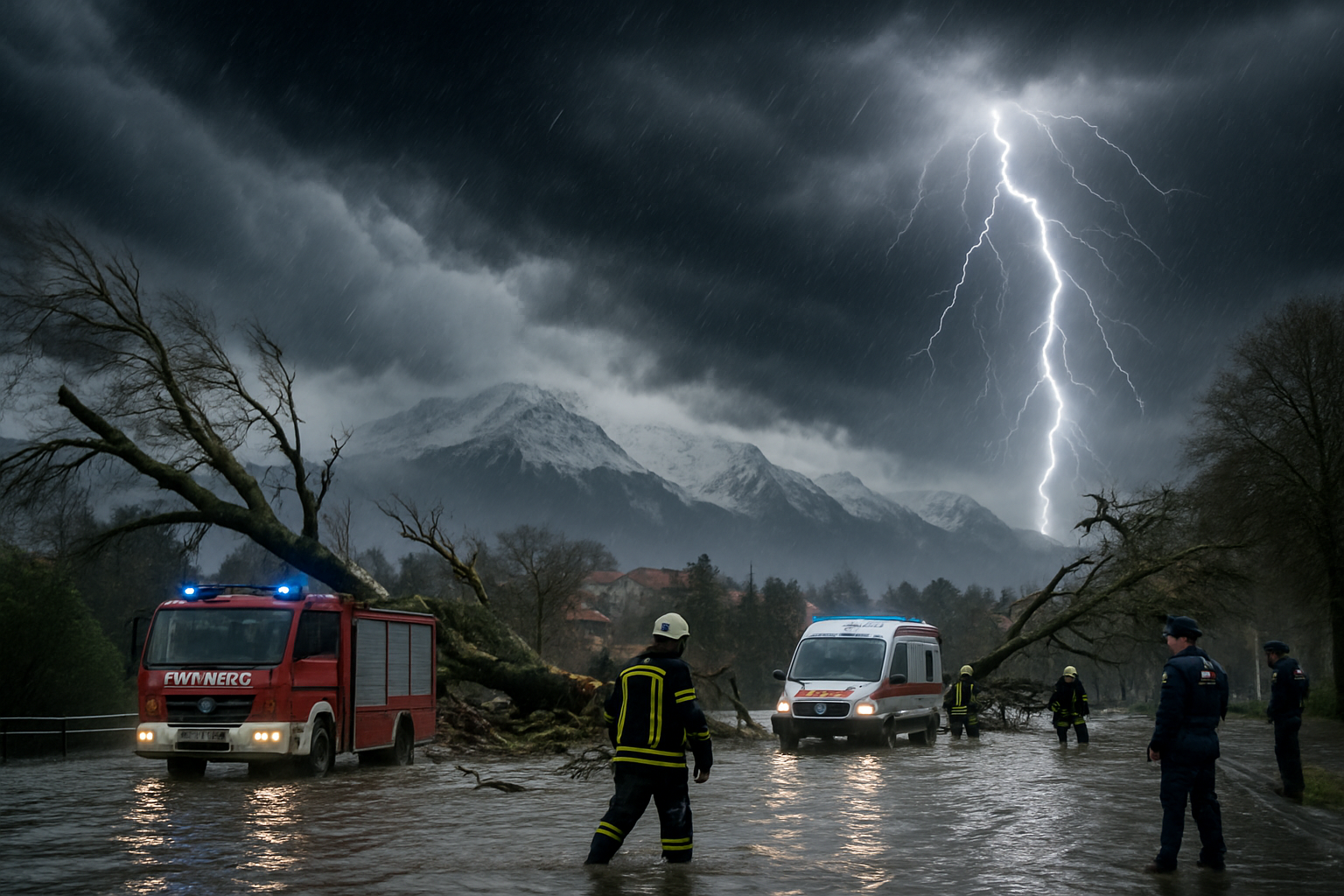
A powerful weather system is unleashing severe conditions across multiple European countries, with Bosnia and Herzegovina experiencing up to one meter of snow accumulation, Croatia facing hurricane-force winds of 140 km/h, and Slovenia grappling with widespread power outages affecting thousands of households.
The latest weather emergency represents the continuation of what meteorologists are calling Europe's most challenging winter and spring weather crisis in recent history, coming during the 22nd consecutive month of global temperatures exceeding 1.5°C above pre-industrial levels.
Bosnia and Herzegovina: Snow Emergency Deepens
Bosnia and Herzegovina is experiencing some of the most severe weather conditions, with meteorologist Ibrahim Smajlović from the Federal Hydrometeorological Institute warning that the current snowfall is "only the beginning" of more severe weather to come. The Krajina region has been particularly hard hit, with some areas reporting snow accumulations exceeding one meter.
According to BH Meteo services, the heaviest snowfall is expected across northwestern, northern, northeastern, and central Bosnia, while Herzegovina has seen the main precipitation event pass but continues to face strong bura winds. The overnight snowfall has been particularly intense in mountainous regions, with snow now descending to lower elevations.
"Yesterday's snow was just the introduction – the real storm is yet to come"
— BH Meteo Weather Service
Orange weather warnings remain in effect across the country, with wind gusts reaching 75 km/h. The meteorological service is advising citizens to avoid unnecessary travel and prepare for potential power outages and transportation disruptions.
Croatia: Zagreb Under Siege
Croatia's capital Zagreb is bearing the brunt of what local authorities are describing as a "violent storm" that has been battering the city since yesterday. Mayor Tomislav Tomašević has issued urgent warnings for residents to remain indoors unless absolutely necessary, citing the extreme danger posed by the severe weather conditions.
The storm has brought incredibly powerful winds with gusts reaching 140 km/h, along with a dramatic temperature drop, rain, hail, and light snow creating chaotic conditions across the city. Trees have been uprooted throughout Zagreb, with some falling onto cars and blocking major roadways.
Emergency services are reporting being "inundated with calls" as the storm continues to cause widespread damage. In response to the dangerous conditions, schools have been closed and residents have been advised to avoid parks and areas with large trees due to the risk of falling branches.
The Croatian weather service indicates that these violent conditions are expected to persist through tomorrow, with a weak earthquake of magnitude 2.6 also recorded near the city center, adding to the challenges facing the capital.
"Don't go out if you don't need to"
— Tomislav Tomašević, Zagreb Mayor
Slovenia: Widespread Infrastructure Damage
Slovenia is experiencing some of the most significant infrastructure impacts from the severe weather, with powerful winds sweeping across northern regions causing extensive damage to buildings, toppling trees, and disrupting both air and road traffic networks.
Emergency authorities have issued alerts to mobile phones of residents in 43 municipalities – representing roughly one quarter of Slovenia's population – warning them to remain indoors, avoid attempting to save property, and stay clear of power lines. The unprecedented scale of these emergency notifications highlights the severity of the current situation.
The Slovenia Environment Agency has recorded wind gusts reaching speeds of 100-150 km/h in mountainous regions, with sustained winds of 60-80 km/h in lower elevations. The severe weather began in the western Primorska region on March 26th before moving northward to affect the Gorenjska region and Slovenia's second-largest city in the Štajerska region.
Thousands of households are currently without power as utility crews work to restore electricity infrastructure damaged by falling trees and debris. Emergency crews are working around the clock to clear roadways and assess damage to critical infrastructure.
Regional Weather Patterns and Climate Context
The current severe weather event occurs within the broader context of unprecedented global climate conditions. January 2026 marked the 18th consecutive month of global temperatures exceeding the critical 1.5°C threshold above pre-industrial levels, representing the longest sustained period of extreme warming in recorded human history.
This latest weather crisis builds upon the devastating February 2026 Atlantic storm succession that included Storms Kristin, Leonardo, Marta, Nils, and Pedro, which claimed over 35 lives across Portugal, Spain, and France. That crisis required the deployment of 26,500 emergency personnel in what became Portugal's largest peacetime rescue operation.
Meteorological experts describe the current conditions as part of a "climate volatility paradox" where sustained global warming enables both unprecedented heat records and devastating regional extreme weather events through disrupted atmospheric circulation patterns and polar vortex instability.
Emergency Response and Infrastructure Strain
Emergency services across the affected regions are operating at or beyond capacity limits as they respond to the multi-national weather crisis. Traditional mutual aid mechanisms designed for sequential regional emergencies are being challenged by the simultaneous nature of extreme weather across multiple countries.
Transportation networks have been severely disrupted, with airports implementing flight restrictions, railway services suspending operations on affected routes, and major highways closing due to dangerous conditions. Power grids across the region are positioning additional crews in anticipation of widespread outages as the storm system continues to move through the area.
The European Union's Civil Protection Mechanism remains on high alert, building on previous activations during the February crisis that resulted in Sweden and Denmark providing €246 million in assistance – the largest coordinated European weather response on record.
Economic and Social Impact
The economic impact of the severe weather is expected to be substantial, affecting agricultural operations during critical seasonal periods, tourism infrastructure at the beginning of the spring season, and business operations across multiple sectors. Recovery timelines are expected to extend from weeks to months, fundamentally changing disaster response approaches across the region.
Mental health services are reporting increased demand as communities face repeated extreme weather events, with families losing homes and businesses facing potential closure. The psychological toll of ongoing climate volatility is becoming a significant factor in emergency response planning.
Agricultural sectors are particularly vulnerable, with unseasonable snow and extreme winds potentially damaging crops and affecting livestock operations across the mountainous regions of the Balkans.
Looking Forward: Climate Adaptation Imperatives
The March 2026 weather crisis represents what climate adaptation experts describe as a "watershed moment" for European climate preparedness. The choice between reactive crisis management and proactive transformative infrastructure adaptation is becoming increasingly critical as extreme weather events exceed the parameters that existing systems were designed to handle.
Scientists warn that current conditions may represent a preview of routine weather patterns expected in the 2030s without significant climate adaptation investment. Traditional seasonal patterns that have guided infrastructure design and emergency preparedness for centuries are proving unreliable in the current climate volatility era.
The concept of "building back better" has evolved from an optional enhancement to what many consider an essential survival strategy for communities facing repeated extreme weather events. Recovery efforts are increasingly focused on climate-resilient infrastructure rather than simply replacing damaged systems with identical designs.
International Cooperation and Future Preparedness
The simultaneity of extreme weather events across multiple European countries highlights the need for enhanced international cooperation frameworks. Environmental challenges transcend political boundaries, with atmospheric and ocean systems transporting climate effects across continents regardless of national borders.
Additional weather systems are currently developing in Atlantic regions, with authorities maintaining high alert status across Europe. The persistence of crisis conditions over recent months is establishing what many meteorologists describe as a "new normal" characterized by extreme weather frequency and intensity that permanently challenges traditional emergency response frameworks.
The tools, knowledge, and cooperation frameworks exist for comprehensive environmental protection, but success depends on unprecedented speed and coordination in implementing sustained international cooperation and political commitment to environmental protection as essential infrastructure for human prosperity and planetary sustainability.
As Europe continues to grapple with this latest weather emergency, the choices made in the coming weeks and months will be decisive for climate resilience strategies that will define how human societies adapt to what is being recognized as the most environmentally challenging period in recorded history.