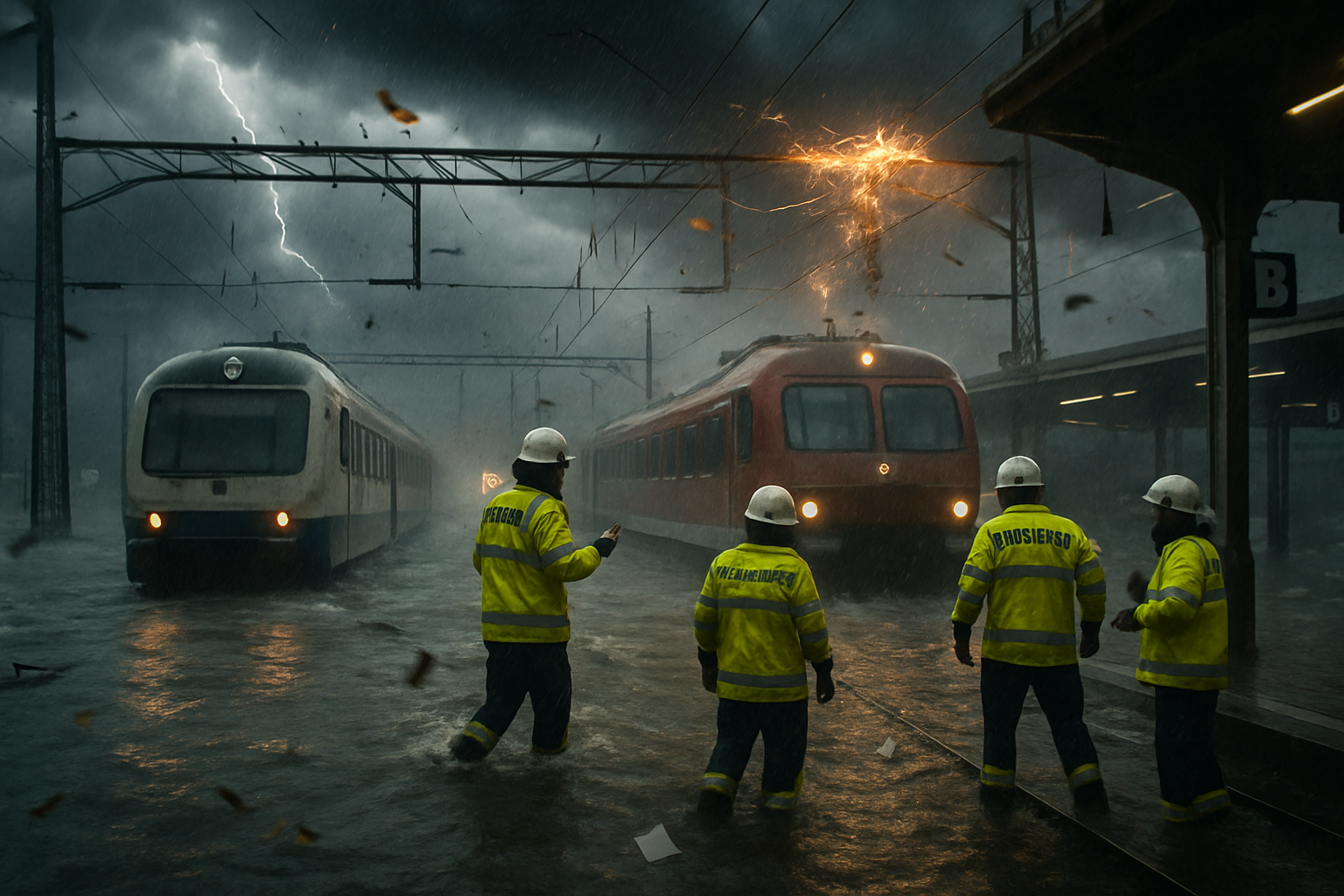
Storm Marta, the third consecutive major Atlantic storm in two weeks, has brought European transport networks to a virtual standstill, affecting millions of passengers and forcing unprecedented emergency responses across Spain and Portugal as the continent grapples with its worst weather crisis in decades.
Portuguese authorities confirmed on Sunday morning that storm conditions have tripled power outages from 56,000 to 167,000 residents, while railway services remain suspended on multiple critical lines including the Norte, Douro, Oeste, Beira Baixa, Cascais and Vendas Novas routes. The disruption comes as Portugal maintains the largest peacetime rescue operation in its history, with 26,500 personnel deployed including 1,975 military staff and 30 naval vessels.
The storm struck Portugal early Saturday with winds reaching 120 km/h and waves towering up to 13 meters, adding to the devastation already caused by Storms Kristin and Leonardo, which have collectively claimed at least 14 lives since late January. Portuguese railway operator CP confirmed that urban services in Coimbra and the West Line remain completely suspended as of 6:30 AM Sunday.
Infrastructure Overwhelmed by Third Storm
The scale of infrastructure damage has overwhelmed European transport systems, with Spain reporting fresh storms and torrential rain just days after the flooding and damage caused by Storm Leonardo. The successive nature of these weather events has prevented recovery efforts from gaining momentum, creating a cascading crisis across multiple sectors.
"The circulation of trains is restricted on several lines due to the bad weather that has been affecting the country for more than a week," warned Infraestruturas de Portugal on Sunday morning, highlighting the cumulative impact of the weather emergency that began with Storm Kristin in late January.
Portuguese authorities have extended the national state of calamity through February 15, with the Douro River in Porto and Vila Nova de Gaia reaching critical 1997-level flows. The Alcácer do Sal region has experienced flooding that exceeds the catastrophic 1963 levels, while the Campo Grande tunnels in Lisbon remain closed to traffic.
Power Grid Crisis Deepens
The tripling of power outages represents one of the most severe electrical grid failures in recent Portuguese history. According to E-Redes President's interview with RTP, the number of affected residents has surged dramatically as Storm Marta's winds and flooding have damaged critical infrastructure across multiple districts.
Some localities in Pombal have now been without electricity for over ten days, prompting demonstrations from frustrated residents on Friday night. The prolonged outages have created cascading problems for essential services, telecommunications, and heating systems during what is being described as one of the harshest winter periods in decades.

Spain Battles Continuing Weather Emergency
Spanish authorities are managing the aftermath of Storm Leonardo while preparing for additional weather systems, having evacuated over 8,000 people from Andalusia during the previous storms. The town of Grazalema, known as Spain's wettest location, recorded an extraordinary 1,500 liters per square meter of rainfall in 36 hours during Leonardo - exceeding Madrid's entire annual precipitation total.
Transportation networks across Spain remain severely impacted, with high-speed rail services between Sevilla-Córdoba and Málaga-Granada still suspended. The Guadalquivir River has exceeded 5.5 meters - more than double the safety limit - while Spanish reservoirs have surged to 67.3% capacity, with 31 reservoirs at 100% capacity.
Democratic Process Tested by Climate Emergency
The timing of the weather emergency has created an unprecedented challenge for Portuguese democracy, as the country proceeded with its presidential election runoff on February 8 despite the infrastructure chaos. While the constitution prevented a national postponement, the crisis has raised questions about climate adaptation in democratic societies.
The election between Socialist António José Seguro and far-right André Ventura took place with approximately 36,000 voters unable to participate due to storm damage, representing 14.4% of the electorate in the worst-affected areas. This situation represents what experts are calling the first major test of the intersection between climate emergencies and democratic processes.
International Response and Climate Context
The European Union has activated its Civil Protection Mechanism in response to the crisis, while Sweden and Denmark have announced a €246 million emergency assistance package. The scale of the international response reflects recognition that this weather emergency extends beyond national borders and requires coordinated action.
The crisis occurs within a broader context of extreme weather across the Northern Hemisphere, with over 140 deaths recorded since late January despite January 2026 being confirmed as the hottest month in global history. This paradox demonstrates the volatility of climate systems, where global warming can trigger regional extremes of unprecedented intensity.
"This represents a new paradigm where democratic institutions must adapt to increasing climate volatility while maintaining essential services and constitutional governance."
— Portuguese Constitutional Expert
Economic and Social Impact
The agricultural and tourism sectors across the Iberian Peninsula face devastating losses, with olive groves and citrus farms particularly affected. The Portuguese government estimates that recovery will require weeks to months, with comprehensive damage assessments pending weather stabilization.
Transportation disruptions have created ripple effects throughout supply chains, affecting everything from food distribution to medical supplies. Emergency services are operating at capacity limits, highlighting the need for enhanced climate adaptation infrastructure across Europe.
Cultural institutions including Lisbon's MAAT, Monument to Discoveries, and São Jorge Castle have been forced to close, while educational systems have suspended operations in affected areas. The crisis has exposed vulnerabilities in systems previously considered resilient to weather events.
Looking Ahead: Climate Adaptation Urgently Needed
The succession of Storms Kristin, Leonardo, and Marta represents an unprecedented challenge to European emergency response systems and infrastructure resilience. Climate scientists note that the intensity and frequency of such events are likely to increase, requiring fundamental changes to transportation design, emergency preparedness, and governance frameworks.
Emergency services across both countries are reporting that current systems are being tested beyond their design limits. The need for enhanced climate adaptation has moved from a long-term planning concern to an immediate operational necessity as extreme weather events become more frequent and severe.
The crisis has demonstrated both the vulnerabilities and resilience of European democratic institutions under environmental stress. As climate change continues to intensify, the lessons learned from this emergency will likely influence adaptation strategies across the continent for years to come.
Recovery efforts are expected to extend well into the spring, with authorities emphasizing that the scale of reconstruction required represents a generational challenge that will require sustained international cooperation and significant investment in climate-resilient infrastructure.