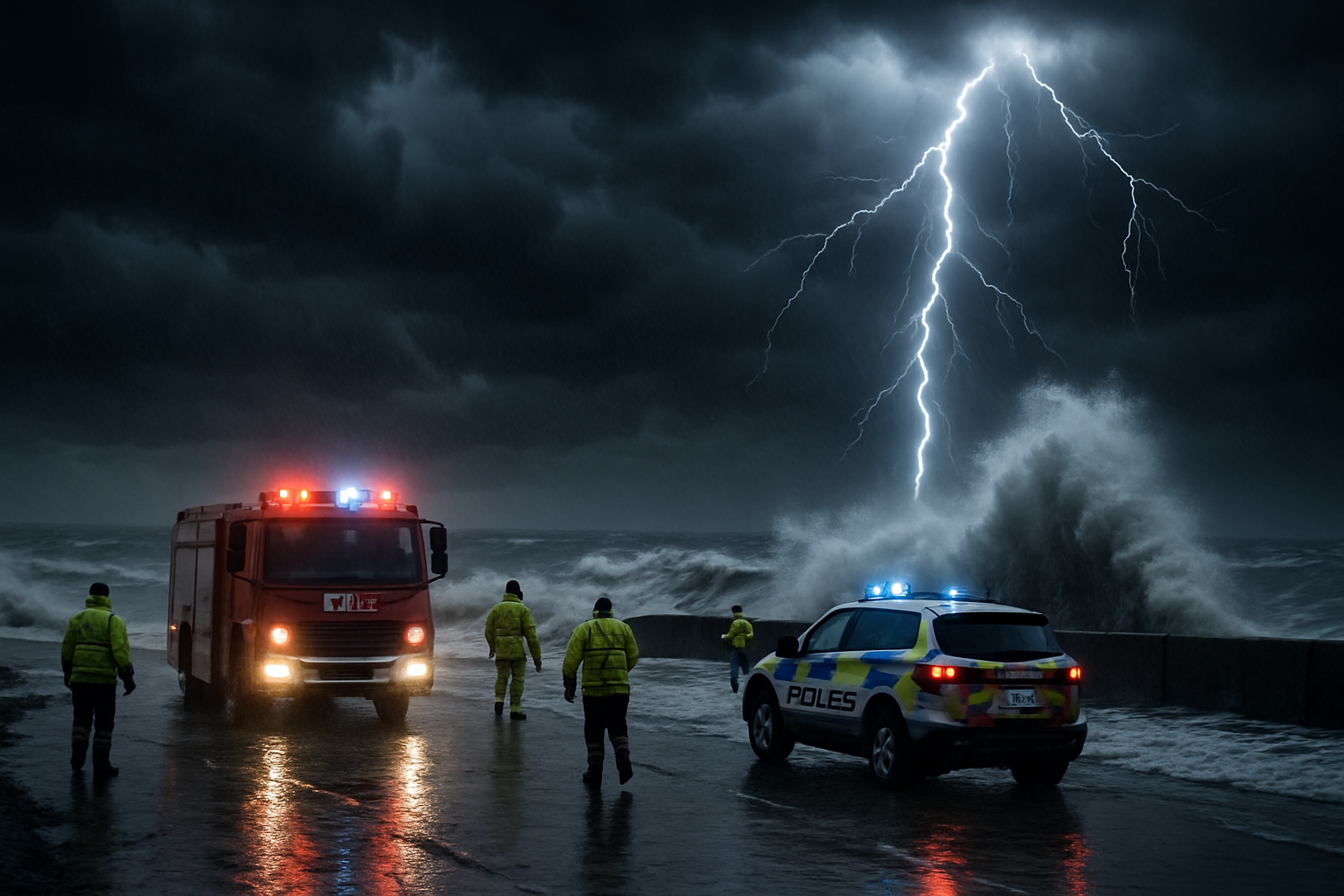
Emergency services across multiple continents are battling simultaneous extreme weather events as New Zealand braces for Cyclone Vaianu's arrival, Russia grapples with deadly flooding, and Australia tracks two tropical cyclones, highlighting the unprecedented strain on global disaster response systems during the 23rd consecutive month of record-breaking global temperatures.
The MetService has issued critical warnings for New Zealand's North Island as Cyclone Vaianu, currently positioned east of Vanuatu, continues to gain speed and power while tracking toward New Zealand waters. The Category 2 system represents an immediate threat to communities already saturated from recent severe weather events.
"The subtropical low system is gaining considerable momentum," confirmed a MetService spokesperson. "We're monitoring this system very closely as it approaches from the northeast, bringing with it the potential for dangerous flooding conditions across multiple regions."
Russia Faces Catastrophic Flooding Crisis
Meanwhile, southern Russia is experiencing what authorities describe as "deadly flooding" that has already claimed at least five lives and forced thousands to evacuate their homes. The disaster, triggered by intense rainfall, has overwhelmed local emergency response capabilities and exposed critical infrastructure vulnerabilities.
The flooding has displaced thousands of residents, with emergency shelters struggling to accommodate the surge of evacuees. Local authorities report that several communities remain completely cut off from emergency services due to damaged transportation networks.
"The scale of this disaster exceeds our immediate response capabilities. We're seeing flood levels that haven't been recorded in decades."
— Regional Emergency Official, Southern Russia
Australia Monitors Dual Tropical Threats
Australia's Bureau of Meteorology is simultaneously tracking two tropical cyclones positioned over the South Pacific, adding another layer of complexity to the Southern Hemisphere's already volatile weather patterns. These systems are being monitored for potential impacts on the eastern Australian coast.
The dual cyclone scenario represents a particular challenge for emergency services, as traditional response protocols are designed for sequential rather than simultaneous threats. This pattern has become increasingly common during what climate scientists are calling the longest sustained period of extreme global warming in recorded history.
Global Climate Context: 23rd Consecutive Record Month
The current severe weather events occur against the backdrop of January 2026 being confirmed as the hottest month ever recorded, extending an unprecedented streak of 23 consecutive months with global temperatures exceeding 1.5°C above pre-industrial levels. This represents the longest sustained period of extreme warming in human history.
Climate scientists emphasize that human-induced warming is now completely overriding natural cooling mechanisms, including La Niña effects that would traditionally moderate global temperatures. The World Meteorological Organization has indicated a 50-60% probability of El Niño development by July-September 2026, which could drive temperatures into unprecedented territory.
Emergency Response Systems Under Unprecedented Strain
The simultaneous nature of these global weather emergencies is exposing critical weaknesses in traditional mutual aid mechanisms, which were designed to handle sequential disasters rather than concurrent multi-continental crises. Emergency services are operating at or beyond capacity limits worldwide.
The Australian Fire and Emergency Services Authority Council (AFAC) has identified a fundamental shift from isolated regional disasters to what they term "compound disasters" – multiple emergency types occurring simultaneously across vast geographic areas. This evolution is fundamentally challenging traditional resource allocation and mutual aid mechanisms.
Transportation networks, power grids, and communication systems designed for historical climate patterns are repeatedly failing as extreme weather conditions exceed their operational parameters. The European Union's Civil Protection Mechanism has been activated multiple times, with the Sweden-Denmark €246 million assistance package representing the largest coordinated European response on record – yet experts warn this scale remains insufficient for the simultaneity of current challenges.
Infrastructure Vulnerabilities Exposed
The current crisis is revealing critical vulnerabilities in infrastructure systems built for climate conditions that no longer exist. Recovery timelines have fundamentally shifted from weeks to months or years, representing a permanent change in disaster response approaches.
"Building back better" with climate-resilient infrastructure has evolved from an optional enhancement to an essential survival strategy. Traditional seasonal patterns that have guided infrastructure design, agricultural planning, and emergency preparedness for centuries are no longer reliable frameworks for the permanent climate volatility era.
Economic and Social Devastation
Agricultural operations are facing billions in losses as extreme weather destroys crops and disrupts supply chains during critical growing seasons. Tourism industries are experiencing extended cancellations and infrastructure damage during what should be peak revenue periods.
- Families are losing generational properties for the second or third time within a decade
- Small businesses face extinction from recurring disruptions
- Mental health services report increased demand for climate anxiety and repeated trauma support
- Vulnerable populations require extended support as social services strain under frequency and intensity
International Cooperation at Breaking Point
Environmental challenges are transcending national boundaries as atmospheric and ocean systems transport climate effects globally, regardless of political borders. The simultaneity of disasters is testing mechanisms designed to allow stable regions to assist others during isolated emergencies.
Traditional frameworks assume that some regions remain stable enough to provide aid to others, but this assumption is breaking down when multiple continents face simultaneous disasters. Success now requires unprecedented cooperation, enhanced multi-sector coordination, and sustained financial commitments to environmental protection as essential infrastructure for planetary sustainability.
Adaptation Strategies and Technology Integration
Despite the challenges, some successful responses are emerging through sophisticated integration of cutting-edge technology and traditional ecological knowledge. Australia has demonstrated effective combinations of advanced meteorological forecasting with Indigenous fire management practices, while Estonia operates continental Europe's largest battery storage system serving 90,000 households with 88% renewable electricity.
Finland is implementing what experts call "transformative adaptation" – proactive systems designed for permanent climate volatility rather than reactive emergency response to exceptional events.
"We're no longer dealing with exceptional weather events that disrupt normal conditions. This is the new normal, and our entire approach to emergency management must evolve accordingly."
— Climate Adaptation Specialist, European Scientific Advisory Council
Strategic Implications for Global Climate Policy
April 2026 is emerging as a watershed moment for global climate preparedness, forcing a fundamental choice between reactive crisis management and transformative infrastructure adaptation. Current conditions provide a preview of what could become routine by the 2030s without comprehensive climate adaptation investment.
The window for effective climate action continues to narrow as ecological systems approach critical thresholds that could trigger irreversible changes to global food security, climate stability, and human settlements. Additional weather systems are developing in both the Atlantic and Pacific regions, suggesting that crisis conditions may persist for weeks, establishing what experts call a "new normal" of extreme weather frequency and intensity.
Looking Ahead: The Question of Planetary Habitability
Climate experts emphasize that the tools, knowledge, and cooperation frameworks exist for comprehensive environmental protection, but success depends on unprecedented speed of coordination and sustained international cooperation with deep political commitment to environmental protection as essential infrastructure for human prosperity and planetary sustainability.
The fundamental question is no longer whether transformative climate action is needed, but whether humanity can organize and implement solutions rapidly enough to maintain planetary habitability during what may be Earth's most environmentally challenging period in recorded history.
As Cyclone Vaianu approaches New Zealand, Russia continues battling deadly floods, and Australia monitors dual tropical threats, the interconnected nature of these events serves as a stark reminder that climate change respects no borders and demands coordinated global action at a scale and speed never before attempted in human history.