President Donald Trump has officially launched the most ambitious anti-cartel military alliance in Western Hemisphere history, signing the "Shield of the Americas" coalition with 17 Latin American and Caribbean nations while coordinated international operations across four continents demonstrate the escalating global war against transnational organized crime.
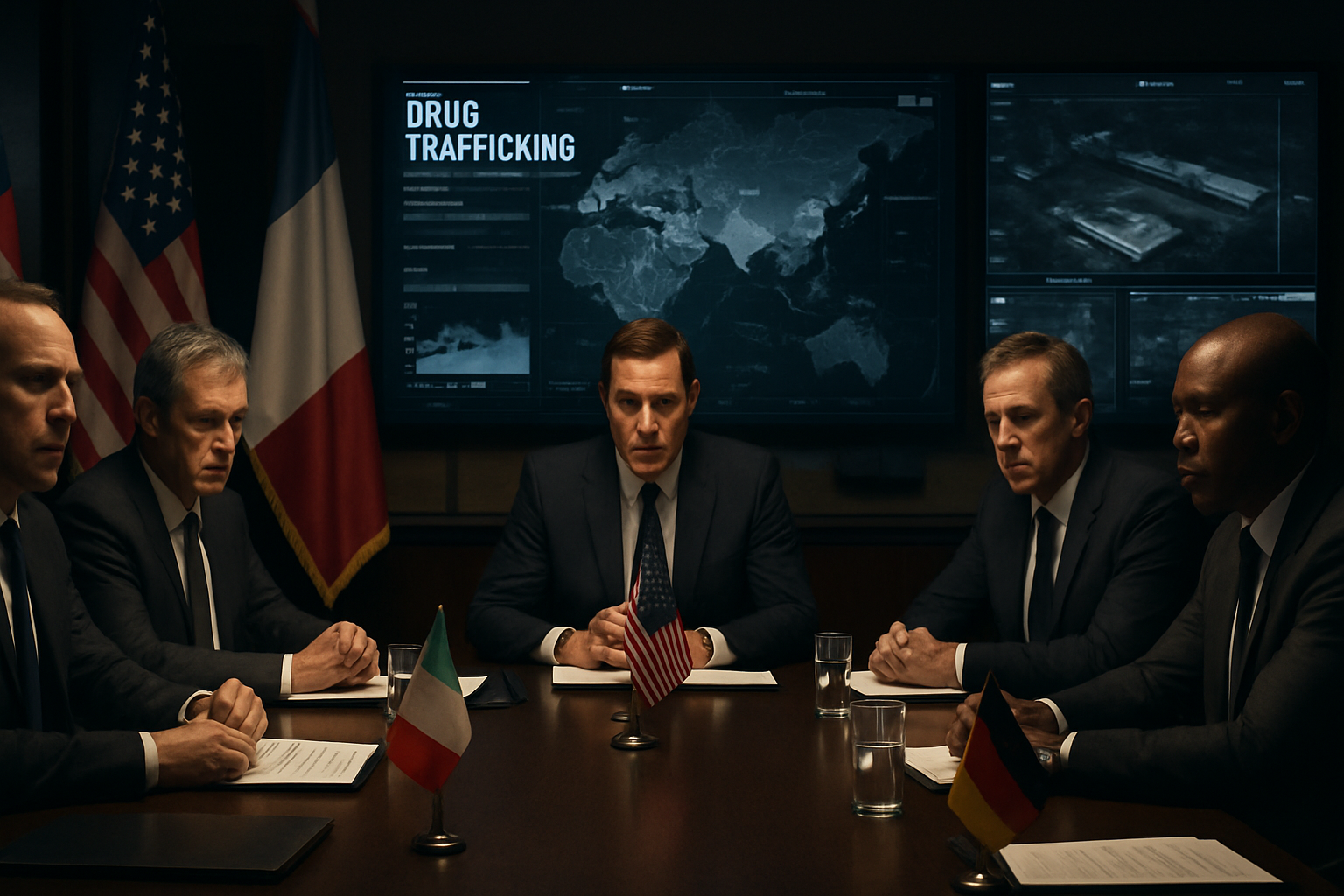
The historic coalition, formalized at Trump's Miami golf club on March 7, 2026, commits member nations to using "lethal military force" against drug cartels, representing a fundamental shift from traditional law enforcement approaches to direct military intervention against criminal organizations that have evolved to possess state-like capabilities.
Coalition Framework and Unprecedented Scope
The "Shield of the Americas" operates under terrorist organization designations that allow kinetic military operations in international waters, building on Operation Southern Spear which has resulted in over 150 fatalities since September 2025. The coalition includes key regional partners such as El Salvador, Argentina, Trinidad and Tobago, Dominican Republic, Peru, and Paraguay, while notably excluding Mexico despite Trump calling it the "epicenter of cartel violence."
President Santiago Peña of Paraguay, speaking at the summit, emphasized the historic nature of the alliance: "We reaffirm our unwavering commitment to regional security and the security of our country. With this historic step, Paraguay assumes an active role against transnational organized crime."
Trump's offer of direct U.S. military support was unprecedented in its scope. "You want us to use a missile? We can do that. You just have to ask," the President told assembled leaders, demonstrating the coalition's commitment to eliminating high-value cartel targets through precision strikes.
Recent Operations Demonstrate Growing Sophistication
The coalition's formation comes amid a series of coordinated international operations that highlight both the sophistication of modern criminal networks and the enhanced cooperation required to combat them. Recent operations across Bosnia and Herzegovina, Guyana, Haiti, and Paraguay illustrate the global nature of the challenge.
In Bosnia and Herzegovina, Operation "Kevlar" resulted in the seizure of over a kilogram of cocaine from a BMW and associated residence in Banja Luka. The operation, conducted by Banja Luka Police Administration, demonstrates how criminal networks have penetrated traditionally stable European regions.
Meanwhile, Guyana President Dr. Irfaan Ali publicly supported the U.S. initiative, stating that "Guyana supports the United States' strong action against transnational criminals and networks." This endorsement came as Trump launched the broader "Shield of the Americas" framework designed to "crush cartels across the hemisphere."
Military Escalation and Legal Framework
The coalition represents a continuation and expansion of Trump's militarized counter-narcotics approach, which has transformed the Caribbean Sea and Eastern Pacific into active military zones. Under the existing legal framework, operations are conducted under terrorist organization designations that provide military authorities for lethal force without requiring traditional Congressional approval.
General Francis Donovan oversees the systematic campaign, which has evolved from traditional interdiction to direct elimination of suspected trafficking vessels. The approach has drawn international criticism over maritime law precedents and civilian casualties, but coalition members argue that criminal organizations now possess capabilities that exceed traditional law enforcement capacity.
"Criminal organizations demonstrate military-grade technology, encrypted communications, compartmentalized structures spanning multiple countries. The adaptation pace consistently exceeds law enforcement capabilities, requiring sustained international cooperation and technological advancement."
— Defense Intelligence Analysis, March 2026
El Salvador Model and Regional Strategy
The coalition is largely based on the El Salvador model developed under President Nayib Bukele, who attended the Miami summit and received extensive praise from Trump. El Salvador's dramatic transformation from one of the world's most violent countries to a regional security success story has become the template for hemispheric cooperation.
Sara Carter, Trump's White House drug czar and Director of the Office of National Drug Control Policy, has championed the El Salvador approach as demonstrating how decisive action can achieve unprecedented results. The model emphasizes comprehensive detention of gang members, state-of-emergency powers, and zero-tolerance enforcement.
Kristi Noem, recently appointed as Special Envoy for the coalition after her departure from the Department of Homeland Security, will head operational coordination between member nations. The framework allows for rapid deployment of U.S. assets, including precision-guided munitions, upon partner nation consent.
International Context and Criminal Evolution
The coalition's formation occurs against the backdrop of increasingly sophisticated criminal networks that have evolved far beyond traditional organized crime. Recent intelligence assessments reveal that major cartels now operate with capabilities previously exclusive to nation-states, including advanced surveillance systems, encrypted global communications networks, and military-grade weaponry.
The death of Jalisco New Generation Cartel leader Nemesio Oseguera "El Mencho" in February 2026 demonstrated both the success of international cooperation and the challenges ahead. While the U.S.-Mexico intelligence partnership successfully eliminated the world's most wanted drug criminal, the violent aftermath—including the deaths of 25 National Guard members and deployment of 10,000 Mexican troops—illustrated the state-like capabilities of modern criminal organizations.
Bolivia's Defense Minister Marcelo Salinas has proposed establishing the country as a regional "sovereign information and security hub" using satellite and drone surveillance systems, recognizing that criminal organizations have "evolved into increasingly complex structures with capacity to operate beyond borders and weaken state sovereignty."
Technology and Intelligence Sharing
The coalition emphasizes technological integration and real-time intelligence sharing as core components of its operational framework. Member nations will have access to satellite surveillance, digital forensics, financial tracking systems, and artificial intelligence capabilities that can match the technological sophistication of criminal networks.
Recent operations have revealed the extent of criminal technological adaptation. The February 2026 closure of El Paso Airport by Mexican cartel drones demonstrated how quickly criminal organizations adopt and weaponize emerging technologies. This technological arms race has forced law enforcement to accelerate adoption of military-grade capabilities while preserving democratic oversight.
The enhanced cooperation building on successful maritime operations, including the seizure of 7.5+ tonnes of cocaine worth $200+ million in coordinated February 2026 operations, provides the foundation for expanded coordination. These successes demonstrate the effectiveness of multinational cooperation when properly coordinated and resourced.
Challenges and International Concerns
Despite the coalition's ambitious framework, significant challenges remain. The splintering of CJNG following El Mencho's death has created multiple smaller but potentially more violent organizations competing for territorial control. Resource constraints particularly affect smaller Caribbean and Central American nations that lack the capacity to implement comprehensive security measures.
International observers, particularly in Europe, have expressed concerns about the emphasis on lethal force and potential civilian casualties. Maritime law experts question the precedent of conducting military strikes against civilian vessels in international waters based on suspected rather than confirmed criminal activity.
The exclusion of Mexico from the coalition, despite its central role in hemispheric drug trafficking, represents a significant diplomatic challenge. While the U.S. maintains bilateral cooperation with Mexico on specific operations, the broader coalition framework proceeds without the participation of the country Trump identified as the primary source of cartel activity.
Strategic Implications and Global Precedent
The "Shield of the Americas" coalition represents the most significant U.S. hemispheric security initiative since the Cold War, establishing precedents that will influence global approaches to transnational organized crime. The initiative is part of Trump's broader "Corolario Trump" doctrine—a 21st-century Monroe Doctrine that combines military pressure, economic incentives, and selective diplomatic engagement to counter Chinese influence while addressing regional security challenges.
The timing coincides with other major geopolitical developments, including the successful Venezuela energy partnership following Nicolás Maduro's removal in January 2026. This demonstrates the administration's dual-track approach of combining aggressive enforcement with strategic partnerships where mutual interests align.
International security experts view the coalition as a critical test case for addressing criminal organizations that have developed capabilities rivaling those of nation-states. The success or failure of this approach will likely influence similar initiatives in other regions facing comparable challenges from transnational criminal networks.
Implementation Timeline and Future Operations
The coalition's operational framework provides for immediate intelligence sharing, joint operations planning, and rapid deployment of U.S. military assets upon partner nation request. The intelligence infrastructure builds on existing capabilities demonstrated in successful operations, including the recent elimination of high-value targets and disruption of major trafficking networks.
Military officials indicate that operations will continue at current intensity levels with potential for escalation based on threat assessment and partner nation requests. The framework explicitly allows for precision missile strikes against cartel leadership, representing an unprecedented offer of direct U.S. military support for elimination operations.
The upcoming months will test the coalition's effectiveness in disrupting established trafficking routes while preventing the power vacuum from being filled by equally dangerous successor organizations. The international community will closely monitor whether this militarized approach achieves sustainable security improvements or simply displaces criminal activity to other regions.
Long-term Strategic Vision
Beyond immediate enforcement operations, the coalition envisions comprehensive institutional development that addresses the underlying conditions enabling criminal recruitment and operation. This includes strengthening democratic governance, improving economic opportunities, and building robust judicial systems capable of processing complex international cases.
The initiative's success depends on sustained political commitment across electoral cycles, adequate resource allocation, and continued international cooperation despite changing political dynamics. Historical precedent suggests that eliminating criminal leadership often leads to organizational fragmentation rather than decreased activity, requiring long-term strategies that go beyond tactical victories.
As the global community grapples with increasingly sophisticated transnational criminal networks, the "Shield of the Americas" coalition represents both an ambitious response to unprecedented challenges and a test of whether democratic nations can effectively coordinate military solutions to civilian criminal problems while preserving fundamental rights and international law principles.
The coalition's ultimate legacy will depend not only on its operational successes but on its ability to establish sustainable frameworks for international cooperation that address the root causes of organized crime while maintaining the democratic values and civil liberties that distinguish legitimate governance from the authoritarian control sought by criminal organizations.