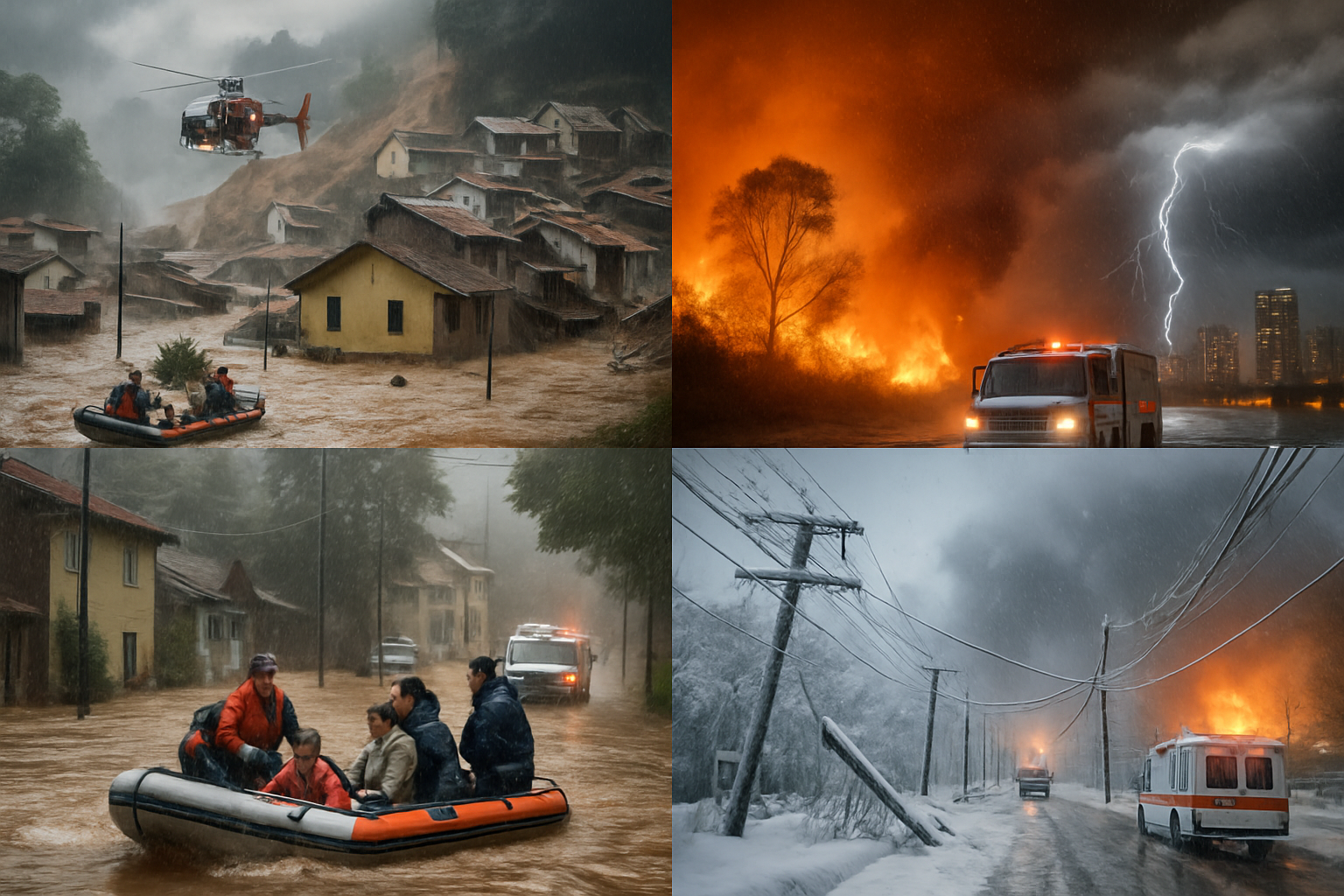
Emergency services across eight nations are overwhelmed as simultaneous extreme weather events continue to devastate communities from European storm zones to Colombian landslides, with death tolls mounting and hundreds of thousands forced from their homes in what meteorologists are calling an unprecedented global weather crisis.
European Storm System Claims Lives and Disrupts Elections
The most severe impact continues across the Iberian Peninsula, where Storm Marta—the third consecutive Atlantic storm in two weeks—has brought death and devastation to Portugal and Spain. At least 14 people have died from the storm succession of Kristin, Leonardo, and Marta, with Portuguese authorities deploying their largest peacetime rescue operation involving 26,500 personnel.
In Portugal, power outages have tripled overnight to affect 167,000 residents, while transportation networks remain paralyzed. The Douro River has reached critical 1997 flood levels in Porto and Vila Nova de Gaia, forcing emergency evacuations. Perhaps most remarkably, the country's presidential election proceeded on February 8 despite the crisis, with 36,000 voters unable to participate due to storm damage.
"This is an unprecedented test of our democratic resilience under environmental emergency conditions," said a Portuguese election observer, as constitutional law prevented national postponement of the vote.
— Electoral Commission Official
Spain has evacuated over 8,000 people from Andalusia, with the town of Grazalema recording an extraordinary 1,500 liters per square meter of rainfall—exceeding Madrid's entire annual precipitation total in just 36 hours.
Deadly Landslides Devastate Colombian Communities
Across the Atlantic, Colombia faces its own weather emergency as heavy rains triggered by a cold front have killed seven people in landslides in Nariño department. The southwestern regions of Cauca and Valle del Cauca are under high alert as rivers swell beyond capacity, with authorities maintaining constant surveillance of major tributaries.
The Caribbean coast of Colombia presents an even more dire situation, where separate flooding has killed 14 people and destroyed 9,000 homes, affecting approximately 50,000 families across Córdoba and Sucre departments. The government is considering declaring a state of emergency for the entire Caribbean coastal region.
Adding to Colombia's woes, massive waves exceeding three meters in height are battering the Cartagena region, forcing authorities to raise red flags at all beaches as the cold front continues to generate dangerous maritime conditions.
Snow Emergencies Block Albanian Mountain Communities
In Albania's mountainous north, the village of Theth faces its third road blockage in recent weeks as snow avalanches continue to disrupt access to the popular tourist destination. Rising temperatures have activated dangerous snow slides at Qafë Thorë pass, completely cutting off vehicle access to the remote community.
The repeated closures highlight the vulnerability of Albania's mountain communities to increasingly erratic winter weather patterns, with local authorities struggling to maintain reliable access routes during the peak winter tourism season.
African Nations Battle Dual Weather Crises
In southern Africa, Mozambique continues to grapple with devastating floods that have killed 23 people and affected 724,000 others across five provinces. The crisis has prompted massive international aid mobilization, with the UN appealing for $187 million in emergency assistance.
Meanwhile, Morocco faces the expanding reach of Storm Marta, which has now crossed from Europe into North Africa. Emergency evacuations have displaced tens of thousands as the Loukkos River overflows its banks, forcing authorities to establish emergency camps for affected populations.
South African Weather Service Issues Severe Warnings
The South African Weather Service has issued urgent flooding warnings as severe storms sweep across multiple provinces, warning residents to prepare for a potentially dangerous day of extreme weather. The warnings come as part of a broader pattern of atmospheric instability affecting the entire southern African region.
Global Climate Context and Emergency Response
These simultaneous extreme weather events are occurring during what has been confirmed as the hottest January on record globally, with 18 of the past 19 months exceeding 1.5°C above pre-industrial levels. This paradox of global heat records coinciding with severe regional storms and flooding highlights the increasing volatility of Earth's climate system.
Emergency services across affected regions report operating at capacity limits, with international cooperation becoming essential for effective disaster response. The European Union has activated its Civil Protection Mechanism, while Sweden and Denmark have pledged €246 million in assistance to storm-affected areas.
"We're seeing a convergence of extreme weather events that is testing our emergency response systems to their absolute limits," said a senior EU disaster response coordinator.
— European Civil Protection Official
Infrastructure Vulnerabilities Exposed
The crisis has exposed critical vulnerabilities in infrastructure across multiple continents. From Portugal's suspended railway lines to Colombia's overwhelmed drainage systems, the extreme weather is revealing how unprepared many regions remain for the increasing intensity and frequency of climate-related disasters.
Transportation networks have been particularly hard hit, with major highways flooded in Colombia, rail services suspended across Portugal and Spain, and mountain passes blocked in Albania. The disruptions are affecting not only immediate emergency response but also long-term economic recovery prospects.
Looking Forward: Recovery and Adaptation Challenges
Recovery efforts are expected to take weeks to months across affected regions, with preliminary damage assessments indicating billions in losses across agricultural, tourism, and infrastructure sectors. The crisis is serving as a wake-up call for enhanced climate adaptation strategies and improved international coordination mechanisms.
The simultaneous nature of these events—spanning four continents and affecting diverse climate zones—represents a new challenge for global disaster response frameworks. Emergency management experts emphasize the need for expanded international cooperation and more robust early warning systems to handle increasingly complex multi-regional crises.
As communities across eight nations continue to battle against nature's fury, the February 2026 weather crisis stands as a stark reminder of humanity's vulnerability to extreme weather and the urgent need for comprehensive climate adaptation strategies on a global scale.