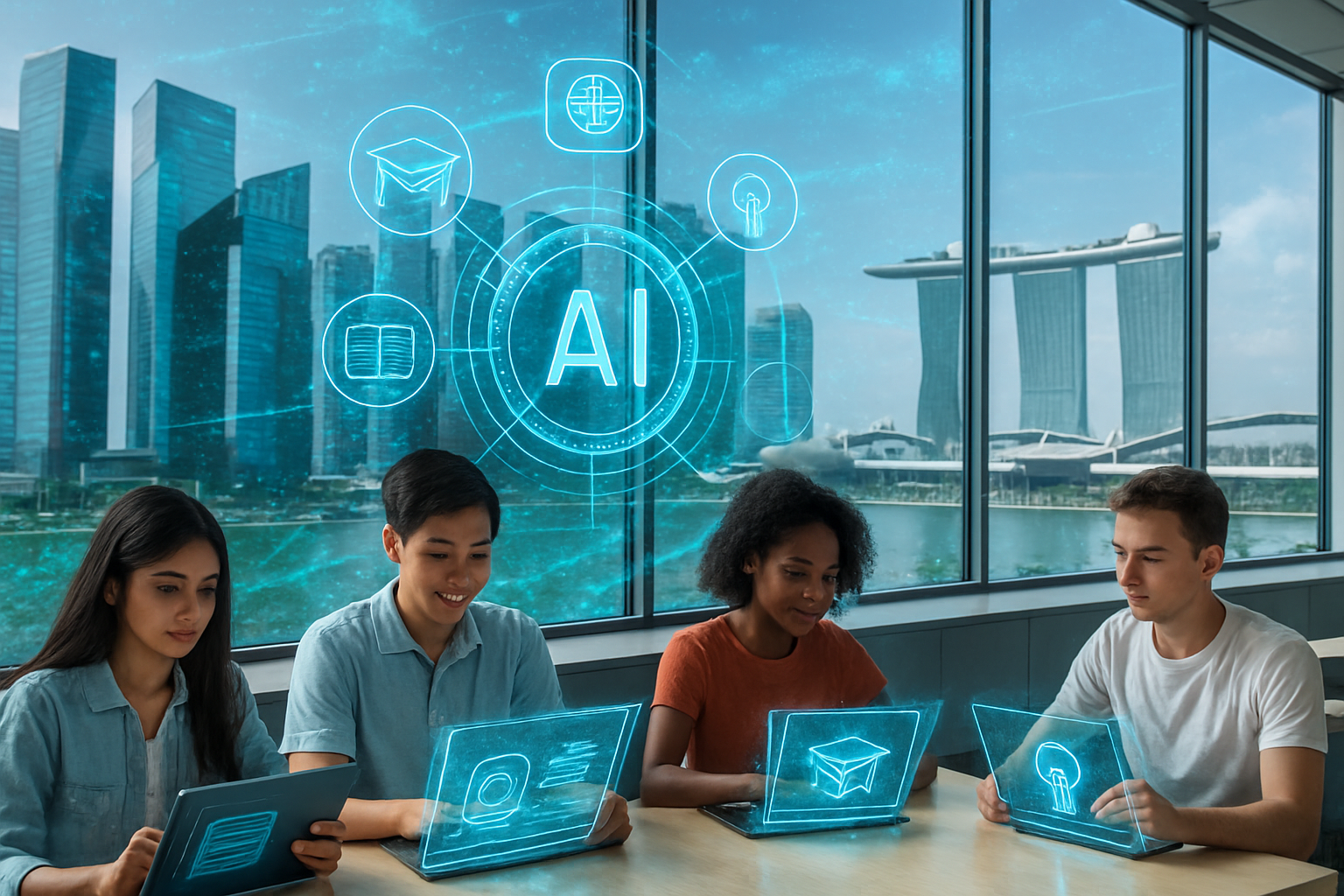
Singapore has announced a groundbreaking industry-led initiative aimed at preparing 10,000 students for a future dominated by autonomous artificial intelligence and physical AI systems, marking a pivotal moment in the nation's educational transformation strategy.
The comprehensive program represents a strategic shift toward preparing students to manage autonomous machines that operate beyond traditional pre-programmed rules, instead utilizing "common sense" reasoning capabilities in real-world environments. This initiative emerges as part of Singapore's broader commitment to maintaining its position at the forefront of global technological advancement while preserving educational excellence and human-centered learning approaches.
Building on Singapore's AI Education Legacy
Singapore's latest announcement builds on an established foundation of educational technology innovation. The nation has already demonstrated successful AI integration through the WonderBot 2.0 conversational AI system for heritage education, which has become a global template for culturally sensitive technological implementation. This success story exemplifies Singapore's approach of treating AI as amplification tools that enhance rather than replace fundamental educational relationships.
The country's systematic approach to AI education research, led by Education Minister Desmond Lee, has involved comprehensive studies examining AI impact on student learning while addressing legitimate concerns about over-reliance on artificial intelligence tools. This evidence-based methodology contrasts with rushed AI adoption elsewhere, providing a template for balancing innovation with educational effectiveness during what experts call the "2026 Educational Technology Renaissance."
The Physical AI Revolution
What sets this new initiative apart is its focus on "physical AI" - artificial intelligence systems that interact with and manipulate the physical world through robotics, sensors, and autonomous systems. Unlike purely digital AI applications, physical AI requires understanding of real-world constraints, safety considerations, and human-machine collaboration in dynamic environments.
"As robots move beyond pre-set rules towards 'common sense', a new industry-led initiative aims to equip students with the skills needed to manage autonomous machines in the real world."
— Singapore Education Officials
This development occurs within the broader context of rapid AI advancement globally, where nations are grappling with preparing their workforce for an economy increasingly dependent on sophisticated AI systems. Singapore's approach emphasizes practical skills development over theoretical knowledge, ensuring students can effectively supervise, troubleshoot, and optimize autonomous systems across various industries.
Global Context and Technological Infrastructure
Singapore's initiative takes place during a critical period in global AI development. The international community is experiencing what researchers characterize as a "civilizational choice point," where decisions made in 2026 will establish decades-long patterns for human-AI relationships. The convergence of massive corporate investments - including Alphabet's $185 billion AI infrastructure commitment and Amazon's $1 trillion development plans - alongside global semiconductor shortages creates both opportunities and challenges for educational institutions.
Despite infrastructure constraints, including a global memory crisis that has driven semiconductor prices up sixfold, Singapore's strategic approach leverages these challenges as catalysts for innovation. The nation is developing memory-efficient algorithms and sustainable deployment strategies that maximize AI capabilities while minimizing hardware requirements, potentially democratizing access to advanced AI education tools.
Educational Integration Strategy
Singapore's educational AI integration strategy reflects lessons learned from international best practices and challenges. The nation has observed concerning trends in other countries, such as the United Kingdom, where two-thirds of secondary school teachers report declining critical thinking abilities among students increasingly dependent on AI tools. This "productivity paradox," documented by researchers like Dr. Frank Bäumer, shows that AI implementation often creates more work rather than the promised efficiency gains.
To address these concerns, Singapore's program emphasizes developing meta-skills for human-AI collaboration, including:
- Critical evaluation of AI-generated recommendations and outputs
- Understanding when to rely on AI assistance versus independent human judgment
- Maintaining authentic voice and creative thinking while leveraging technological support
- Developing troubleshooting and optimization skills for autonomous systems
- Ethical reasoning and cultural sensitivity in AI deployment
Industry-Led Implementation
The program's industry-led approach ensures direct relevance to market demands while maintaining educational rigor. Singapore has learned from successful models worldwide, including Malaysia's world-first AI-integrated Islamic school, which achieved a remarkable 97.82% teacher placement rate while combining artificial intelligence with traditional religious and academic learning. Similarly, Canadian universities have successfully implemented AI teaching assistants that maintain critical thinking standards while providing personalized learning support.
The initiative addresses practical challenges that students will face in an AI-integrated economy, including the management of autonomous vehicles, smart city infrastructure, advanced manufacturing systems, and healthcare robotics. This practical focus distinguishes Singapore's approach from purely theoretical AI education programs, ensuring graduates possess immediately applicable skills.
Teacher Training and Professional Development
Recognizing that successful AI education requires comprehensive teacher preparation, Singapore has implemented extensive professional development programs. The initiative builds on the nation's track record of sustained political commitment to education, comprehensive stakeholder engagement, and cultural sensitivity in implementing technological innovations.
Teachers receive training in AI literacy, digital pedagogy skills, and supervision of AI-enhanced learning environments. This approach treats AI as enhancement tools serving educational goals rather than replacement mechanisms for traditional teaching methods. The program emphasizes preserving human creativity, critical thinking, and cultural knowledge while preparing students for technical competence in an AI-integrated global economy.
International Cooperation and Knowledge Sharing
Singapore's initiative participates in broader international cooperation networks that have emerged during the 2026 Educational Technology Renaissance. The nation contributes to bilateral partnerships, peer-to-peer knowledge sharing, and regional frameworks that enable comprehensive educational reform strategies while respecting cultural diversity and local adaptation needs.
This distributed cooperation model has proven more resilient than traditional multilateral approaches, allowing flexible and culturally responsive strategies while maintaining evidence-based standards. Singapore's experience with the WonderBot 2.0 heritage education system demonstrates how global technological innovations can be adapted to preserve local cultural values and educational traditions.
Economic and Strategic Implications
The economic implications of Singapore's AI education investment extend beyond immediate educational outcomes. Countries implementing comprehensive, prevention-first educational approaches have documented superior economic results, including reduced crisis intervention costs, decreased unemployment rates, improved workforce productivity, and enhanced international competitiveness.
Educational investments in AI literacy are increasingly viewed as strategic 21st-century infrastructure rather than cost centers. These initiatives create self-reinforcing cycles where educational excellence supports economic development, which enables further educational investment. Singapore's approach positions the nation to maintain its competitive advantage in the global knowledge economy while contributing to international understanding of effective AI education strategies.
Addressing Digital Wellness and Ethical Considerations
Singapore's comprehensive approach includes addressing digital wellness concerns that have emerged from global research. Studies show that 96% of children aged 10-15 use social media, with 70% experiencing harmful content exposure. Early smartphone exposure before age 5 has been linked to persistent sleep disorders, cognitive decline, and weight problems extending into adulthood.
The AI education program incorporates digital wellness strategies alongside technical training, emphasizing conscious technology use and responsible digital citizenship. This holistic approach prepares students not just for technical proficiency with AI systems, but for maintaining healthy relationships with technology throughout their lives.
Future Trajectories and Global Influence
Singapore's initiative occurs at what educational policy experts identify as a critical juncture determining educational trajectories for the coming decade. Success in preparing students for AI-integrated economies while preserving human creativity, critical thinking, and cultural knowledge will significantly influence global approaches to educational modernization.
The program's emphasis on physical AI systems positions Singapore at the forefront of preparing students for a future where autonomous systems manage critical infrastructure, transportation networks, healthcare delivery, and manufacturing processes. This forward-looking approach ensures graduates will be prepared for emerging career paths that don't yet exist but will be essential in an increasingly automated world.
As artificial intelligence continues its rapid evolution from experimental technology to essential infrastructure, Singapore's comprehensive educational strategy provides a valuable template for nations seeking to balance technological advancement with human development priorities. The success of this initiative will likely influence educational policy discussions internationally, contributing to global understanding of effective AI integration in educational systems.
The program represents a critical test of whether democratic educational institutions can successfully prepare students for an AI-enhanced future while preserving the human elements that define meaningful education. Singapore's approach - emphasizing human-AI collaboration over replacement, cultural sensitivity alongside technological sophistication, and practical skills development within educational excellence frameworks - offers a promising path forward for educational systems worldwide.