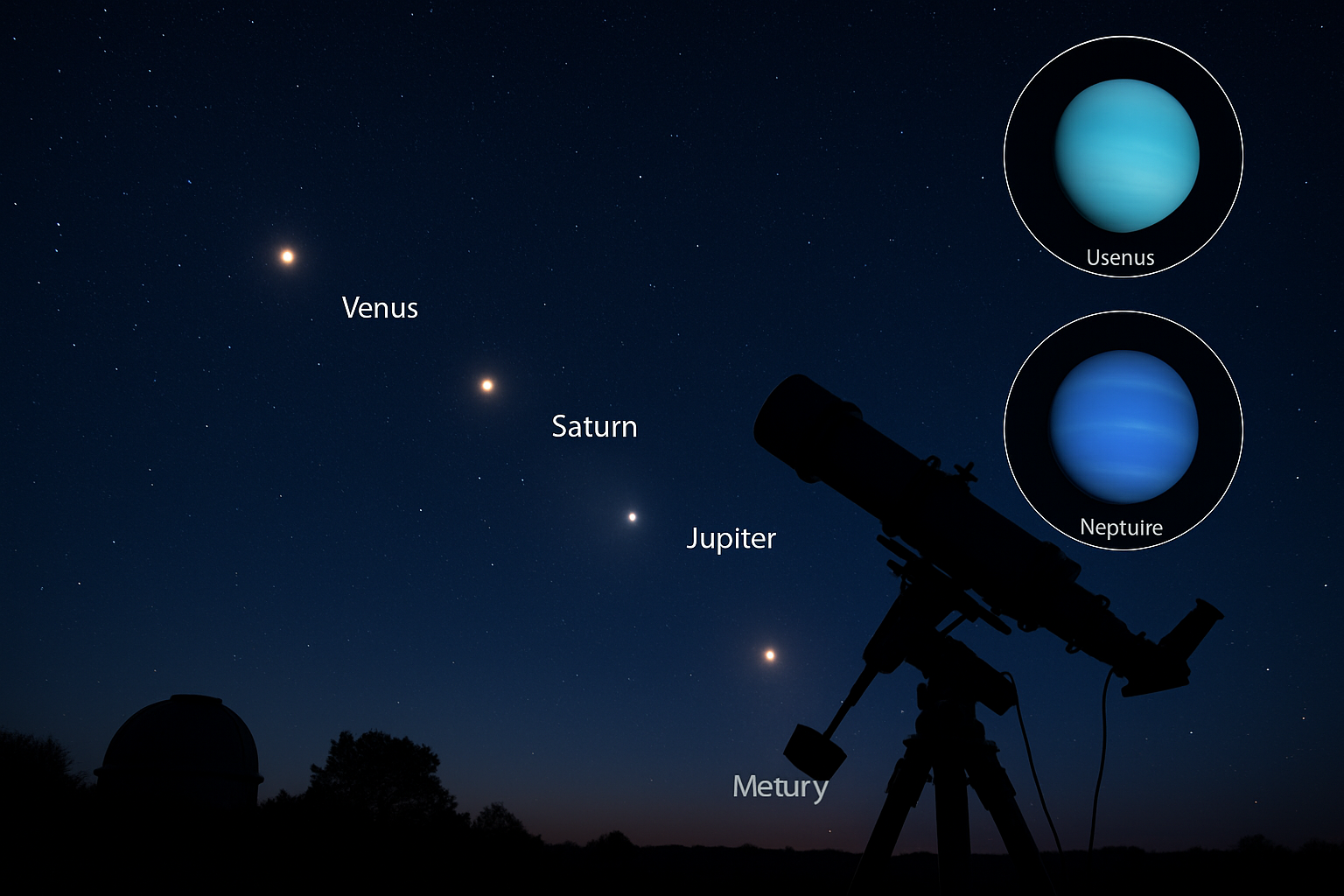
Six planets will align in a spectacular celestial parade visible tonight, February 27, 2026, offering astronomy enthusiasts worldwide a rare opportunity to witness this extraordinary astronomical phenomenon that occurs due to the unique orbital mechanics of our solar system.
According to NASA, this remarkable planetary alignment will feature Mercury, Venus, Saturn, and Jupiter prominently visible to the naked eye, while Uranus and Neptune will require binoculars or telescopes for optimal viewing. The event represents a convergence of planetary orbits that creates what astronomers call a "parade of planets" formation.
Understanding the Planetary Parade Phenomenon
"This planetary parade occurs due to the alignment of the planets' orbits around the sun," explained Heidi Haviland, a planetary scientist at NASA's Marshall Space Flight Centre in Huntsville, Alabama. The alignment is a result of the complex orbital mechanics governing our solar system, where planets occasionally appear to line up when viewed from Earth's perspective.
The six planets participating in tonight's celestial display will be positioned in a way that allows observers to see them spanning across the night sky in a relatively straight line. This phenomenon builds upon February 2026's extraordinary astronomical events, which have included the record-breaking comet C/2024 E1 with its distinctive emerald glow and various other cosmic phenomena that have marked this month as particularly significant for sky watchers.
Optimal Viewing Conditions and Timing
For the best viewing experience, NASA recommends that early risers attempt to glimpse the planetary parade before sunrise, while night owls will find optimal visibility right after sunset. The timing is crucial, as the planets will be positioned at their most favorable angles during these twilight periods.
The four naked-eye planets - Mercury, Venus, Saturn, and Jupiter - will appear as bright points of light against the darkening or brightening sky. Venus, known as the "morning star" or "evening star" depending on its position, will likely be the most prominent and easiest to identify due to its exceptional brightness.
Jupiter, the largest planet in our solar system, will appear as a steady, bright golden-white point, while Saturn may appear slightly dimmer but still clearly visible. Mercury, being the closest planet to the Sun, may be more challenging to spot due to its proximity to the solar glare, requiring observers to look carefully during the optimal viewing windows.
Equipment Needed for Complete Observation
While four of the six planets can be observed with the naked eye, astronomy enthusiasts seeking the complete experience will need optical assistance to spot Uranus and Neptune. Binoculars will be sufficient for Uranus, which may appear as a faint blue-green dot, while Neptune will likely require a telescope for clear identification.
For those with access to telescopes, this event provides an excellent opportunity to observe planetary details. Jupiter's four largest moons - Io, Europa, Ganymede, and Callisto - may be visible through modest telescopic equipment, while Saturn's distinctive ring system could potentially be glimpsed under favorable conditions.
Historical Context and Rarity
Based on astronomical records and previous observations, six-planet alignments are relatively rare events that capture public imagination and scientific interest. The February 28, 2026 alignment mentioned in recent astronomical forecasts represents part of this broader celestial phenomenon, with tonight's event serving as the culmination of this remarkable planetary configuration.
This alignment occurs during what astronomers have termed the "golden age" of space observation, coinciding with advanced technological capabilities, international cooperation in space research, and unprecedented public access to astronomical events through digital streaming and enhanced observation equipment.
Scientific Significance Beyond Spectacle
While planetary parades offer spectacular viewing opportunities, they also provide valuable scientific data about orbital mechanics, gravitational influences, and the dynamic nature of our solar system. These alignments allow researchers to study planetary positions with enhanced precision and contribute to our understanding of celestial mechanics.
The event also demonstrates the predictable nature of astronomical phenomena, showcasing how orbital calculations can accurately forecast these cosmic events years in advance. This predictability contrasts with other recent astronomical discoveries, such as the unexpected characteristics of comet C/2024 E1, which have challenged existing theories about solar system formation.
Global Viewing Opportunities
The six-planet parade will be visible from locations worldwide, though viewing conditions will vary based on geographic location, weather patterns, and local light pollution levels. Urban observers may find it more challenging to spot the fainter planets due to city lights, making darker, rural locations ideal for the complete viewing experience.
International astronomical organizations and observatories are coordinating observation efforts, with many offering public viewing sessions and educational programs to help enthusiasts identify and appreciate this celestial event. The global nature of this phenomenon reflects the shared human fascination with cosmic events that transcend national boundaries.
Connection to Broader Astronomical Events
Tonight's planetary parade occurs during an exceptionally active period for astronomical phenomena in February 2026. The month has featured remarkable discoveries including breakthrough black hole research, advanced space missions, and the continuing observations from the James Webb Space Telescope that have revolutionized our understanding of distant cosmic phenomena.
This alignment also coincides with ongoing international cooperation in space exploration, including recent successful missions to the International Space Station and preparations for future lunar exploration programs. The convergence of natural cosmic phenomena with human space exploration capabilities represents a unique moment in astronomical history.
Photography and Documentation Tips
Astronomy photographers and enthusiasts planning to document this event should prepare for low-light conditions and consider using tripods for stable, long-exposure shots. Wide-angle lenses can capture the full span of the planetary alignment, while telephoto lenses may be useful for detailed shots of individual planets.
For smartphone users, recent technological advances have made astronomical photography more accessible, with specialized apps and camera settings optimized for night sky photography. The integration of consumer technology with astronomical observation reflects the democratization of space science and the growing public engagement with cosmic events.
Looking Forward: Future Astronomical Events
While tonight's six-planet parade represents a spectacular immediate opportunity, it also serves as a preview of continued astronomical excitement throughout 2026 and beyond. The year has already established itself as remarkable for space discoveries and observations, with this planetary alignment adding to the growing catalog of memorable cosmic events.
Future planetary alignments, though occurring at different intervals and involving various combinations of planets, will continue to provide opportunities for public engagement with astronomy and scientific education. These events serve as bridges between professional astronomical research and public curiosity about our place in the cosmos.
As weather permits and viewing conditions allow, tonight's six-planet parade offers a rare chance to witness the beauty and precision of celestial mechanics in action, providing both spectacular visual entertainment and deeper appreciation for the complex orbital dance of our solar system's planetary family.