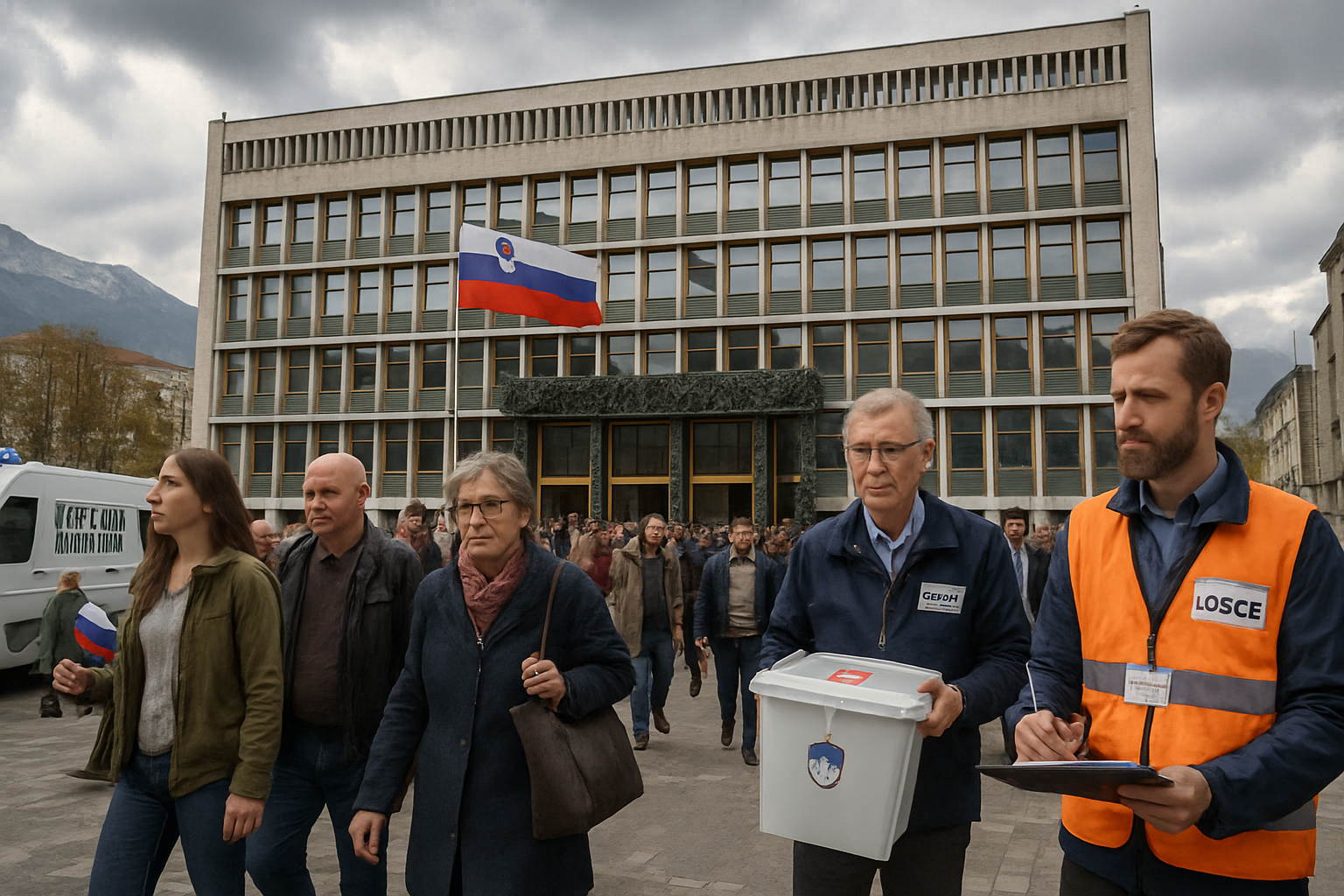
Slovenia's ruling Freedom Movement party has claimed a narrow victory over the opposition Slovenian Democratic Party (SDS) in parliamentary elections held on March 22, 2026, in what observers are calling the tightest electoral contest in the Alpine nation's history since gaining independence in 1991.
With 99.28% of polling stations counted, Prime Minister Robert Golob's center-left Freedom Movement (GS) secured 29.9% of the vote, while former Prime Minister Janez Janša's conservative SDS trailed closely with 27.5% - a margin of less than one percentage point that has left the final outcome hanging in the balance for hours after polls closed.
The razor-thin results reflect deep political polarization in the European Union member state of 2.1 million people, where voters faced a stark choice between Golob's pro-European liberal agenda and Janša's nationalist conservative platform that has drawn comparisons to Hungarian Prime Minister Viktor Orbán's governance model.
Foreign Interference Allegations Cast Shadow
The election campaign was overshadowed by explosive allegations of foreign interference, specifically claims that an Israeli private security firm had been operating to influence the outcome in favor of Janša's candidacy. These accusations emerged in the final weeks of the campaign, contributing to what observers described as a "spy scandal" that undermined public confidence in the democratic process.
The interference allegations represent part of a broader pattern of concerns about foreign meddling in European elections, with intelligence sources reporting increasingly sophisticated operations targeting electoral processes across EU member states. The timing of these revelations was particularly damaging to Janša, who had been considered the frontrunner in early polling.
International election observers, deployed in unprecedented numbers for a Slovenian election, monitored the voting process closely for signs of irregularities. The presence of foreign observers was seen as crucial for maintaining democratic legitimacy amid the swirling allegations of external interference.
A Choice Between Two Visions
The election represented a fundamental choice between competing visions for Slovenia's future. Golob, who has served as Prime Minister since 2022, campaigned on a platform emphasizing European integration, democratic norms, and environmental sustainability. His Freedom Movement positioned itself as the defender of liberal democratic values against what it characterized as authoritarian populist threats.
Janša, a veteran politician who previously served as Prime Minister from 2020-2022 and has been a dominant figure in Slovenian politics for over two decades, ran on a platform emphasizing national sovereignty, traditional values, and skepticism toward EU migration policies. His campaign rhetoric often echoed themes popular among European populist movements, leading critics to label him Slovenia's "mini-Trump."
"This election is about more than party politics - it's about the fundamental direction of our democracy and our place in Europe,"
— Robert Golob, Prime Minister and Freedom Movement Leader
The campaign was marked by increasingly heated rhetoric from both sides, with debates focusing on issues ranging from media freedom and judicial independence to Slovenia's relationship with the European Union and its position on the war in Ukraine.
European Context and Regional Implications
Slovenia's election took place amid what analysts are describing as the most severe political crisis facing European democracy since World War II. The vote occurred as multiple EU member states grapple with rising far-right movements, coalition instability, and challenges to traditional democratic norms.
The timing was particularly significant given recent political upheavals across Europe, including Sweden's unprecedented cooperation between the Liberal Party and the far-right Sweden Democrats, violent political confrontations in France, and increasing polarization in Germany where the far-right Alternative for Germany (AfD) has made significant gains.
For Slovenia, strategically located between Austria and the Balkans, political stability carries implications far beyond its borders. The country serves as a crucial link between Western Europe and the Western Balkans, making its democratic health important for regional security and EU enlargement prospects.
Coalition Mathematics and Government Formation
Despite claiming victory, Golob's Freedom Movement faces significant challenges in forming a stable government. With no party achieving an absolute majority, coalition negotiations will be crucial in determining Slovenia's next administration.
The fragmented parliamentary landscape reflects broader European trends toward political pluralization, with 15 different parties and coalitions competing for seats. This fragmentation complicates traditional coalition mathematics and may require creative political arrangements to ensure governmental stability.
Early projections suggest that the Freedom Movement may secure 29 parliamentary seats compared to 28 for the SDS, leaving both major parties dependent on smaller coalition partners to form a government. The final seat allocation will depend on the distribution of remaining votes and could potentially shift as final counting concludes.
Democratic Resilience Under Pressure
The conduct of the election itself has been closely scrutinized as a test of democratic resilience in the face of multiple pressures. Despite the foreign interference allegations and intense political polarization, the voting proceeded smoothly across the country's 2,987 polling stations.
Approximately 1.7 million Slovenians were eligible to vote in what many observers characterized as the most consequential election since independence. Turnout appeared robust, suggesting continued public engagement with the democratic process despite widespread concerns about political polarization.
"The fact that we can conduct free and fair elections despite all the external pressures and internal divisions shows the strength of our democratic institutions,"
— A European Union election observer
The election's peaceful conduct and general acceptance of preliminary results by major political actors has been seen as a positive sign for democratic stability, even as the narrow margin ensures continued political tension.
Economic Challenges Await
Regardless of which party ultimately forms the government, Slovenia's next administration will face significant economic challenges. Like many European countries, Slovenia is grappling with inflation pressures, energy costs related to the war in Ukraine, and the broader economic uncertainties facing the European Union.
Both major parties presented competing economic visions during the campaign, with the Freedom Movement emphasizing green transition and European integration while the SDS focused on traditional industries and national economic sovereignty. These fundamental disagreements about economic policy will likely continue to define political debate regardless of the election outcome.
The narrow electoral result may actually complicate effective governance on economic issues, as any coalition government will likely require compromises between parties with differing economic philosophies.
International Reactions and Implications
European Union officials have been closely monitoring the Slovenian election as an indicator of democratic health within the bloc. The preliminary results suggesting a victory for the pro-European Freedom Movement have been quietly welcomed in Brussels, where officials had expressed concerns about the potential implications of a Janša victory for EU unity on key issues.
The election outcome may influence Slovenia's positions on crucial European issues, including continued support for Ukraine, migration policy, and the rule of law mechanisms that have been sources of tension between Brussels and some member states.
Regional partners, particularly in the Western Balkans, have also watched the election closely given Slovenia's role in EU enlargement processes and regional diplomatic initiatives.
Looking Forward: Challenges and Opportunities
As coalition negotiations begin in the coming days, Slovenia faces a critical period in its democratic development. The narrow electoral margin reflects deep divisions within Slovenian society that will require careful political management to prevent further polarization.
The new government, regardless of its political composition, will need to address the underlying issues that have contributed to political fragmentation - from economic inequality to concerns about national identity in an increasingly integrated Europe.
Perhaps most importantly, the next administration will need to restore public confidence in democratic institutions following the foreign interference allegations and demonstrate that Slovenia can maintain its democratic credentials while effectively addressing citizen concerns.
The March 22, 2026 election may ultimately be remembered as a crucial test of Slovenia's democratic maturity - showing that even under intense pressure and amid serious allegations of foreign interference, the country's institutions proved resilient enough to conduct credible elections that reflected the genuine will of its people.
As vote counting concludes and coalition negotiations begin, Slovenia's political future remains uncertain. What is clear, however, is that this election has reinforced the country's position as a small but strategically important democracy whose political health matters not just for its own citizens, but for the broader European project and regional stability in Central Europe.