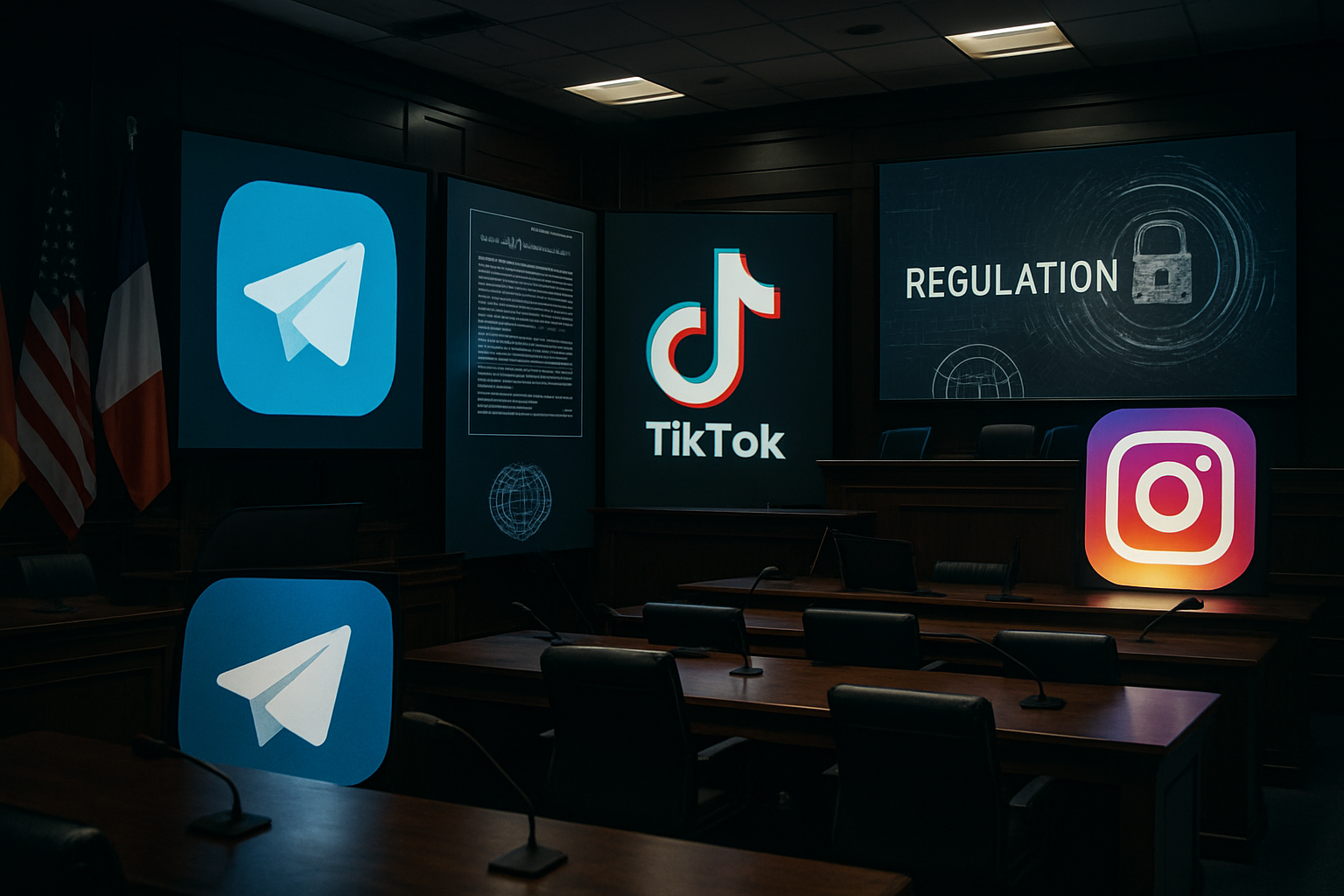
The global social media platform crisis deepened significantly on March 5, 2026, as Telegram founder Pavel Durov was banned from TikTok, while Russian regulators intensified pressure on his messaging platform with new advertising restrictions, marking another escalation in the ongoing battle between tech platforms and government oversight worldwide.
Durov's TikTok account, which had amassed over 150,000 followers since its launch in January 2026, was permanently suspended without explanation from the Chinese-owned platform. The ban comes as Russia's Federal Antimonopoly Service (FAS) declared that advertising on Telegram violates federal law, creating a dual regulatory assault on the Telegram founder's digital presence.
Durov Under Siege: TikTok Ban and Russian Pressure
The suspension of Durov's TikTok account represents a significant escalation in platform-to-platform enforcement actions. According to reports from Russian media outlet Meduza, the account showed a simple message: "Account blocked. The durov account is no longer available." Neither Durov nor TikTok representatives provided immediate commentary on the suspension.
Simultaneously, Russia's FAS announced that advertising on Telegram constitutes violations of the country's advertising legislation. "The law prohibits the distribution of advertising on information resources whose activities are recognized as undesirable on the territory of the Russian Federation, as well as access to which is restricted," the FAS stated on March 5.
"Both the advertiser and the advertising distributor bear responsibility for violations when there are grounds."
— Russian Federal Antimonopoly Service
The FAS emphasized that both advertisers and platforms face liability under the new interpretation, significantly expanding the scope of potential enforcement actions against Telegram's business model in Russia.
Australian Instagram Crisis Exposes Platform Vulnerabilities
Meanwhile, in Australia, fitness coach Jed Zimmer's case has become emblematic of the broader platform accountability crisis. The 27-year-old from the Gold Coast estimates he has lost close to $50,000 in earnings since his Instagram business account was suspended by Meta's AI system in December 2025.
Zimmer had been posting to his @the__healthproject account for six years without incident before receiving what he described as a "horrifying email" on December 22, 2025. The suspension highlights growing concerns about automated content moderation systems and their impact on legitimate business users.
"He felt sick when he woke up to the email accusing him of something vile," according to reports from 9News Australia, demonstrating how algorithmic enforcement can devastate individual livelihoods without human oversight.
Global Regulatory Revolution Reaches Critical Mass
These individual cases occur within the context of the most significant social media regulatory wave in internet history. The crisis has evolved from isolated national responses to coordinated international enforcement targeting platform design, content moderation, and executive accountability.
Spain continues to lead the regulatory revolution with its world-first criminal executive liability framework, creating personal imprisonment risks for tech executives beyond traditional corporate penalties. The Spanish model has spread across Europe, with Greece implementing its "Kids Wallet" system for under-15 restrictions, while France, Denmark, and Austria conduct formal consultations on age-based social media bans.
Australia's under-16 social media ban has already eliminated 4.7 million teen accounts since December 2025, proving the technical feasibility of large-scale platform restrictions. The success of the Australian model has encouraged other nations to pursue similar measures.
Scientific Evidence Drives Policy Changes
The regulatory momentum is supported by mounting scientific evidence about social media's impact on children and adolescents. Dr. Ran Barzilay's research at the University of Pennsylvania demonstrates that early smartphone exposure before age 5 causes persistent sleep disorders, cognitive decline, and weight problems extending into adulthood.
Current statistics reveal the scope of the problem: 96% of children aged 10-15 use social media, with 70% experiencing harmful content exposure and over 50% encountering cyberbullying. Large-scale studies show that children spending four or more hours daily on screens face a 61% increased risk of depression through sleep disruption and decreased physical activity.
University of Macau research has definitively proven that short-form video consumption damages cognitive development, causing social anxiety and academic disengagement. The more students consume short-form videos, the less they engage with educational activities, creating a direct correlation between platform usage and academic performance decline.
Platform Design Under Scrutiny
The European Commission's findings against TikTok for Digital Services Act violations have established a legal framework for challenging "addictive design" features. The Commission identified unlimited scrolling, autoplay functionality, and personalized recommendation systems as elements that prioritize engagement over user wellbeing.
TikTok faces potential penalties of 6% of global revenue—potentially billions of euros—for these violations. The platform has "categorically" rejected the findings as "fundamentally flawed" and promised vigorous legal challenges, but the precedent has been established for regulatory intervention in platform design.
Instagram CEO Adam Mosseri's recent testimony distinguished between "clinical addiction" and "problematic use" of social platforms, arguing that users cannot be "clinically addicted" to Instagram. However, internal Meta documents from 2014-2015 revealed explicit company goals to increase user engagement time by double-digit percentages, contradicting public statements about user wellbeing.
Criminal Liability Revolution
Spain's criminal executive liability framework represents the most aggressive shift from corporate penalties to personal legal consequences for tech leadership. The framework creates imprisonment risks for platform executives who fail to comply with regulatory requirements, fundamentally altering the risk calculus for technology companies operating in European markets.
This approach has sparked fierce industry resistance. Elon Musk has characterized Spanish measures as "fascist totalitarian," while Pavel Durov has issued warnings about "surveillance state" implications. Government officials have used this opposition as evidence supporting the necessity of stronger regulatory intervention.
Technical Implementation Challenges
The global implementation of age verification systems faces significant technical and privacy challenges. Real age verification requires biometric authentication or identity document validation, creating comprehensive databases that privacy advocates warn could enable broader government monitoring beyond child protection purposes.
The Netherlands' Odido data breach affecting 6.2 million customers—nearly one-third of the country's population—demonstrates the vulnerabilities of centralized data repositories. This breach has heightened concerns about the security of the infrastructure governments are building for digital oversight.
Additionally, a global memory crisis with sixfold semiconductor price increases affecting Samsung, SK Hynix, and Micron has constrained the technical infrastructure needed for comprehensive age verification systems. Industry experts predict these constraints will persist until new manufacturing facilities come online in 2027.
Alternative Approaches Emerge
Not all nations have embraced the European regulatory enforcement model. Malaysia emphasizes parental responsibility through digital safety campaigns, with Communications Minister Datuk Fahmi Fadzil stressing that parents must control device access rather than relying on platforms as "digital babysitters."
Oman has implemented its "Smart tech, safe choices" education initiative, focusing on conscious digital awareness and teaching young people to recognize "digital ambushes" where attackers exploit security vulnerabilities. These approaches represent a philosophical divide between government intervention and individual agency in digital governance.
The effectiveness of different approaches remains to be seen, but the European model's emphasis on regulatory enforcement contrasts sharply with Asian strategies focused on education and awareness.
Economic and Market Implications
The "SaaSpocalypse" of February 2026 eliminated hundreds of billions in technology market capitalization amid regulatory uncertainty. Compliance costs may advantage large platforms over smaller competitors, potentially consolidating market power while raising barriers to innovation in the digital space.
Content creators like Australia's Jed Zimmer face immediate financial consequences from algorithmic enforcement decisions, while the broader creator economy grapples with platform algorithm changes designed for regulatory compliance. These changes threaten engagement-based monetization models while potentially improving user wellbeing.
Traditional gatekeepers including television networks and social media algorithms face challenges from direct creator-audience relationships, but regulatory pressures may fundamentally restructure these economic relationships.
International Coordination and Jurisdiction Shopping
The coordinated timing of European regulations is specifically designed to prevent "jurisdictional shopping," where platforms relocate operations to more permissive regulatory environments. Parliamentary approval is required across European nations throughout 2026 for coordinated year-end implementation of these measures.
This represents the most sophisticated global technology governance attempt since internet commercialization, testing whether democratic institutions can effectively regulate multinational platforms while preserving beneficial aspects of digital connectivity.
Cross-border enforcement requires unprecedented international cooperation, with complex technical and legal frameworks needed to ensure compliance across multiple jurisdictions simultaneously.
Looking Ahead: March 2026 as a Watershed Moment
The convergence of Durov's TikTok ban, Russian advertising restrictions on Telegram, and Australia's individual platform accountability crises represents a critical inflection point in global digital governance. These events demonstrate that the stakes extend far beyond regulatory debates, with real-world impacts on individual livelihoods, business operations, and democratic institutions.
Success in implementing coordinated regulatory frameworks could establish criminal liability as a global standard for platform governance, fundamentally altering the relationship between technology companies and democratic governments. Failure, however, might strengthen anti-regulation arguments and consolidate platform power beyond governmental authority.
The resolution of these ongoing conflicts will establish precedents affecting millions of children and adults globally, determining the framework for 21st-century technology governance in an era where digital and physical realities intersect in increasingly complex ways.
As governments worldwide grapple with balancing technological advancement with democratic accountability, individual rights with collective protection, and national sovereignty with international cooperation, the outcomes of March 2026's social media crisis will likely influence digital policy for decades to come.