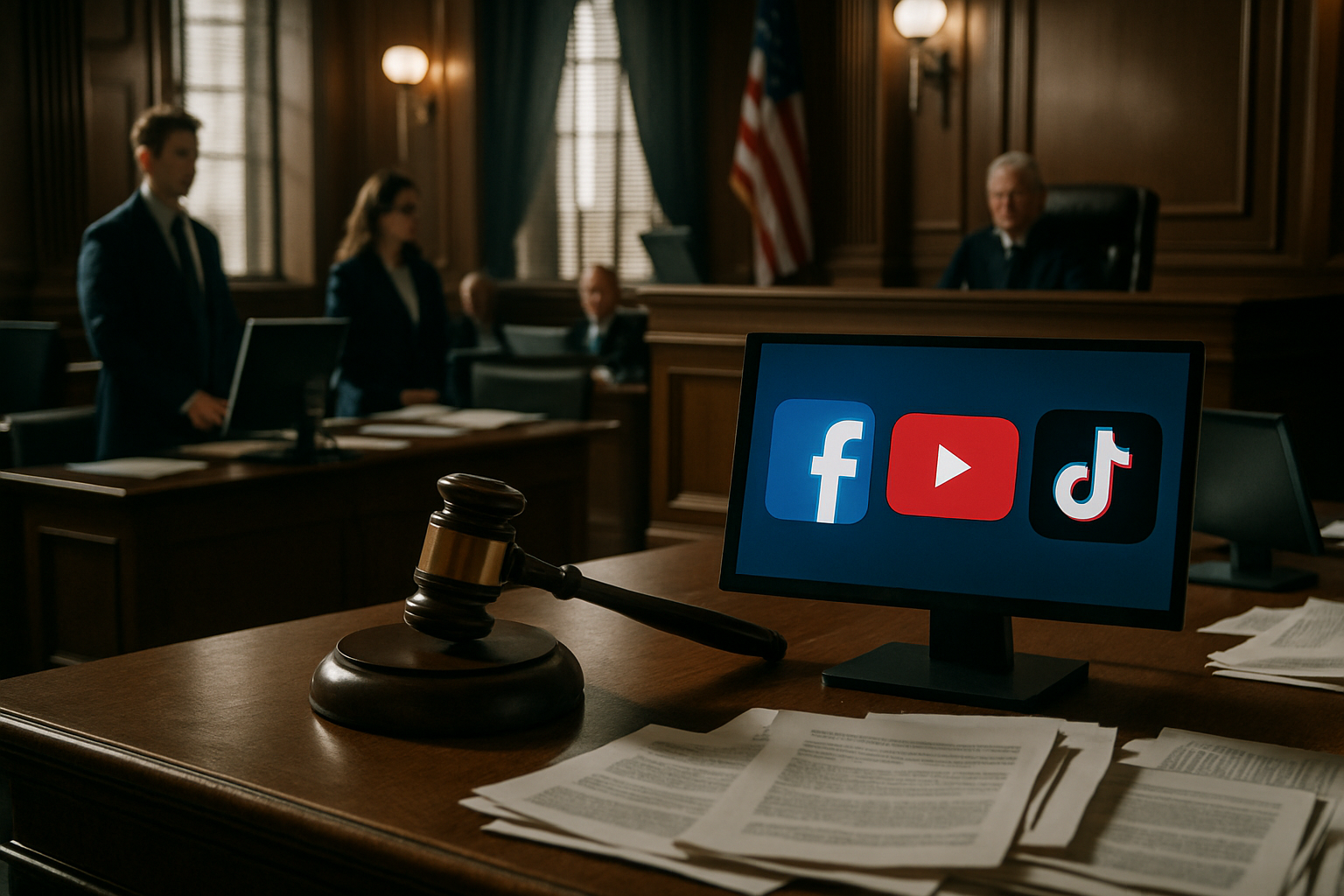
Social media giants are facing their most severe legal reckoning in history, with courts across four continents delivering devastating verdicts that challenge the fundamental business models of Meta, Google, YouTube, and other major platforms in an unprecedented wave of judicial accountability.
In what legal experts are calling a watershed moment for digital governance, multiple jurisdictions have simultaneously ruled against tech platforms for failures ranging from AI-generated harmful content to deliberate addiction-inducing design features targeting minors. The coordinated nature of these legal challenges represents the most comprehensive assault on Big Tech's traditional legal immunity since the internet's commercialization.
Historic Verdicts Reshape Platform Liability
The most significant development emerged from a Dutch court's unprecedented ruling against Elon Musk's xAI and its Grok chatbot. Amsterdam's Court issued a preliminary injunction prohibiting the platform from generating and distributing sexualized images of adults or children without explicit consent, imposing daily fines of €100,000 ($115,350) for non-compliance.
This decision, reported by Cyprus Mail, marks one of the first times a European court has directly addressed AI platforms' responsibility for non-consensual image generation. The ruling could set a crucial precedent across the European Union, where similar cases are pending against multiple tech companies.
"This represents the first direct judicial intervention in AI content generation," said legal analyst Dr. Maria Andersen. "Courts are no longer willing to treat these platforms as neutral intermediaries when they actively generate harmful content."
— Dr. Maria Andersen, Digital Rights Legal Expert
Simultaneously, German media outlets reported on groundbreaking US court decisions finding major social media platforms liable for deliberately creating addictive features targeting vulnerable users. Tagesschau characterized these verdicts as a "thunderbolt" for the entire industry, suggesting that the era of platform self-regulation may be definitively ending.
Global Regulatory Momentum Accelerates
The legal defeats come amid the most significant social media regulation wave in internet history. Portugal's RTP Notícias reported that Facebook and YouTube have been condemned in multiple proceedings initiated by users themselves, opening discussions about fundamental platform limitations and responsibilities.
These developments build on earlier breakthrough cases, including recent historic verdicts where juries found Meta and Google liable for social media addiction, resulting in combined damages of $381 million. The cases established crucial precedents holding platforms legally responsible for harm to minors through deliberately addictive design features.
Key evidence in these proceedings included internal Meta documents from 2014-2015 showing explicit goals to increase user engagement time by double-digit percentages, directly contradicting public statements about user wellbeing. Whistleblower testimony revealed that algorithms actively help predators locate children, with one expert stating: "If your interest is little girls, they will be very good at connecting you with little girls."
International Coordination Prevents Jurisdictional Shopping
The timing of these legal challenges is not coincidental. Courts and regulators across multiple jurisdictions have coordinated their efforts to prevent platforms from simply relocating operations to more permissive legal environments—a practice known as "jurisdictional shopping."
Australia's successful under-16 social media ban, which eliminated 4.7 million teen accounts in December 2025, provided a technical feasibility model for other nations. Spain has implemented the world's first criminal executive liability framework, creating personal imprisonment risks for tech executives who fail to ensure platform compliance with child safety measures.
Scientific Evidence Drives Legal Action
The wave of legal victories is supported by mounting scientific evidence about social media's impact on child development. Research by Dr. Ran Barzilay at the University of Pennsylvania shows that 96% of children aged 10-15 use social media, with 70% experiencing harmful content exposure and over 50% encountering cyberbullying.
Studies demonstrate that early smartphone exposure before age 5 causes persistent sleep disorders, cognitive decline, and weight problems extending into adulthood. Children spending four or more hours daily on screens face a 61% increased risk of depression, while University of Macau research proves that short-form video consumption damages cognitive development, causing social anxiety and academic disengagement.
"The 'perfect storm' occurs because children's reward systems are vulnerable to smartphone stimulation while impulse control remains underdeveloped until age 25."
— Austrian Neuroscience Research Team
Industry Resistance Backfires
Tech executives' aggressive opposition to regulation has paradoxically strengthened the case for judicial intervention. Elon Musk's characterization of European measures as "fascist totalitarian" and Pavel Durov's warnings about "surveillance state" implications have been cited by government officials as evidence supporting the necessity of stronger regulatory frameworks.
The "SaaSpocalypse" of February 2026 eliminated hundreds of billions in tech market capitalization amid regulatory uncertainty, demonstrating markets' recognition that the industry's traditional business models face existential challenges.
Implementation Challenges and Technical Solutions
Despite legal victories, significant implementation challenges remain. Real age verification requires biometric authentication systems, raising legitimate surveillance concerns among privacy advocates. The Netherlands' Odido breach, affecting 6.2 million customers, demonstrates the vulnerabilities of centralized databases that governments are building for digital oversight.
A global semiconductor crisis has created sixfold memory chip price increases, constraining the technical infrastructure needed for comprehensive age verification until 2027. Cross-border enforcement requires unprecedented international cooperation among legal systems with different standards and procedures.
Alternative Approaches Gain Attention
Not all jurisdictions are pursuing purely regulatory solutions. Malaysia emphasizes parental responsibility through digital safety campaigns led by Communications Minister Datuk Fahmi Fadzil, while Oman implements "Smart tech, safe choices" education programs focusing on conscious digital awareness rather than blanket restrictions.
These alternative approaches represent a philosophical divide between government intervention and individual agency in digital governance, highlighting the complexity of regulating global platforms while preserving beneficial aspects of digital connectivity.
Looking Forward: The Future of Platform Accountability
The BBC's reporting on potential UK bans for under-16 social media access suggests this legal momentum will continue accelerating throughout 2026. As one legal expert noted, "We're witnessing the end of Big Tech's legal immunity and the beginning of meaningful accountability for platform design choices."
The success of these legal challenges could trigger worldwide adoption of criminal liability frameworks for tech executives, fundamentally altering how platforms operate globally. Conversely, if appeals successfully overturn these verdicts, it might strengthen anti-regulation arguments and entrench existing business models.
March 2026 represents a critical inflection point determining whether democratic institutions can effectively regulate multinational technology platforms while preserving digital rights and innovation. The stakes extend far beyond corporate profits, encompassing fundamental questions about childhood development, democratic accountability, and human agency in an increasingly digital age.
As courts continue issuing these groundbreaking decisions, one thing becomes clear: the era of platform self-regulation is ending, replaced by an emerging framework of judicial oversight that prioritizes user wellbeing over engagement maximization. The implications of this transformation will reshape how billions of people interact with technology for generations to come.