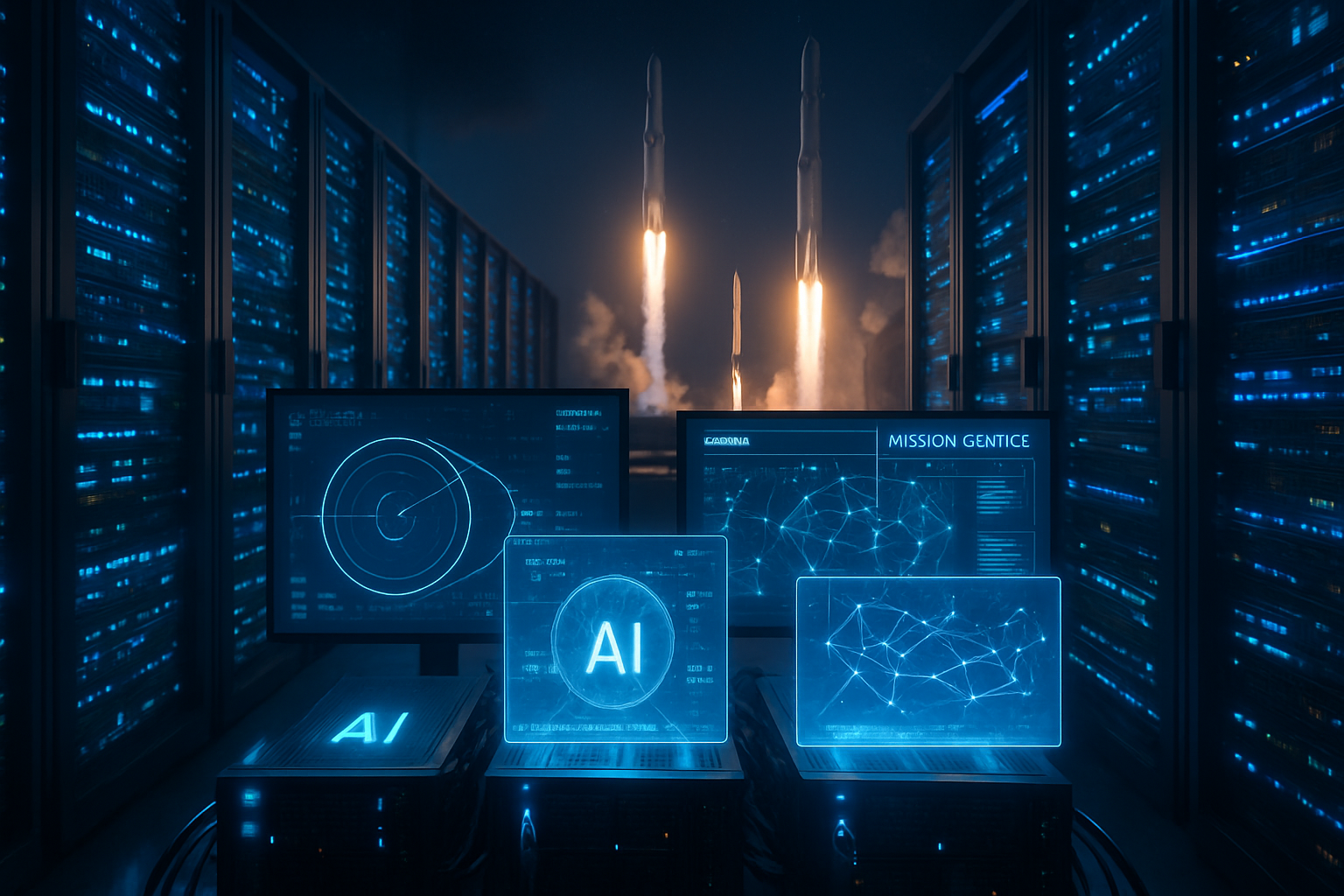
SoftBank Group Corp has announced a transformative $500 billion investment to construct the world's largest artificial intelligence data center in Ohio, coinciding with NASA's strategic expansion of SpaceX's role in lunar missions and Jeff Bezos' Blue Origin filing for a massive 51,600-satellite constellation to support space-based data centers.
The convergence of these developments represents a watershed moment in the transition from what industry analysts term the "AI revolution" to the emerging "space economy golden age," with implications extending far beyond individual corporate initiatives to reshape humanity's technological infrastructure both terrestrial and cosmic.
SoftBank's Unprecedented AI Infrastructure Investment
SoftBank Chairman Masayoshi Son unveiled the ambitious project targeting a former uranium enrichment complex owned by the U.S. Energy Department, with construction scheduled to begin sometime this year. The scale of the investment—$500 billion—represents one of the largest single technology infrastructure commitments in history, dwarfing most national space budgets and rivaling the market capitalizations of entire industries.
The project addresses critical bottlenecks in AI development, particularly the global memory crisis that has seen semiconductor prices surge sixfold, affecting major manufacturers including Samsung, SK Hynix, and Micron. This infrastructure constraint has become a limiting factor for AI advancement, making SoftBank's massive data center investment strategically crucial for maintaining technological momentum.
"This represents the largest single investment in AI infrastructure we've ever seen, positioned to address fundamental capacity constraints that have been throttling innovation across the industry."
— Industry Analysis, Technology Sector Review
NASA's Strategic Lunar Partnership Expansion
Simultaneously, NASA is reportedly reassessing its lunar exploration strategy with significant implications for major contractors. The agency appears to be reducing Boeing's traditional role in the Artemis program while substantially expanding SpaceX's involvement, reflecting growing confidence in commercial space capabilities following SpaceX's successful track record with International Space Station missions.
This shift occurs as NASA prepares for the Artemis II mission, targeting April 1, 2026 launch after resolving critical technical issues including hydrogen leak problems and helium system failures. The mission will mark humanity's return to lunar orbit with a four-astronaut international crew including Canadian Jeremy Hansen, the first Canadian beyond Earth orbit since the Apollo era ended in 1972.
The strategic realignment represents more than operational adjustments—it signals NASA's embrace of commercial space partnership models that have proven both cost-effective and technically superior to traditional government contractor approaches. SpaceX's Starship system is increasingly viewed as the future backbone of lunar transportation, capable of delivering unprecedented payload capacity to support sustained lunar presence.
Blue Origin's Orbital Data Center Vision
Adding another dimension to this technological convergence, Jeff Bezos' Blue Origin has filed with the Federal Communications Commission to launch up to 51,600 satellites designed to support space-based data centers. This ambitious constellation would leverage the company's internet infrastructure announced in January, creating orbital computing capabilities that could revolutionize data processing and storage.
The space-based approach offers unique advantages: unlimited expansion potential beyond Earth's physical constraints, continuous solar power without atmospheric interference, and no cooling requirements that consume billions of gallons of water annually for terrestrial data centers. Industry projections suggest such systems could achieve cost-effectiveness within 36 months, fundamentally altering computing economics.
Convergence of Terrestrial and Space Technologies
These developments reflect a fundamental shift in technological strategy, where Earth-based infrastructure investments like SoftBank's data center project directly enable space-based capabilities, while space technology advancement creates new possibilities for terrestrial applications. The convergence is particularly evident in AI development, where space-based processing could complement ground-based systems.
Current space exploration efforts, including the ongoing ISS Crew-12 mission featuring French astronaut Sophie Adenot's record eight-month stay, are generating crucial data about human adaptation to space environments. This research, including studies of Space-Associated Neuro-Ocular Syndrome (SANS) and lung tissue cultivation in microgravity, directly informs the design of future space-based facilities.
International Competition and Cooperation Dynamics
The timing of these announcements occurs within an intensifying international space competition landscape. China continues advancing its Shenlong reusable spacecraft program while preparing to send its first Pakistani astronauts to the Tiangong space station in October-November 2026, demonstrating space capability democratization beyond traditional space powers.
European nations are simultaneously pursuing space independence through initiatives like Germany's €10 billion SATCOMBw 4 satellite system and Isar Aerospace's Swedish facilities testing 30 rocket engines monthly. These developments create both competitive pressure and collaboration opportunities as space infrastructure becomes essential rather than experimental.
"We're witnessing the maturation of space as critical infrastructure for modern civilization, with both competitive and cooperative elements driving unprecedented innovation."
— International Space Policy Analysis
Economic and Strategic Implications
The combined value of these initiatives—SoftBank's $500 billion data center, NASA's multi-billion dollar Artemis program expansion, and Blue Origin's satellite constellation—represents hundreds of billions in coordinated technology infrastructure investment. This scale suggests a fundamental economic transition where space capabilities become integral to terrestrial economic systems.
SpaceX's preparation for a potential June 2026 IPO with valuations exceeding $1 trillion further demonstrates the commercial space sector's maturation. The convergence of massive terrestrial AI infrastructure with expanding space capabilities creates new economic models spanning Earth and space-based operations.
Addressing Global Technology Challenges
These investments directly address several converging technological challenges: the global memory crisis constraining AI development, the need for sustainable computing infrastructure, and the requirement for space-based capabilities supporting future lunar settlements and Mars exploration. The integrated approach—combining terrestrial data centers with space-based processing—offers solutions that neither approach could achieve independently.
Environmental considerations also play crucial roles. Recent Austrian research documenting atmospheric pollution from rocket debris, including tenfold lithium concentration elevation, emphasizes the need for sustainable space development practices. Space-based data centers could reduce terrestrial environmental impact while providing cleaner computing alternatives.
Future Implications for Human Civilization
The convergence of SoftBank's massive AI infrastructure investment, NASA's enhanced space exploration capabilities, and Blue Origin's orbital data center vision represents more than business strategy—it signals humanity's transition toward becoming a truly spacefaring civilization with integrated Earth-space technological systems.
Success in these initiatives could establish the foundation for permanent lunar settlements, Mars exploration missions, and space-based manufacturing that transforms human technological capabilities. The investments position key players for leadership in emerging markets projected to exceed $1 trillion by 2030, while addressing immediate constraints limiting AI advancement and space exploration progress.
As these projects advance throughout 2026 and beyond, their success or failure will largely determine whether humanity successfully navigates the transition from experimental space activities to essential space-based infrastructure supporting modern civilization's technological foundations.