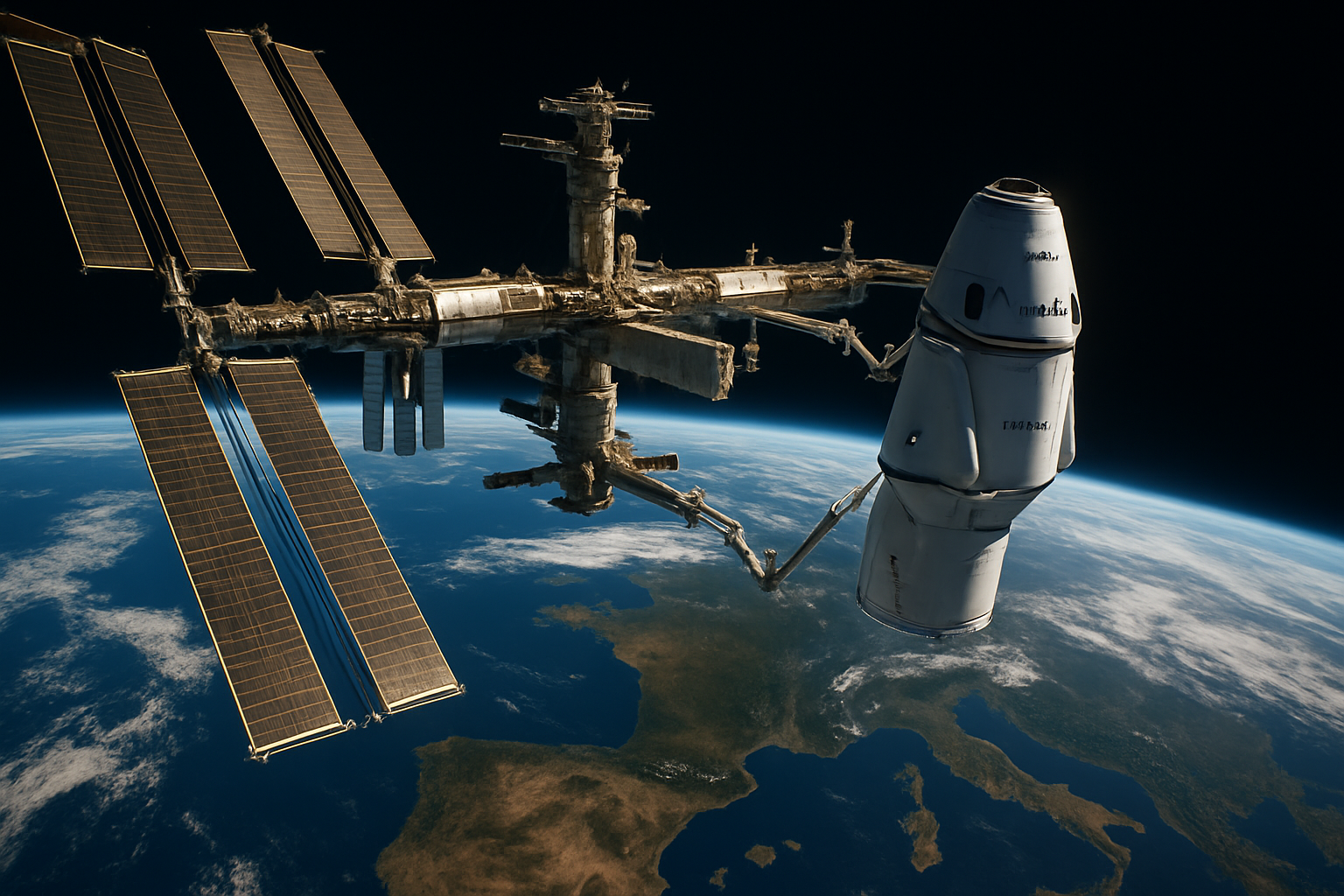
February 13, 2026, marked a watershed moment in space exploration as Sophie Adenot successfully launched aboard SpaceX's Crew-12 mission, becoming the first French woman to reach the International Space Station since Claudie Haigneré's historic journey 25 years ago, while simultaneously showcasing the expanding global landscape of scientific research and innovation.
The Crew Dragon Freedom capsule lifted off from Kennedy Space Center in Florida at 11:15 CET, carrying a diverse international crew of four astronauts to the ISS. Adenot's presence aboard the mission represents not just a personal achievement, but a symbol of the democratization of space exploration and the vital role of international scientific cooperation in advancing human knowledge.
Breaking Barriers: Adenot's Historic Journey
At 43 years old, Sophie Adenot brings a unique combination of engineering expertise and piloting experience to her role as ESA Mission Specialist. As an accomplished engineer and helicopter pilot, she represents the evolution of astronaut qualifications and the increasing recognition of diverse technical backgrounds in space exploration.
Her eight-month mission duration sets a new record for European astronauts and positions France as a renewed leader in human spaceflight. The mission comes at a critical time when the ISS requires full crew complement following an unprecedented medical evacuation that left the station operating with a skeleton crew of three.
"This mission represents France's return to crewed spaceflight after a quarter-century absence and demonstrates our commitment to international scientific collaboration."
— ESA Mission Control, Kennedy Space Center
Joining Adenot on the Crew-12 mission are Jessica Meir serving as commander, Jack Hathaway as pilot, and Russian cosmonaut Andreï Fediaïev as Mission Specialist. This international crew composition exemplifies the continued cooperation in space exploration despite terrestrial geopolitical tensions.
Scientific Renaissance Beyond Earth's Atmosphere
The timing of Adenot's mission coincides with what space industry analysts describe as the transition from the "AI revolution" to the "space economy golden age." SpaceX is preparing for a potential June 2026 IPO that could value the company at over $1 trillion, while NASA's Artemis II mission continues preparations for March 2026 despite technical delays.
The scientific focus of Crew-12 extends far beyond routine operations. The mission will conduct groundbreaking research in lung tissue cultivation, crucial for understanding how human biology responds to microgravity environments. This research directly supports future lunar settlements and Mars exploration by addressing one of the most significant challenges facing long-duration space missions.
Additionally, the crew will investigate Space-Associated Neuro-Ocular Syndrome (SANS), a condition affecting astronaut vision during extended missions. Portuguese scientists have been leading research into SANS, demonstrating how international cooperation tackles the medical challenges of space exploration.
Global Scientific Innovation Renaissance
While Adenot's mission captures headlines, parallel developments in scientific research worldwide demonstrate the global nature of innovation in 2026. Filipino scientists, as highlighted in recent studies, exemplify how researchers worldwide are contributing to state-building and national development through diverse scientific endeavors.
The Philippines has emerged as a significant contributor to global scientific discourse, with researchers exploring the intersection of personality, practicality, and policy in scientific advancement. This approach recognizes that scientists are not isolated experts but individuals who question, investigate, and contribute to societal understanding.
Recent research emphasizes that scientists in developing nations like the Philippines face unique challenges that require innovative approaches to research methodology and application. Their work demonstrates how scientific activities contribute to national development while maintaining rigorous academic standards.
"Scientists are a rare breed of experts who can genuinely think and act out of the box, yet they too are individuals who ask questions, can be skeptical, and want to lighten the mood."
— Research Analysis on Filipino Scientific Community
Technology Integration and International Cooperation
The convergence of space exploration achievements and global scientific research initiatives reflects broader trends in 21st-century innovation. NASA's recent approval of smartphone technology for space photography represents the blurring boundaries between consumer technology and professional space applications.
This technological democratization extends beyond space exploration to terrestrial research, where scientists in diverse global settings leverage both traditional methodologies and cutting-edge tools to advance human knowledge. The integration of AI systems, as demonstrated by NASA's successful autonomous Mars rover missions, shows how artificial intelligence enhances rather than replaces human scientific inquiry.
Countries worldwide are investing in space capabilities as symbols of technological sovereignty and scientific advancement. Pakistan's upcoming astronaut mission to China's Tiangong station in October-November 2026 exemplifies how space exploration has become accessible to emerging nations through international cooperation.
Challenges and Future Prospects
Despite remarkable progress, significant challenges remain in both space exploration and global scientific research. The ongoing global memory crisis, with semiconductor prices increasing sixfold, affects both space technology development and terrestrial research infrastructure.
Climate change continues to present unprecedented challenges, with January 2026 marking the hottest month on record for the 18th consecutive time exceeding 1.5°C above pre-industrial levels. This environmental pressure adds urgency to scientific research initiatives worldwide and emphasizes the importance of international cooperation in addressing global challenges.
Space medicine research, particularly studies of conditions like SANS, becomes increasingly critical as missions extend beyond Earth orbit. The eight-month duration of Adenot's mission provides valuable data for future lunar and Mars missions, where medical challenges could determine mission success.
Economic and Strategic Implications
The economic implications of current scientific advances extend far beyond individual achievements. SpaceX's strategic pivot from Mars colonization to lunar settlement within 10 years reflects pragmatic business decisions based on technical feasibility and economic viability.
The space economy's growth, combined with advances in global scientific research, creates opportunities for developing nations to participate in high-value technological sectors. Countries like the Philippines demonstrate how scientific research capacity building contributes to economic development and international competitiveness.
Investment in space infrastructure, including proposed space-based data centers, represents solutions to terrestrial challenges like the memory crisis while creating new economic opportunities. This convergence of necessity and innovation drives continued international cooperation in space exploration.
Looking Toward the Future
Sophie Adenot's mission represents more than individual achievement; it symbolizes humanity's continued commitment to exploration and scientific advancement. Her presence aboard the ISS alongside international colleagues demonstrates that space exploration remains a collaborative enterprise despite global tensions.
The broader context of global scientific research, exemplified by work in the Philippines and other developing nations, shows that innovation emerges from diverse sources worldwide. This distributed approach to scientific advancement creates resilience and ensures continued progress regardless of geopolitical challenges.
As Crew-12 conducts its research over the coming months, the mission will provide crucial data for future space exploration while contributing to our understanding of human adaptation to space environments. Simultaneously, scientists worldwide continue advancing knowledge in their respective fields, creating a comprehensive foundation for addressing 21st-century challenges.
The convergence of space exploration achievements and global scientific research initiatives in February 2026 marks a pivotal moment in human scientific endeavor. From the International Space Station to research institutions worldwide, scientists continue pushing boundaries and expanding human knowledge, ensuring that exploration and discovery remain central to human progress.