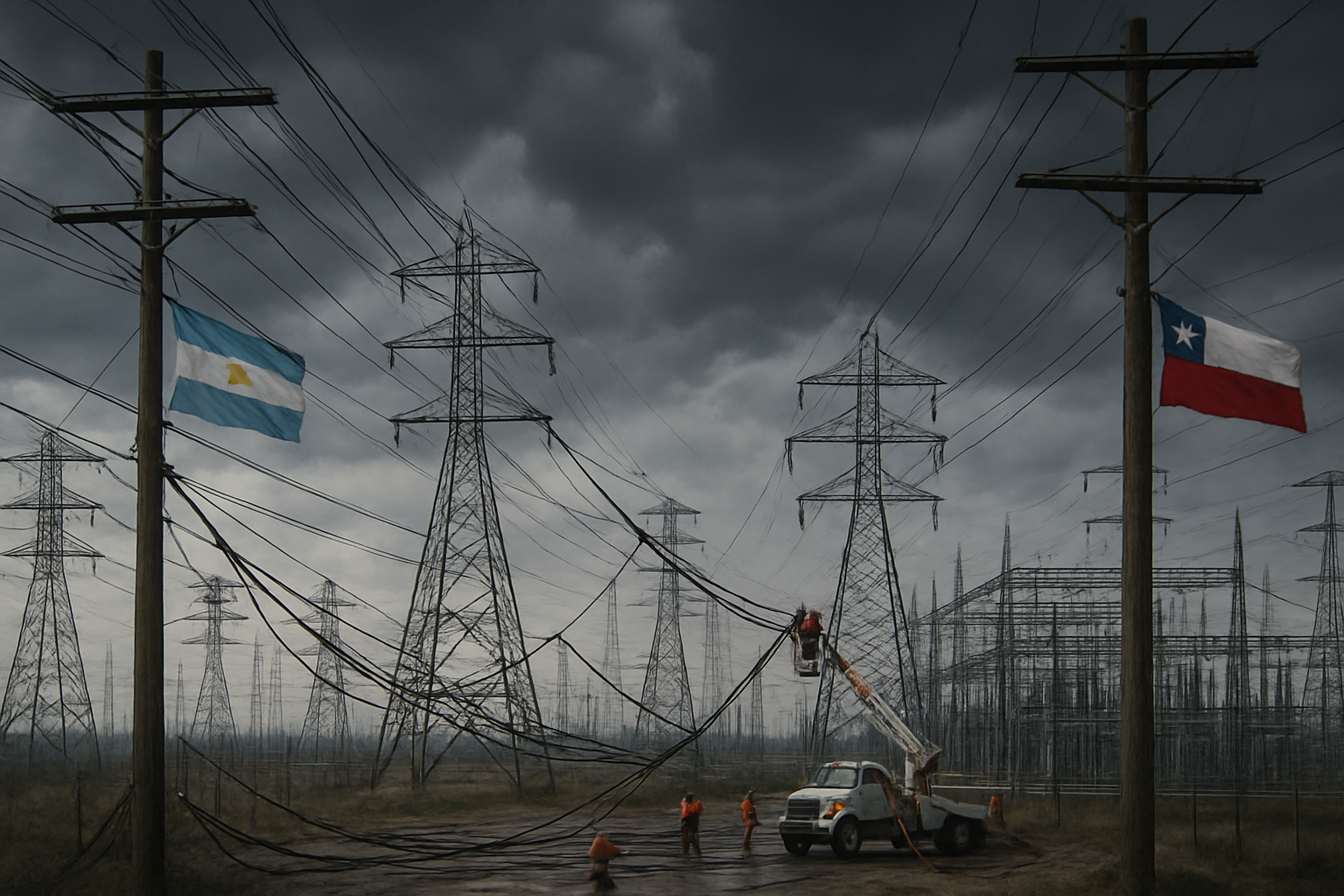
South America's electrical infrastructure is buckling under unprecedented strain, with cascading blackouts affecting millions across Paraguay, Chile, and Ecuador while Argentina accelerates controversial electricity market reforms that could reshape the continent's energy landscape.
The crisis reached a dramatic crescendo when Paraguay, experiencing scorching 40°C temperatures, plunged into darkness as 90% of the country lost power following a failure at the Yguazú substation in Alto Paraná. The cascading failure left nearly five million people without electricity, forcing hospitals to perform emergency surgeries using cell phone flashlights as makeshift lighting while traffic lights failed across the capital Asunción.
This latest blackout represents just one incident in a pattern of electrical grid failures plaguing the continent. Chile experienced its worst power outage in fifteen years on February 25, 2025, affecting 19 million people and prompting authorities to declare a state of emergency with curfews. Ecuador has endured daily power cuts lasting up to 14 hours, while Argentina, Uruguay, and Brazil have all suffered similar episodes in recent years.
Infrastructure Crisis Amid Clean Energy Success
The regional power crisis presents a stark paradox: South America generates 65% of its electricity from clean sources, yet suffers from chronic infrastructure instability that leaves millions in darkness. While the continent leads globally in renewable energy production, its transmission and distribution networks are failing to keep pace with growing demand and extreme weather events.
The Yguazú substation failure in Paraguay exemplifies the fragility of interconnected grid systems. What began as a localized technical problem quickly cascaded across the national network, demonstrating how single points of failure can cripple entire countries. The incident occurred during peak summer demand when air conditioning usage was at maximum levels, highlighting the vulnerability of aging infrastructure to extreme weather conditions.
Chile's February 2025 blackout similarly exposed systemic weaknesses, affecting not only electricity supply but also water distribution systems dependent on electric pumps. The Chilean government was forced to deploy military resources to maintain public order during the extended outage, underscoring the social and political implications of grid instability.
Argentina's Radical Market Transformation
Against this backdrop of regional infrastructure crisis, Argentina's government under President Javier Milei is advancing ambitious electricity market reforms designed to transition from state-dominated to private sector-led energy systems. The initiative aims to reduce government dependence while fostering direct contracts between generators and large consumers, significantly weakening the central role of CAMMESA, Argentina's wholesale electricity market administrator.
Energy Secretary officials have characterized the deregulation as a "normalization" of the system, enabling "generators, distributors, and large users to freely negotiate prices." Economic journalist Elizabeth Peger explains the government's vision: "the objective is for each user to contract their own energy with the company."
The reform package, outlined in Resolution SE, represents one of Latin America's most comprehensive electricity market liberalizations in decades. The government projects that open market competition will attract billions in private investment while reducing consumer costs through competitive pricing mechanisms.
"This paradigm shift toward energy independence strategy leverages Argentina's potential while reducing state intervention in market mechanisms."
— Argentine Energy Ministry Official
Regional Interconnection Challenges
The electricity crisis extends beyond individual countries to reveal fundamental problems with regional grid interconnection systems. South America's electrical networks, originally designed as national systems, struggle to provide adequate cross-border backup capacity during emergencies. When Paraguay's grid failed, neighboring countries had limited ability to provide emergency power due to insufficient transmission infrastructure.
Brazil, despite being the continent's largest economy and electricity producer, faces its own grid stability challenges. The country's vast territory and diverse energy sources create complex balancing requirements that have resulted in periodic blackouts affecting major urban centers including São Paulo and Rio de Janeiro.
Uruguay's smaller grid system makes it particularly vulnerable to disruptions from neighboring countries. When Argentina experienced major blackouts in recent years, the cascading effects crossed borders, leaving Montevideo and other Uruguayan cities without power for hours.
Climate Change and Extreme Weather Impacts
The increasing frequency and intensity of extreme weather events compound South America's electrical infrastructure challenges. Record-breaking temperatures, like the 40°C heat wave that preceded Paraguay's blackout, drive electricity demand to unprecedented levels while simultaneously stressing transmission equipment beyond design limits.
Hydroelectric facilities, which provide the majority of South America's clean electricity, face dual pressures from climate variability. Severe droughts reduce generation capacity while extreme rainfall events threaten dam infrastructure and flood electrical substations. Colombia's grid has experienced multiple failures during both drought and flood conditions, highlighting the vulnerability of hydro-dependent systems.
Argentina's reforms acknowledge these climate challenges by incentivizing private investment in grid modernization and resilience improvements. However, critics argue that market-based solutions may not adequately address the massive infrastructure investment requirements needed to climate-proof regional electrical systems.
Economic and Social Consequences
The economic impact of widespread blackouts extends far beyond immediate inconvenience. Paraguay's five-hour national blackout disrupted manufacturing operations, shut down financial systems, and forced the cancellation of commercial flights. Hospitals had to delay non-emergency procedures while relying on backup generators with limited fuel supplies.
In Chile, the 2025 blackout cost the economy an estimated $500 million in lost productivity, damaged equipment, and emergency response costs. Small businesses bore disproportionate impacts, with many lacking backup power systems or insurance coverage for electrical interruptions.
Argentina's market reforms promise to address these reliability issues through improved private sector investment incentives. The government argues that competitive markets will drive efficiency improvements and infrastructure modernization that state-controlled systems have failed to deliver.
Technology and Investment Solutions
Addressing South America's electrical infrastructure crisis requires substantial technological and financial investments. Smart grid technologies, improved weather forecasting systems, and enhanced grid interconnections represent potential solutions, but implementation costs run into hundreds of billions of dollars.
Argentina's privatization approach aims to attract international capital and expertise to modernize its electrical infrastructure. The country hopes that competitive markets will incentivize innovative solutions and efficient operations that government-controlled systems have struggled to achieve.
Regional cooperation initiatives, including plans for improved cross-border transmission capacity, could provide backup power during emergencies. However, these projects require unprecedented coordination between countries with different regulatory frameworks and economic priorities.
Future Outlook and Regional Implications
South America's electrical crisis represents a critical test of the continent's ability to maintain reliable energy systems while transitioning to renewable sources. The contrast between impressive clean energy generation statistics and frequent blackouts highlights the gap between political commitments and infrastructure realities.
Argentina's market reforms will provide a crucial test case for whether private sector-led approaches can succeed where state-controlled systems have struggled. Success could inspire similar reforms across the region, while failure might strengthen arguments for continued government involvement in critical infrastructure.
The outcomes will influence not only South America's energy future but also serve as lessons for other developing regions facing similar infrastructure challenges. With climate change intensifying extreme weather events and electricity demand continuing to grow, the urgency of finding sustainable solutions has never been greater.
The next few years will determine whether South America can build electrical systems capable of supporting economic development while providing reliable service to all citizens. The continent's clean energy resources provide a strong foundation, but translating that potential into stable, accessible electricity for 400 million people remains the defining challenge of the energy transition.