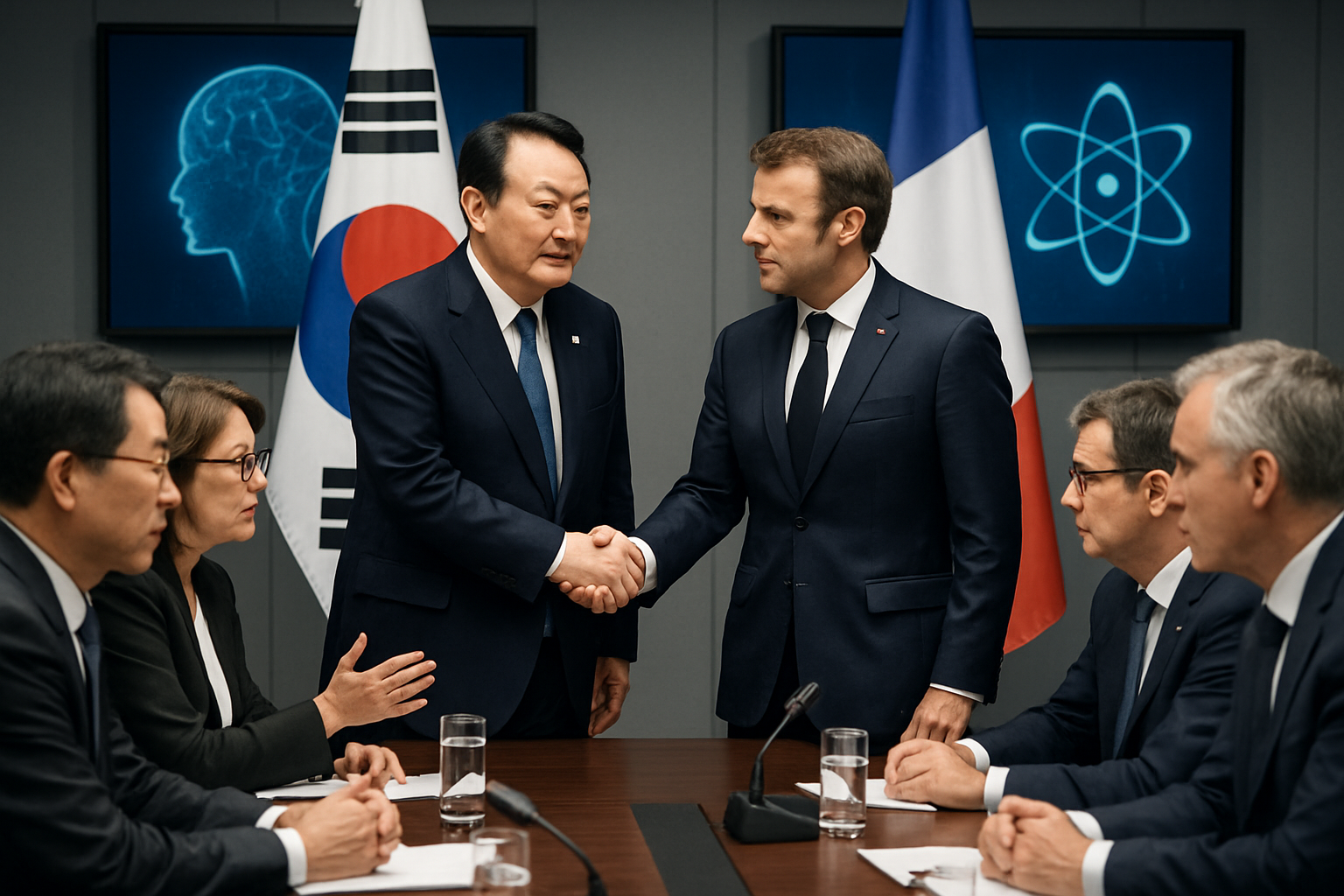
South Korean President Lee Jae-myung has called for relations with France to move beyond traditional partnerships toward comprehensive strategic cooperation focused on future industries and economic resilience, as French President Emmanuel Macron begins his state visit to Seoul on Thursday.
In remarks published by Le Figaro ahead of Macron's arrival, President Lee emphasized the potential for closer coordination between the two nations in artificial intelligence and nuclear energy sectors, describing these areas as critical for creating major economic opportunities in an increasingly competitive global landscape.
The French President's visit comes following successful diplomatic engagements in Tokyo, where Macron and Japanese Prime Minister agreed to push for reopening the Strait of Hormuz, which has been disrupted by ongoing Middle Eastern conflicts affecting global energy markets and trade routes.
Strategic Cooperation Beyond Traditional Frameworks
President Lee's vision for enhanced South Korea-France relations represents a significant evolution from conventional diplomatic partnerships. The South Korean leader specifically highlighted artificial intelligence and nuclear energy as sectors where bilateral cooperation could generate transformative economic benefits and technological advancement.
"Closer coordination between our two countries in artificial intelligence and nuclear energy could create major opportunities," Lee stated in his Le Figaro interview, signaling Seoul's commitment to deepening technological partnerships with European allies.
This strategic approach builds on South Korea's recent diplomatic momentum, including President Lee's successful Singapore summit in March 2026, which resulted in a $300 million Global AI Fund for joint artificial intelligence development with Prime Minister Lawrence Wong. That partnership demonstrated South Korea's growing leadership in AI cooperation frameworks across the Asia-Pacific region.
Technological Leadership and Innovation
The timing of Macron's visit coincides with what analysts describe as the "Therapeutic Revolution of 2026" and broader technological transformation occurring globally. South Korea has positioned itself as a crucial player in multiple advanced technology sectors, from semiconductors to artificial intelligence applications in healthcare and energy management.
France brings complementary expertise in nuclear technology and European regulatory frameworks, particularly relevant as both nations navigate energy security challenges highlighted by current global crises. France's recent announcement of nuclear arsenal expansion and European defense cooperation demonstrates its commitment to strategic autonomy, aligning with South Korea's pursuit of technological sovereignty.
The partnership discussions occur during unprecedented global semiconductor shortages, with memory chip prices increasing sixfold and affecting major South Korean manufacturers including Samsung and SK Hynix. This supply chain vulnerability underscores the importance of strategic partnerships in critical technology sectors.
Nuclear Energy Cooperation Prospects
Nuclear energy cooperation represents a particularly significant aspect of the emerging partnership. South Korea's advanced reactor technology and France's extensive nuclear expertise could create synergies addressing both nations' energy security requirements and global climate commitments.
France recently announced its most significant shift in nuclear doctrine in decades, including expansion of nuclear deterrence cooperation with European partners. Meanwhile, South Korea has demonstrated sophisticated nuclear technology management, positioning it as a valuable partner for civilian nuclear energy development and safety protocols.
This cooperation framework extends beyond bilateral benefits, potentially serving as a template for international nuclear energy partnerships emphasizing safety, sustainability, and technological innovation. Both nations have expressed commitment to responsible nuclear technology development within international regulatory frameworks.
Regional Security and Economic Context
The enhanced partnership develops against a complex regional security environment. Macron's previous stop in Tokyo, where leaders agreed on Strait of Hormuz issues, demonstrates the interconnected nature of European and Asian security concerns, particularly regarding energy transit routes and global supply chain stability.
South Korea's diplomatic approach under President Lee has emphasized middle power cooperation and strategic partnerships with technologically advanced allies. The country's recent cultural diplomacy initiatives, including successful partnerships with Southeast Asian nations, demonstrate Seoul's sophisticated approach to international engagement.
Economic resilience represents another key partnership component, with both nations seeking to reduce dependencies on single suppliers and develop alternative cooperation frameworks. This approach aligns with broader global trends toward supply chain diversification and strategic autonomy in critical technologies.
Implementation and Future Prospects
The success of expanded South Korea-France cooperation will depend on developing concrete institutional mechanisms for technology transfer, joint research initiatives, and commercial partnerships. Both nations have demonstrated capacity for sustained international cooperation across political transitions, providing foundation for long-term strategic relationships.
Regular consultations, technical working groups, and joint investment committees will likely form the framework for implementing enhanced cooperation. The partnership model could influence similar arrangements with other European and Asian partners, contributing to broader networks of technological cooperation among democratic allies.
President Lee's emphasis on moving "beyond traditional partnership" suggests Seoul's commitment to innovative diplomatic frameworks addressing 21st-century challenges through practical cooperation rather than purely symbolic agreements.
Global Implications
The South Korea-France strategic partnership contributes to evolving patterns of international cooperation prioritizing technological advancement, economic resilience, and shared values. This approach offers alternatives to dependence relationships, emphasizing mutual benefit and joint innovation capacity.
As both nations navigate complex global challenges including climate change, technological competition, and security concerns, their enhanced partnership provides a template for sophisticated middle power diplomacy. Success could influence broader international cooperation frameworks, demonstrating effective approaches to maintaining technological sovereignty while participating in global innovation networks.
The partnership represents significant potential for addressing critical global challenges through coordinated action between technologically advanced democracies, potentially serving as a model for similar cooperation initiatives worldwide.