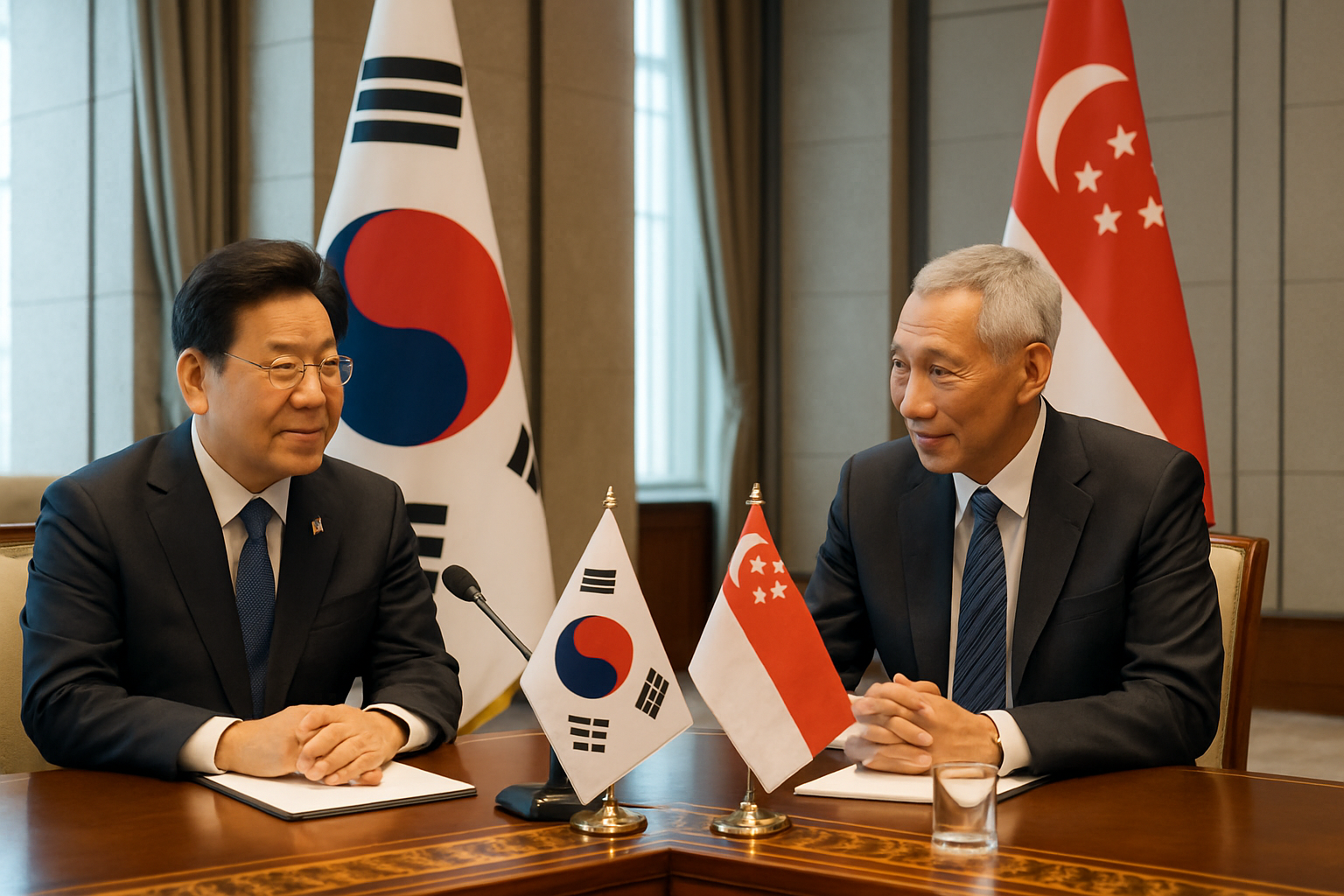
South Korean President Lee Jae Myung concluded a significant bilateral summit with Singapore Prime Minister Lawrence Wong in Singapore on March 2, 2026, focusing on artificial intelligence and nuclear energy cooperation while preparing to return to Seoul where parliament faces an emergency session on the escalating Iran crisis.
The high-stakes diplomatic engagement comes as South Korea balances its expanding technological partnerships in Southeast Asia against urgent security concerns stemming from the volatile Middle East situation following the recent US-Israeli military operations against Iran.
Strategic Partnership Expansion with Singapore
During his third day in Singapore, President Lee engaged in comprehensive discussions with Prime Minister Wong centered on deepening cooperation in cutting-edge technology sectors. The bilateral summit addressed artificial intelligence development frameworks and nuclear energy cooperation, positioning both nations as leaders in Asia's technological transformation.
The Singapore visit represents part of South Korea's broader strategy to strengthen regional partnerships amid an increasingly complex geopolitical environment. Singapore's proven leadership in AI integration—demonstrated through innovations like WonderBot 2.0 and systematic AI deployment across manufacturing, connectivity, finance, and healthcare sectors—makes it an ideal partner for South Korea's own technological ambitions.
"This partnership exemplifies South-South cooperation between emerging technology leaders rather than traditional North-South technology transfer."
— Based on bilateral cooperation analysis
President Lee's expressions of interest in learning from Singapore's real estate policies also signal deeper economic integration beyond the technology sector. This comprehensive approach reflects South Korea's determination to diversify its international relationships and leverage regional expertise for domestic development challenges.
Cultural Diplomacy and Symbolic Gestures
The visit included a notable cultural dimension with the naming of a new orchid hybrid after President Lee and First Lady Kim Hye-kyung. This symbolic gesture, while ceremonial, demonstrates the depth of bilateral relations and Singapore's commitment to honoring the South Korean leadership's visit through its renowned orchid diplomacy tradition.
Such cultural exchanges, though often overlooked, play crucial roles in cementing long-term diplomatic relationships and creating positive associations that extend beyond formal political agreements.
Parliamentary Crisis Response Preparation
While President Lee concluded his Singapore engagements, South Korea's National Assembly Foreign Affairs Committee prepared for an emergency session to address the Iran conflict situation. The parliamentary session, scheduled in response to escalating tensions in the Middle East, reflects South Korea's careful approach to managing international crises while maintaining its alliance obligations.
Before departing Singapore, President Lee activated South Korea's emergency response system under Prime Minister leadership, with Finance Minister Koo Yun-cheol warning of "heightened market volatility" due to the Middle East situation. This dual-track approach—diplomatic engagement abroad while crisis management at home—demonstrates sophisticated statecraft under pressure.
Regional Security Implications
The timing of the parliamentary session coincides with unprecedented global tensions following US-Israeli military operations in Iran and subsequent Iranian retaliation that affected multiple Gulf states. South Korea's response reflects its position as a key US ally that must balance alliance commitments with regional stability interests.
The emergency session represents South Korea's commitment to diplomatic solutions, consistent with Foreign Ministry statements urging "all parties to make utmost efforts to ease tensions" during the crisis. This measured approach contrasts with more aggressive stances from other regional powers, positioning Seoul as a stabilizing influence.
Economic and Technological Context
The Singapore summit occurs within broader context of Asia's technological renaissance, with South Korea playing a leading role alongside Singapore in developing AI governance frameworks and nuclear energy cooperation. Both nations face similar challenges from global semiconductor shortages—with memory chip prices surging sixfold affecting Samsung and SK Hynix until 2027 facilities come online.
The partnership announced during Lee's visit provides both countries with strategic advantages: Singapore gains access to South Korea's advanced manufacturing capabilities and nuclear technology expertise, while South Korea benefits from Singapore's regulatory innovation and regional financial hub status.
This technological cooperation takes on added significance given global supply chain disruptions and the need for reliable partnerships in critical technology sectors. The timing also aligns with concerns about over-dependence on single suppliers for strategic materials.
Diplomatic Balance in Multipolar Era
President Lee's Singapore visit exemplifies South Korea's sophisticated approach to navigating an increasingly complex international environment. While maintaining strong alliance relationships with the United States, Seoul continues expanding partnerships across Asia-Pacific to enhance economic opportunities and technological capabilities.
The contrast between the positive, forward-looking discussions in Singapore and the crisis management required for the Iran situation highlights the multifaceted challenges facing South Korean leadership in 2026. The ability to maintain productive international engagement while addressing urgent security concerns demonstrates mature diplomatic capabilities.
Regional Leadership Role
South Korea's approach—combining technological cooperation with crisis response—positions the nation as a responsible regional power capable of contributing to both innovation and stability. The Singapore partnership contributes to broader Asian technological integration while the parliamentary Iran session shows commitment to conflict resolution through diplomatic channels.
This dual approach reflects understanding that 21st-century diplomacy requires simultaneous engagement on multiple fronts: economic development, technological advancement, and security management. South Korea's success in balancing these priorities offers lessons for other middle powers navigating similar challenges.
Future Implications
The outcomes of both President Lee's Singapore summit and the National Assembly's Iran crisis session will have lasting implications for South Korea's international positioning. Success in technological cooperation with Singapore can catalyze broader regional partnerships, while effective crisis management regarding Iran enhances Seoul's reputation as a responsible alliance partner and regional stabilizer.
The Singapore partnership particularly represents evolution toward more diversified international relationships, reducing dependence on traditional partners while exploring new forms of cooperation suited to contemporary challenges. Nuclear energy collaboration, in particular, positions both nations to address climate change while maintaining energy security.
As President Lee returns to Seoul to address the parliamentary session, his administration faces the complex task of translating diplomatic successes into domestic benefits while managing international crisis response. The ability to achieve both objectives will test South Korean institutional capacity and leadership effectiveness during a period of unprecedented global uncertainty.
The convergence of technological opportunity and security challenges facing South Korea in early 2026 reflects broader themes in contemporary international relations, where nations must simultaneously pursue development goals and manage crisis response in an interconnected but unstable world.