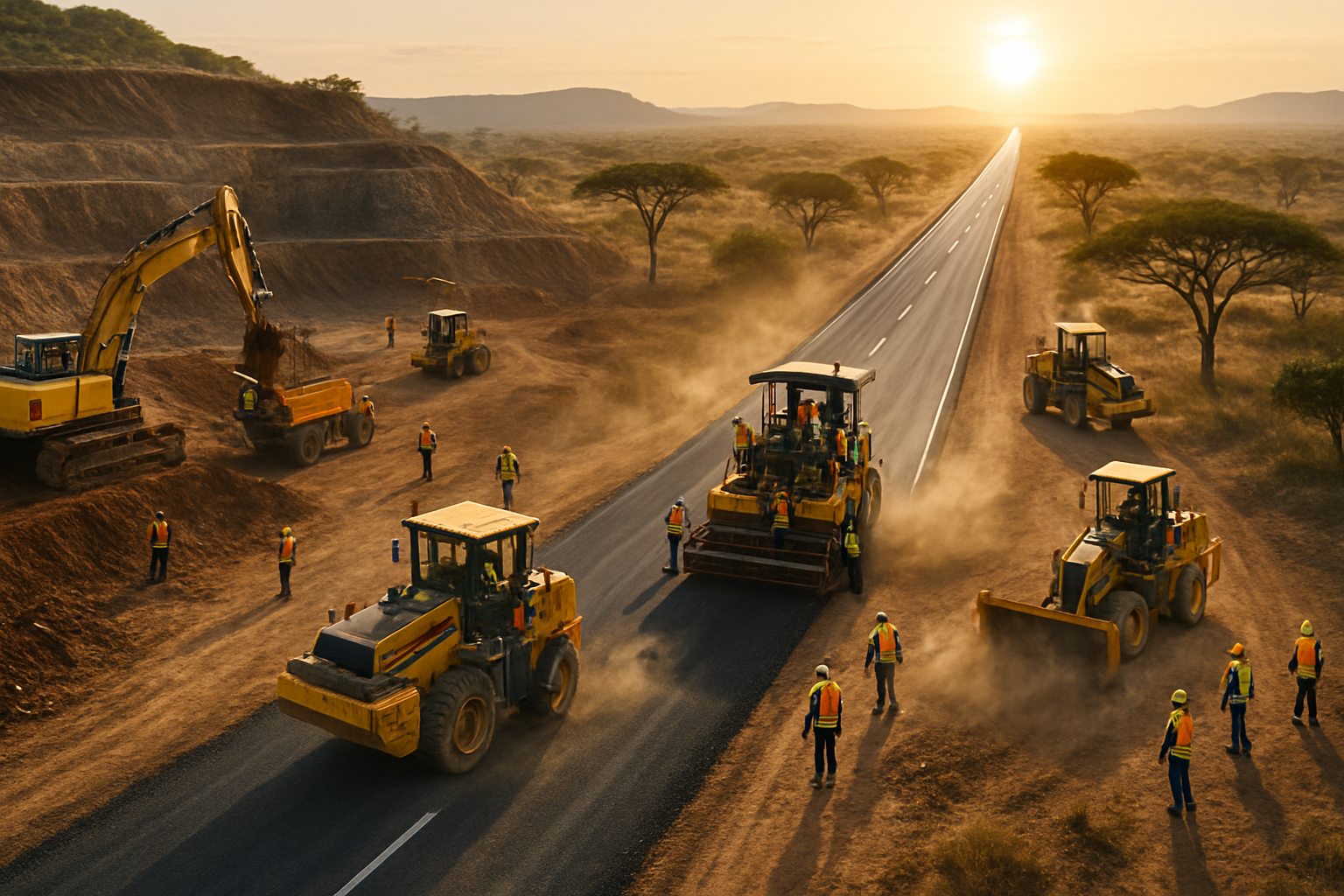
South Sudan's government has approved a groundbreaking $2 billion road construction deal backed by the country's gold reserves, marking a historic milestone in resource-backed infrastructure financing, even as mining tragedies across Africa underscore the urgent need for enhanced safety protocols in the continent's extractive industries.
The ambitious infrastructure project, approved Friday by South Sudan's Council of Ministers under President Salva Kiir's leadership, represents the largest single infrastructure investment in the young nation's history. Information Minister Ateny Wek Ateny announced that the government granted a sovereign guarantee to Shamrock Global Group to construct and upgrade more than 1,031 kilometers of strategic roads, averaging approximately $2.3 million per kilometer.
Strategic Road Network Transformation
The comprehensive project encompasses critical transportation corridors that will fundamentally reshape South Sudan's connectivity infrastructure. Key routes include the Juba–Yei–Kaya corridor, the Yei–Faraksika–Maridi connection, the Juba–Lobonok–Moli Junction pathway, and the Wau–Raja–Boro Medina route. These arterial roads are designed to enhance trade flows, improve access to remote regions, and support economic development across multiple states.
Mining Minister Lasuba Ludoru Wongo championed the proposal to use gold as collateral to secure financing, though government officials provided no details on valuation terms, repayment schedules, or oversight mechanisms. The lack of transparency has raised concerns among international observers about the potential for corruption and opaque resource management practices that have historically plagued resource-backed infrastructure schemes across Africa.
Continental Mining Safety Crisis
While South Sudan celebrates its infrastructure breakthrough, tragic events elsewhere on the continent highlight the dangerous conditions facing Africa's mining workforce. In South Africa, five diamond miners went missing Tuesday and are now presumed dead following a mudslide incident, according to authorities who confirmed the grim news Friday.
The South African tragedy reflects broader safety challenges across Africa's mining sector, which has experienced unprecedented investment growth despite persistent workplace hazards. Recent memory includes the devastating Guinea artisanal mining disaster that killed 10 women at Kondianakoro village in February, when pit walls collapsed during gold washing operations.
These incidents underscore the human cost of Africa's mining renaissance, even as the continent positions itself as a critical supplier of minerals essential for global energy transition and technological advancement.
Africa's Mining Investment Boom
The contrasts between South Sudan's ambitious infrastructure plans and ongoing mining tragedies occur within the context of Africa's extraordinary mining investment surge. The African Finance Corporation reports that Africa holds $29.5 trillion in mineral reserves—representing 20 percent of the global total—with $8.6 trillion remaining untapped despite growing international demand for critical materials.
Recent major investments demonstrate the scale of this renaissance. Ivory Coast approved 732.7 billion CFA francs ($1.2 billion) in gold mining projects, while South Africa committed R325 million to the Zandkopsdrift rare earth project. Burkina Faso achieved record 94-ton gold production in 2025, generating over $6 billion in revenue under Captain Ibrahim Traoré's resource sovereignty reforms.
Infrastructure development has paralleled mining expansion, with Algeria launching the Gara Djebilet railway to access the world's third-largest iron ore reserves, Angola reviving the Lobito Corridor to connect Atlantic ports with DRC mineral regions, and Tanzania completing feasibility studies for the 1,000-kilometer Mtwara-Mbamba Bay railway.
Geopolitical Dimensions
South Sudan's gold-backed infrastructure financing occurs as seven African countries—Angola, DRC, Guinea, Kenya, Morocco, Sierra Leone, and Zambia—participate in the US-EU-Japan Critical Minerals Partnership, designed to challenge China's dominant position controlling 60 percent of global critical mineral production and 90 percent of refining capacity.
This geopolitical competition has intensified following China's announcement of zero-tariff access for 53 African countries beginning May 1, 2026—the most comprehensive China-Africa trade expansion in history. The timing of South Sudan's infrastructure deal reflects the continent's strategic positioning between competing international partnerships while asserting greater control over natural resources.
The 32nd African Mining Indaba in Cape Town demonstrated this evolution toward continental cooperation under the theme "Stronger Together." Ghana and Botswana have emerged as pioneers of sustainable mining models that emphasize local value addition over traditional extractive approaches, setting new standards for environmental compliance and community engagement.
Implementation Challenges and Governance Concerns
Despite the ambitious scope of South Sudan's infrastructure project, significant implementation challenges remain. The government has not indicated whether environmental impact assessments have been completed, nor has it outlined specific oversight mechanisms for the gold collateral arrangement. The absence of detailed terms raises questions about debt sustainability and potential risks to the country's mineral assets.
International experience with resource-backed infrastructure financing presents mixed results. While successful projects have transformed national connectivity and economic prospects, failed schemes have resulted in asset seizures and unsustainable debt burdens. Angola's experience with Chinese infrastructure loans backed by oil revenues offers both cautionary lessons and potential templates for sustainable resource-based financing.
Continental Safety Standards Evolution
The tragic mining incidents in South Africa and Guinea highlight the urgent need for enhanced safety standards across Africa's extractive industries. Modern mining projects increasingly incorporate advanced waste management, digital monitoring systems, and comprehensive worker protection protocols, but artisanal operations often lack basic safety infrastructure.
The Democratic Republic of Congo's recent suspension of Congo Dongfang Mining for environmental violations demonstrates African governments' growing willingness to enforce regulatory standards. This represents a significant shift from traditional tolerance of violations toward active protection of both environmental and worker safety interests.
Women remain particularly vulnerable in artisanal mining operations, as evidenced by the Guinea tragedy where female miners were engaged in crucial processing activities that provide essential rural livelihoods. Addressing these safety gaps requires comprehensive approaches that combine technological solutions with community-based safety training and regulatory enforcement.
Regional Integration and Economic Impact
South Sudan's infrastructure project aligns with broader African Continental Free Trade Area (AfCFTA) objectives that require enhanced cross-border connectivity and regional value chains. The road network is expected to facilitate trade with neighboring Uganda, Kenya, and Central African Republic, potentially transforming South Sudan from a landlocked nation dependent on oil exports to a regional trade hub.
Economic multiplier effects from the infrastructure investment could extend far beyond transportation improvements. Enhanced connectivity typically catalyzes agricultural modernization, mining sector development, and service industry growth. However, realizing these benefits requires coordinated planning that addresses complementary investments in power generation, telecommunications, and institutional capacity.
The project's success will largely depend on South Sudan's ability to manage the complex relationship between immediate infrastructure needs and long-term fiscal sustainability. Gold-backed financing offers advantages including reduced reliance on traditional development aid and greater national ownership of projects, but it also requires sophisticated risk management and transparent governance frameworks.
Future Implications for African Development
The convergence of South Sudan's infrastructure ambitions with continental mining safety challenges reflects broader tensions in Africa's development trajectory. The continent's emergence as a critical global supplier of minerals essential for renewable energy and advanced technology creates unprecedented opportunities for economic transformation.
However, realizing these opportunities while protecting worker safety and environmental integrity requires fundamental advances in governance, technology adoption, and international cooperation. The success of initiatives like South Sudan's gold-backed infrastructure financing could establish new models for resource-based development that benefit local populations while engaging global markets productively.
Contemporary African development increasingly emphasizes moving beyond traditional extractive models toward comprehensive value-addition strategies that create sustainable employment, technology transfer, and regional integration. This evolution demands balancing immediate economic pressures with long-term sustainability goals through innovative financing mechanisms, enhanced regulatory frameworks, and strengthened institutional capacity.
As Africa continues its infrastructure renaissance amid ongoing mining expansion, the continent's ability to achieve both economic development and human safety will determine whether current investments become foundations for shared prosperity or perpetuate cycles of resource extraction without corresponding social benefits. The choices made in projects like South Sudan's road network and mining safety reforms across the continent will influence Africa's development trajectory for generations to come.