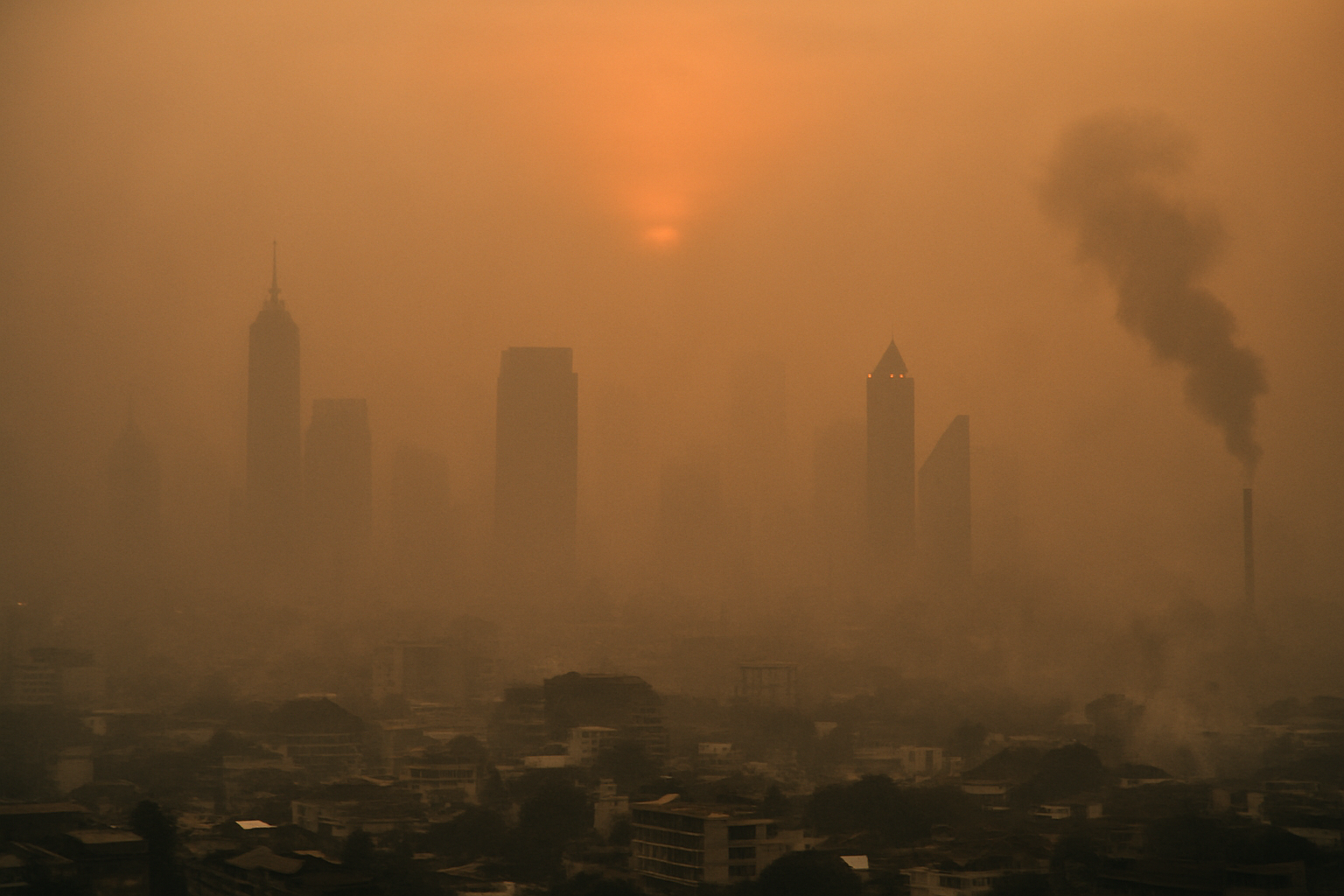
Indonesia has emerged as Southeast Asia's most polluted country, with average fine-particle pollution running at six times the World Health Organization's safe limit despite a modest 16% year-on-year improvement, according to IQAir's 2025 World Air Quality Report released this week.
The report, highlighting the region's deteriorating air quality situation, comes amid a broader environmental health crisis affecting millions across Southeast Asia, with additional incidents including mysterious marine wildlife deaths and deliberate coastal pollution threatening critical ecosystems.
Indonesia's Pollution Emergency
Despite showing improvement from previous years, Indonesia's PM2.5 levels remain at dangerous concentrations that pose significant health risks to its 270 million residents. The WHO guideline for safe PM2.5 exposure is 5 micrograms per cubic meter annually, but Indonesian cities consistently record readings well above 30 micrograms per cubic meter.
Fine particulate matter PM2.5, with particles smaller than 2.5 micrometers in diameter, can penetrate deep into lung tissue and enter the bloodstream. Prolonged exposure has been linked to cardiovascular disease, lung cancer, stroke, and premature death. Recent European Environment Agency research has also established compelling links between PM2.5 exposure and mental health problems, as these particles can cross the blood-brain barrier, triggering inflammatory responses that contribute to depression, anxiety, and cognitive decline.
"The scale of Indonesia's air pollution challenge reflects broader regional patterns where industrial development has outpaced environmental protection infrastructure," said environmental health experts tracking the crisis. "Despite measurable improvements, the levels remain dangerously high for vulnerable populations."
Regional Environmental Compound Crisis
The air pollution crisis forms part of a broader environmental emergency affecting Southeast Asia during what scientists are calling an unprecedented period of environmental stress. This comes as global temperatures have exceeded 1.5°C above pre-industrial levels for 22 consecutive months, marking the longest sustained extreme warming in recorded human history.
In New Zealand, conservation efforts are facing severe setbacks as almost 13% of the country's bee colonies were lost last winter, primarily due to varroa mite infestations. The external parasite can weaken or completely destroy entire bee colonies, threatening critical pollination services that underpin food security across the region.
Papua New Guinea has reported stranded dolphins raising alarms about ocean health, while Vietnam faces deliberate marine pollution as tons of storm debris have been dumped into coastal waters near beaches that attract 2 million tourists annually, transforming local waste management problems into widespread marine ecosystem damage.
Health Impact on Vulnerable Populations
The compounding environmental challenges disproportionately affect Southeast Asia's most vulnerable populations. Children and elderly residents face particular risks from prolonged exposure to dangerous air quality levels, with respiratory conditions, cardiovascular disease, and developmental problems linked to sustained PM2.5 exposure.
Traditional emergency response systems are being overwhelmed by the simultaneity of environmental crises. Unlike historical patterns where environmental challenges were sequential and localized, the current period presents multiple concurrent threats across vast geographic areas, challenging the capacity of regional governments to provide adequate protection for their populations.
Economic and Social Implications
The environmental crisis carries massive economic implications extending beyond immediate healthcare costs. Indonesia's air pollution affects workforce productivity, increases healthcare expenditures, and threatens the country's position as a regional economic hub. Tourism industries across Southeast Asia face long-term damage from both air quality deterioration and marine pollution incidents.
Vietnam's coastal pollution particularly threatens tourism revenue from international visitors, while New Zealand's bee colony collapse could have cascading effects on agricultural productivity and food security across the Pacific region.
Technology and Traditional Knowledge Integration
Addressing the crisis requires sophisticated integration of cutting-edge monitoring technology with traditional ecological knowledge and community-based environmental management. Advanced air quality monitoring systems provide real-time data for public health responses, while satellite tracking enables early detection of environmental threats.
However, technology alone cannot solve the complex environmental challenges. Success depends on combining scientific innovation with community engagement, traditional environmental stewardship practices, and economic incentives that make environmental protection financially viable for local populations.
International Cooperation Imperative
Environmental challenges in Southeast Asia demonstrate the critical need for unprecedented international cooperation, as atmospheric systems, ocean currents, and pollution transport effects across national boundaries regardless of political borders. Air pollution plumes from Indonesia affect neighboring countries, while marine pollution spreads through regional ocean systems.
The diversity of environmental approaches across different countries provides resilience against single-solution dependencies, offering multiple adaptation pathways for addressing complex environmental challenges that span biological, physical, and human systems.
Urgent Action Required
Environmental experts emphasize that April 2026 represents a critical juncture for regional environmental protection, with the choice between reactive crisis management and proactive ecosystem service management becoming increasingly urgent. The environmental action window is narrowing rapidly as ecological systems approach critical thresholds that could trigger irreversible changes affecting global food security, climate stability, and human settlements.
Success requires sustained international cooperation, enhanced coordination across multiple sectors and scales, and increased financial commitments that recognize environmental protection as essential infrastructure for human prosperity and planetary sustainability.
As Southeast Asia grapples with compound environmental emergencies, the region's response will likely influence global environmental protection approaches for decades to come, determining whether conservation efforts can keep pace with accelerating environmental change during this decisive climate action decade.