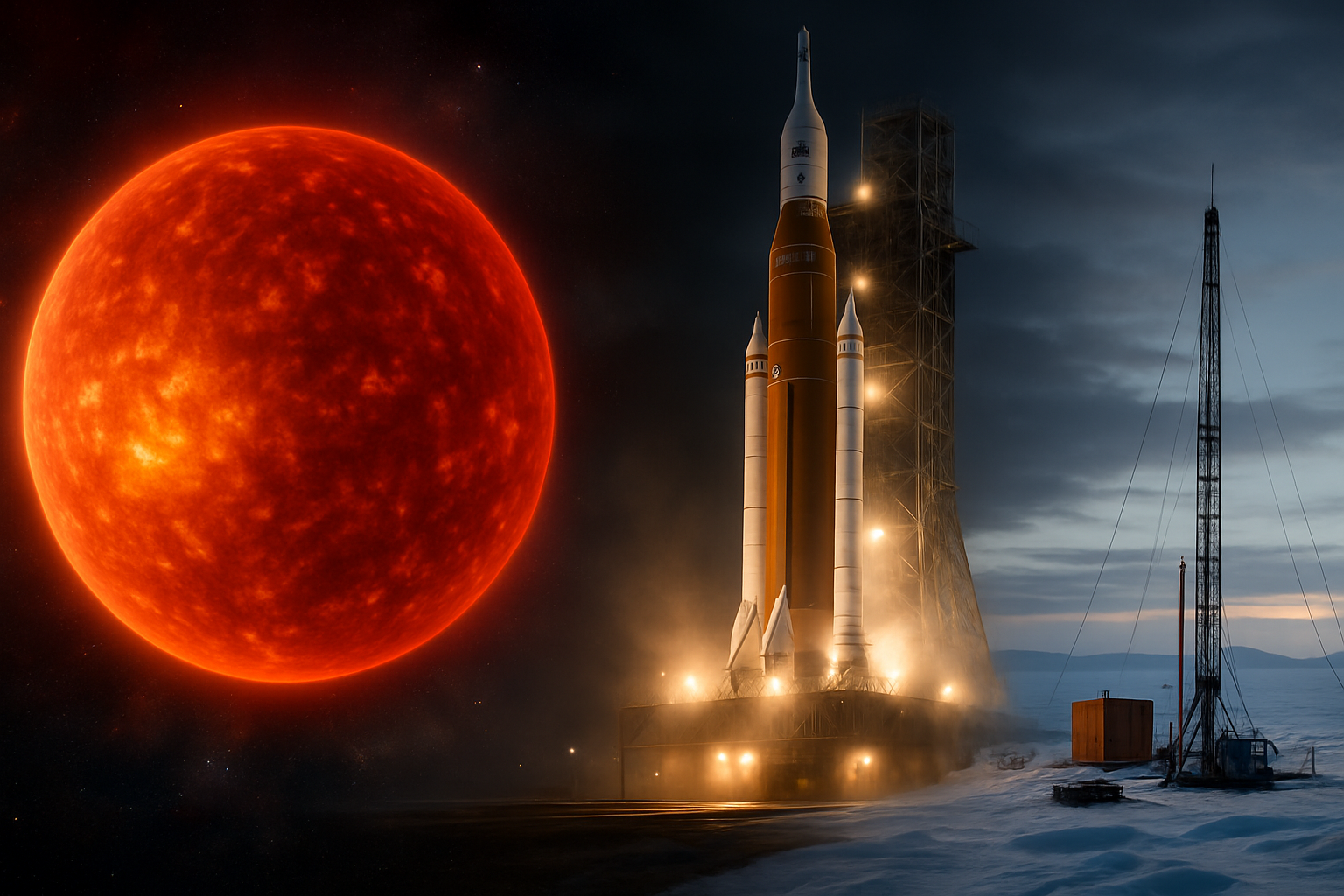
A convergence of mission postponements, stellar discoveries, and climate research breakthroughs has marked early March 2026 as a defining moment in space exploration, highlighting both the promise and persistent challenges of humanity's cosmic ambitions.
NASA's Artemis Program Faces Further Delays
NASA Administrator Jared Isaacman announced yet another postponement of the highly anticipated Artemis II lunar flyby mission, pushing the launch timeline beyond the originally scheduled March window to at least April 2026. The delay stems from critical technical failures discovered during final launch preparations, including helium system malfunctions affecting the Space Launch System (SLS) rocket's upper stage.
The four-astronaut international crew—Canadian Jeremy Hansen, NASA's Reid Wiseman (commander), Christina Koch, and Victor Glover—remains prepared for what will be the first crewed mission beyond Earth orbit since Apollo 17 in December 1972. Their planned 10-day lunar flyby covering 600,000 miles represents a crucial stepping stone toward the Artemis III lunar landing scheduled for 2027.
"Engineers at the agency identified a helium leak in one of the rocket's stages overnight. We will only launch when we believe we are ready."
— Jared Isaacman, NASA Administrator
The technical challenges center around the SLS rocket's helium system, essential for engine purging and fuel tank pressurization. At 322 feet tall and weighing 5.75 million pounds when fully fueled with over 700,000 gallons of liquid hydrogen and oxygen, the SLS represents the most powerful rocket NASA has ever built. However, persistent issues emerging consistently at T-minus 5 minutes during countdown simulations have forced the agency to prioritize crew safety over schedule adherence.
Dramatic Stellar Evolution Captured
While NASA grapples with terrestrial technical challenges, astronomical observations have revealed dramatic transformations occurring in the universe's most massive stars. Scientists have documented unprecedented changes in WOH G64, a massive star whose rapid evolution mirrors the brief but brilliant careers of legendary performers like Jimi Hendrix—burning bright and fast before their inevitable dramatic finale.
The star represents a class of cosmic giants that, despite their enormous scale, live remarkably short lives by astronomical standards. These massive stellar objects undergo rapid evolution, experiencing dramatic changes that can be observed over relatively brief periods, providing crucial insights into stellar physics and the life cycles of the universe's largest stars.
Antarctic Climate Archive Unlocked
In a breakthrough that could reshape future climate predictions, Greek scientists have successfully drilled deep beneath Antarctica's ice sheets, recovering geological records spanning 23 million years. This ancient climate archive provides unprecedented data about Earth's atmospheric and oceanic systems over geological timescales.
The research team's findings could fundamentally alter predictions for future sea level rise, as the recovered data reveals complex patterns of ice sheet behavior during past climate cycles. The geological record hidden beneath Antarctica's frozen surface contains information about atmospheric composition, temperature variations, and ice sheet dynamics that occurred millions of years before human civilization.
Potential Lunar Impact Threat Identified
Egyptian space monitoring agencies have detected a concerning astronomical development: a potential collision scenario involving the Moon scheduled for 2032. While the probability remains low, the potential consequences could be significant, highlighting the ongoing need for comprehensive space surveillance and planetary defense capabilities.
This development underscores the importance of continued astronomical monitoring and the expansion of planetary defense systems. The identification of this potential threat demonstrates the sophistication of modern space surveillance networks and the critical importance of international cooperation in monitoring cosmic hazards.
International Space Economy Momentum
Despite technical setbacks affecting major government programs, the commercial space economy continues its rapid expansion. SpaceX maintains preparations for its potentially trillion-dollar IPO scheduled for June 2026, while international cooperation expands through initiatives including Pakistan's astronaut candidates selected for China's Tiangong station missions planned for October-November 2026.
The contrast between NASA's methodical safety-first approach to the Artemis program and the rapidly advancing commercial space sector illustrates the industry's dual nature during this transitional period. While government programs prioritize comprehensive safety protocols, commercial entities drive innovation through rapid iteration and technological advancement.
Space Medicine Research Advances
Critical research continues aboard the International Space Station, where astronauts are conducting essential studies on Space-Associated Neuro-Ocular Syndrome (SANS) and lung tissue cultivation in microgravity environments. These investigations provide fundamental data for planning sustained human presence on the Moon and eventual Mars missions.
The ongoing ISS research, including Sophie Adenot's record eight-month European mission, contributes crucial medical knowledge for deep space exploration. Understanding how extended spaceflight affects human physiology remains essential for mission planning beyond Earth orbit, particularly as space agencies prepare for permanent lunar settlements and interplanetary travel.
Looking Forward: The Space Economy Golden Age
These developments occur during what analysts describe as the transition from the "AI revolution" to a "space economy golden age." The convergence of artificial intelligence capabilities, international cooperation, and expanding commercial space activities positions 2026 as a watershed year for space exploration despite persistent technical challenges.
The methodical approach demonstrated by NASA's Artemis delays reflects institutional maturity gained from decades of experience, prioritizing crew safety over schedule pressures. This conservative methodology, while causing frustration among space enthusiasts, builds long-term confidence in deep space transportation systems essential for humanity's expansion beyond Earth.
As the space industry navigates these challenging early months of 2026, the fundamental question remains whether the momentum of commercial innovation and international cooperation can overcome the technical hurdles that continue to plague ambitious exploration programs. The coming months will prove crucial in determining the trajectory of humanity's cosmic future.