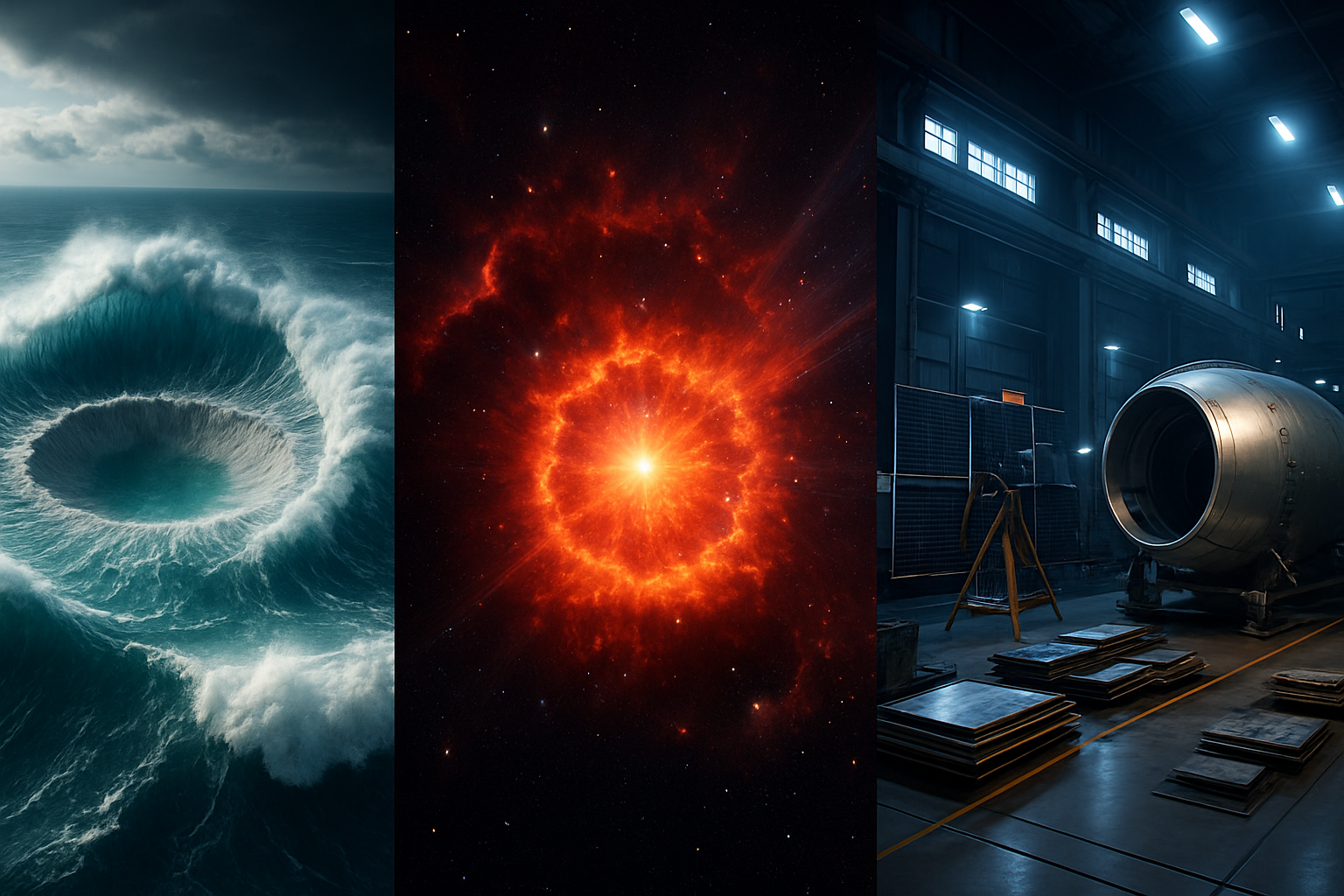
Three groundbreaking discoveries spanning ancient asteroid impacts, stellar formation processes, and advanced space materials have emerged simultaneously, marking March 2026 as a watershed moment in astronomical and space technology advancement during what experts call the "golden age of space observation."
Researchers from Heriot-Watt University confirmed that the Silverpit crater, a massive structure buried beneath the North Sea floor, represents evidence of a catastrophic asteroid impact that generated mega-tsunamis reaching heights of 106 meters. This revelation adds to mounting evidence of Earth's violent cosmic history while informing modern planetary defense strategies.
Simultaneously, astronomers achieved the unprecedented feat of observing the birth of a supergiant star through massive supernova explosions, opening new pathways for understanding extreme stellar phenomena. The observation enables scientists to examine the "engine" behind these cosmic events with detail never before possible.
Ancient Catastrophe Reveals Planetary Defense Lessons
The Silverpit crater discovery represents more than geological curiosity—it provides crucial insights into the destructive potential of asteroid impacts and the long-term consequences for planetary environments. Located beneath the North Sea, this buried structure bears witness to an ancient cosmic collision that reshaped regional geography and likely influenced evolutionary patterns through massive environmental disruption.
The research builds on NASA's growing concern about planetary defense gaps, with approximately 15,000 undetected "city-killer" asteroids over 140 meters in diameter remaining untracked by current detection systems. Dr. Kelly Fast, NASA's Planetary Defense Coordination Officer, has emphasized that Earth remains "completely defenseless" against these medium-sized threats capable of destroying entire metropolitan areas.
"These discoveries remind us that asteroid impacts are not theoretical threats—they are inevitable events that have shaped Earth's history and will continue to pose risks to human civilization."
— Dr. Kelly Fast, NASA Planetary Defense Coordination Officer
The successful DART mission demonstration in 2022, which altered the orbit of asteroid Dimorphos, proved that kinetic impactor techniques can work in practice. This achievement represents a historic milestone demonstrating humanity's capability to prevent extinction-level cosmic impacts, providing confidence for expanded asteroid monitoring and deflection programs.
Stellar Birth Through Cosmic Violence
The astronomical breakthrough documenting supergiant star formation through supernova explosions challenges traditional understanding of stellar evolution. These massive stellar objects undergo rapid evolution observable over relatively brief cosmic periods, providing crucial insights into the universe's most energetic processes.
The observation opens entirely new avenues for understanding how the universe's largest stars form through catastrophic events, revealing the complex mechanisms behind stellar nurseries and the role of explosive phenomena in cosmic architecture. This discovery joins recent astronomical achievements including the detection of cosmic rays in the Barnard 68 nebula 400 light-years away and the identification of complex organic molecules in interstellar space.
International cooperation through shared space telescope facilities, particularly the James Webb Space Telescope's revolutionary infrared capabilities, continues enabling these breakthrough observations. The telescope's position at the L2 Lagrange point provides unprecedented views of cosmic phenomena previously invisible to ground-based instruments.
Revolutionary Spacecraft Materials Transform Industry
The Slovenian Steel Group (SIJ) has achieved a critical breakthrough in space-grade materials, developing high-tech steel specifically engineered for the demanding environment of space exploration. The company has already supplied over 500 tonnes of specialized material to an undisclosed client for key structural components of a spacecraft expected to launch soon.
This development represents a significant advancement in space manufacturing capabilities, addressing fundamental challenges in spacecraft construction. As every spacecraft relies heavily on steel components, the breakthrough positions specialized metallurgy as a crucial link in the expanding space economy supply chain.
"This breakthrough proves SIJ Group, with its subsidiaries SIJ Metal Ravne and SIJ Acroni Jesenice, is a capable partner in research and development projects and plays an important role in the most demanding technological segments of global industry."
— Jernej Močnik, CEO of SIJ Metal Ravne
The space technology sector represents an upgrade from aviation and nuclear industries where SIJ has built extensive experience. Steel remains a fundamental material for spacecraft construction, making advanced metallurgical capabilities essential for the expanding commercial space sector projected to exceed $1 trillion by 2030.
Convergence During Space Economy Golden Age
These discoveries occur during what analysts describe as the transition from the "AI revolution" to the "space economy golden age." SpaceX's preparation for a potential June 2026 IPO valuing the company over $1 trillion exemplifies the commercial space sector's explosive growth, while international cooperation continues advancing through programs like the International Space Station and emerging partnerships.
The development of sophisticated space-grade materials directly supports expanding launch capabilities, with companies like Germany's Isar Aerospace constructing facilities in Sweden capable of testing 30 rocket engines monthly. European space independence initiatives complement American commercial space leadership while emerging nations including Pakistan, Thailand, and Paraguay develop indigenous space capabilities.
AI integration revolutionizes space operations through autonomous navigation systems that enabled NASA's fully AI-planned Mars rover missions in December 2025. These technological advances reduce Earth-based control dependence and enable real-time decision-making across cosmic distances, essential for future lunar settlements and Mars exploration.
Medical and Scientific Research Advancement
Concurrent space medicine research addresses critical challenges for extended human space presence. The ongoing study of Space-Associated Neuro-Ocular Syndrome (SANS), which affects astronaut vision during prolonged missions, represents essential preparation for lunar bases and Mars colonization efforts.
Portuguese scientists lead breakthrough SANS research while ISS Crew-12, featuring French astronaut Sophie Adenot on a record eight-month mission, conducts lung tissue cultivation studies crucial for understanding microgravity effects on human biology. These medical advances directly inform protocols for sustainable human presence beyond Earth orbit.
International Cooperation and Competition
The space sector demonstrates complex dynamics combining unprecedented international cooperation with intensifying competition. While NASA continues partnerships with ESA, Roscosmos, and other agencies through ISS operations, competitive dynamics emerge in reusable spacecraft development, lunar exploration capabilities, and satellite infrastructure deployment.
China's fourth Shenlong spacecraft launch represents advancing reusable technology capabilities, while Pakistan's selection of astronaut candidates for the Chinese Tiangong station demonstrates space access democratization. Thailand's appointment as UN space governance chair reflects emerging nations' growing influence in space policy frameworks.
Future Implications and Strategic Significance
The convergence of ancient impact studies, stellar formation observations, and advanced materials development establishes March 2026 as a pivotal moment for human space capabilities. Understanding prehistoric catastrophes informs modern planetary defense while stellar birth observations expand knowledge of cosmic evolution processes.
Advanced spacecraft materials enable the infrastructure necessary for sustained space economy growth, supporting everything from satellite constellations to eventual lunar manufacturing facilities. The combination of historical geological insights, cutting-edge astronomical observations, and practical materials engineering represents the interdisciplinary approach essential for humanity's transition to a spacefaring civilization.
These developments occur within the broader context of climate urgency, with January 2026 marking the 18th consecutive month exceeding 1.5°C pre-industrial temperature levels. Space-based capabilities for climate monitoring, disaster response, and potential resource access become increasingly critical for addressing terrestrial challenges while expanding human presence beyond Earth.
The successful integration of scientific discovery, technological innovation, and international cooperation during this period suggests 2026 represents a watershed year for human cosmic presence, establishing foundations for next-generation space exploration and the maturation of space-based economic systems essential for long-term human development.