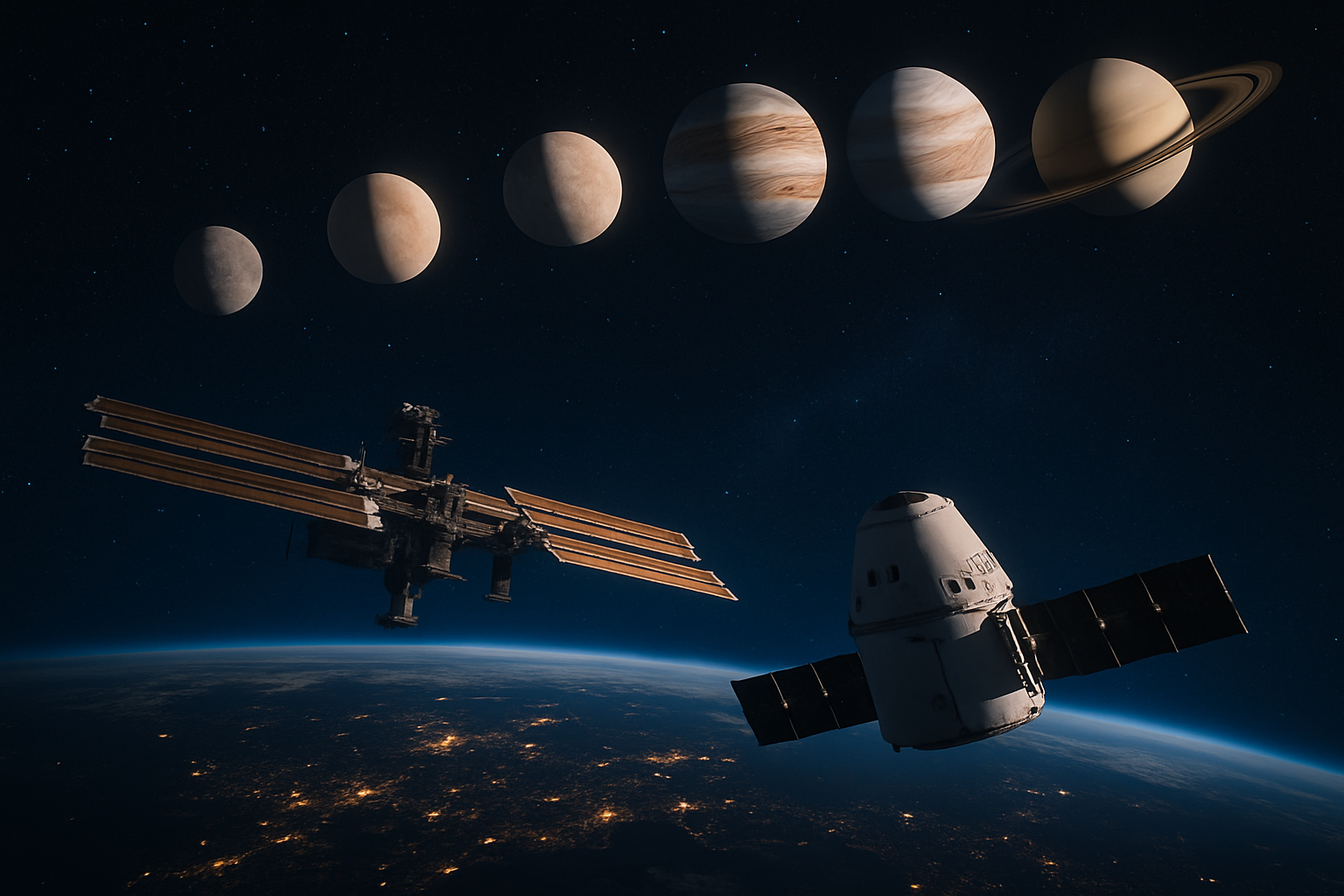
February 2026 has emerged as a watershed month for space exploration and astronomical observation, with a spectacular six-planet alignment, historic international space missions, and unexplained atmospheric phenomena capturing global attention as humanity's presence in space reaches new milestones.
The convergence of these celestial events and human achievements reflects a remarkable period where ancient cosmic mechanics intersect with cutting-edge space technology, while international cooperation in space reaches unprecedented levels despite earthbound tensions.
Spectacular Six-Planet Alignment Dominates February Skies
Italian astronomers are preparing for what they describe as one of February's most spectacular celestial shows: a rare alignment of six planets visible to observers across the globe. The phenomenon, scheduled to reach peak visibility on February 28, will present Mercury, Venus, Mars, Jupiter, Saturn, and Uranus in a distinctive "dance" formation across the night sky.
This extraordinary alignment occurs when the orbital mechanics of multiple planets bring them into apparent proximity from Earth's perspective, creating a visual spectacle that captivates both professional astronomers and casual stargazers. Such comprehensive six-planet alignments are relatively rare, making this event particularly significant for astronomical observation and education.
The alignment coincides with other astronomical highlights, including a solar eclipse that will be visible through digital streaming for global audiences, demonstrating how modern technology democratizes access to cosmic events previously limited to specific geographic locations.
Historic French Return to Space Station
In a milestone achievement for European space exploration, French astronaut Sophie Adenot successfully launched aboard SpaceX Crew-12 mission on February 13, becoming the first French female astronaut to reach the International Space Station and marking France's return to crewed spaceflight after a 25-year absence.
The 43-year-old engineer and helicopter pilot embarked on what will be a record-breaking eight-month mission—the longest duration ever undertaken by a European astronaut. Adenot's mission represents a critical crew rotation that restores the ISS to its full seven-person complement following an unprecedented medical evacuation that had left the station operating with a skeleton crew of three.
"This mission represents not just France's return to space, but Europe's growing capabilities in human spaceflight as we prepare for the next generation of lunar and Mars exploration."
— European Space Agency Official
The Crew-12 mission launched with an international crew including Jessica Meir as commander, Jack Hathaway as pilot, and Russian cosmonaut Andrey Fedyaev as Mission Specialist. The mission's scientific focus includes crucial lung tissue cultivation research in microgravity, providing essential data for future long-duration space missions to the Moon and Mars.
Scientific Research Priorities
Adenot's extended mission duration enables comprehensive research into the effects of prolonged microgravity exposure on human physiology, particularly addressing Space-Associated Neuro-Ocular Syndrome (SANS), which affects astronaut vision during extended missions. This research directly supports planning for future lunar settlements and Mars exploration missions, where crew members may spend years away from Earth.
Mysterious Atmospheric Phenomena Over Lithuania
Lithuanian aviation authorities issued unprecedented warnings to pilots on Friday evening regarding navigational anomalies characteristic of balloon activity, creating intrigue about unusual atmospheric phenomena in the Baltic region. The warnings, distributed to aircraft approaching Lithuania, highlighted distinctive radar signatures that prompted heightened alertness among aviation professionals.
While official details remain limited, the incident underscores the complex intersection between civilian aviation, atmospheric monitoring, and the increasing sophistication of aerial surveillance systems across Eastern Europe. Such warnings are typically issued when atmospheric conditions or aerial objects could potentially interfere with standard navigation systems.
The timing of these atmospheric observations coincides with increased space-based monitoring activities globally, as nations expand their capabilities for tracking both natural and artificial phenomena in Earth's atmosphere and near-Earth space.
Global Space Industry Transformation
These February developments occur within the broader context of what experts describe as the transition from the "AI revolution" to the "space economy golden age." SpaceX continues preparations for a potential June 2026 IPO that could value the company at over $1 trillion, while the recent $1.25 trillion SpaceX-xAI merger signals unprecedented integration of artificial intelligence with space infrastructure.
The space industry is experiencing remarkable democratization, with emerging nations gaining independent space capabilities. Pakistan has selected candidates for its first astronaut mission to China's Tiangong space station scheduled for October-November 2026, while countries across Africa, Asia, and Latin America develop indigenous satellite programs and space research initiatives.
Technical Challenges and Achievements
Despite remarkable progress, the space industry faces ongoing technical challenges. NASA's Artemis II lunar mission continues experiencing delays due to persistent hydrogen leak issues, now pushed to March 2026. However, the program represents humanity's return to deep space exploration, with the first crewed mission beyond Earth orbit since Apollo 17 in 1972.
Simultaneously, breakthrough achievements continue emerging. NASA's Mars rover program achieved a historic milestone in December 2025 with the first fully AI-planned mission, demonstrating autonomous navigation capabilities crucial for future Mars exploration when communication delays make real-time Earth control impossible.
International Cooperation and Competition
The current space environment reflects a complex balance between international cooperation and strategic competition. While the ISS continues serving as a symbol of peaceful collaboration among nations—including the United States, Russia, European partners, and others—competitive dynamics intensify in areas like lunar exploration, satellite constellations, and space-based infrastructure development.
China's advancement of the Shenlong reusable spacecraft program, European expansion of rocket testing facilities in Sweden, and multiple nations developing independent launch capabilities demonstrate the global scope of space competition. Yet scientific cooperation continues through shared missions, data exchange, and collaborative research programs.
The UN has established new governance frameworks for space activities, with Thailand appointed to chair critical committees addressing space technology regulation and international cooperation standards. These developments reflect growing recognition that space activities require coordinated international oversight to ensure peaceful and sustainable development.
Future Implications and Cosmic Context
February 2026's space developments occur against the backdrop of broader astronomical discoveries that continue expanding human understanding of the universe. Recent breakthroughs include the detection of cosmic rays in distant nebulae, discovery of the largest sulfur-containing organic molecules in interstellar space, and new insights into Jupiter's composition from ongoing Juno mission data.
These scientific advances complement practical space exploration achievements, creating a comprehensive picture of humanity's expanding cosmic presence. From the International Space Station conducting cutting-edge research 400 kilometers above Earth to space-based telescopes observing galaxies billions of light-years away, February showcases the full spectrum of human space capabilities.
The convergence of spectacular natural phenomena like the six-planet alignment with human achievements in space exploration provides a powerful reminder of humanity's place in the cosmos. As we develop the technological capability to explore and potentially inhabit other worlds, events like planetary alignments connect us to the fundamental astronomical processes that have shaped our solar system for billions of years.
Looking forward, the achievements and phenomena of February 2026 establish a foundation for even more ambitious space exploration goals. With lunar missions planned for 2027, Mars exploration programs advancing, and space-based infrastructure expanding rapidly, this month may be remembered as a pivotal moment when humanity's space age truly began reaching maturity.