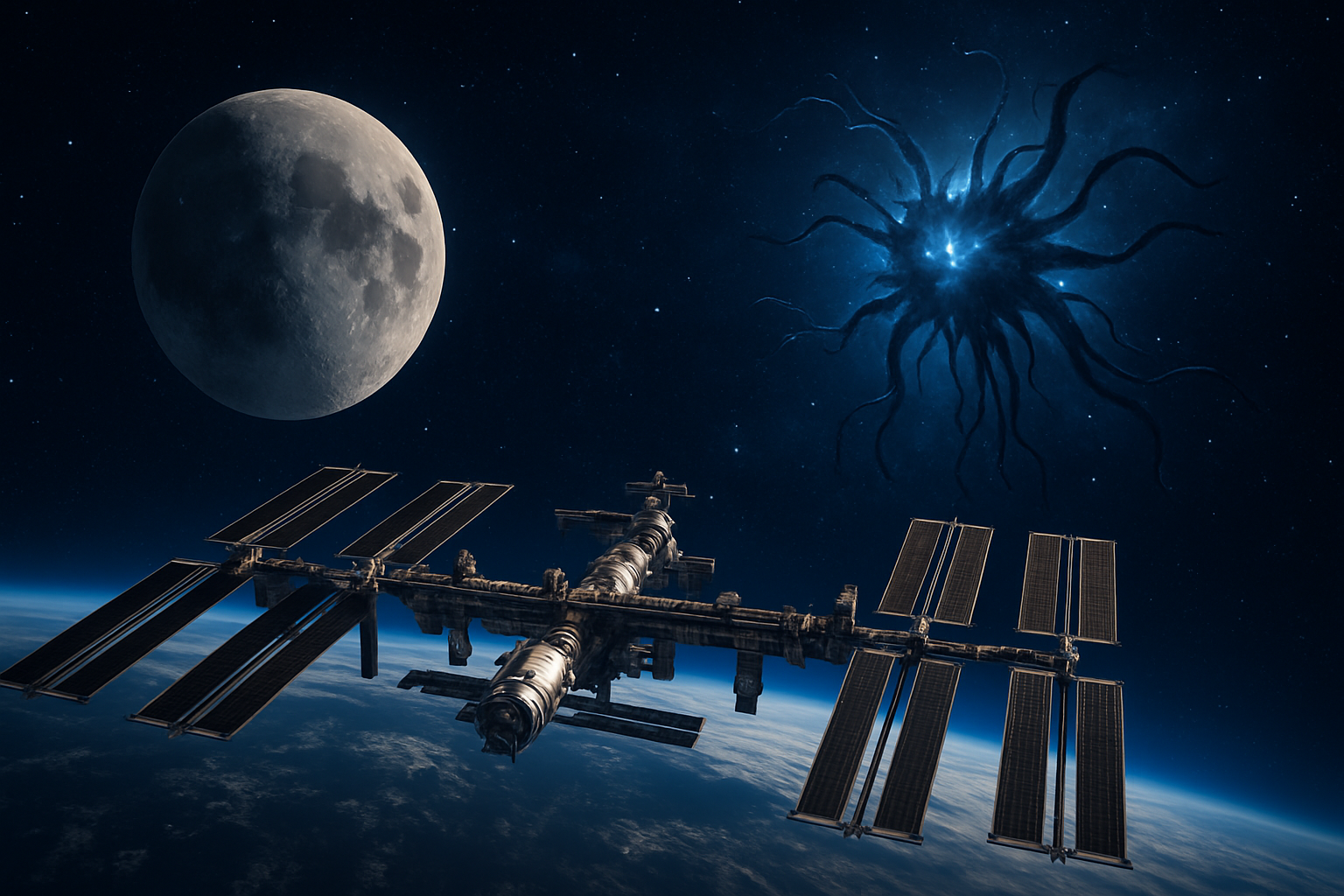
April 2026 has witnessed unprecedented achievements in space exploration, with NASA's Artemis II mission successfully completing humanity's first crewed lunar flyby in 54 years while breaking distance records, complemented by groundbreaking discoveries from amateur astronomers and international research teams pushing the boundaries of our cosmic understanding.
Artemis II: Humanity's Return to Deep Space
NASA's historic Artemis II mission has achieved a milestone that seemed impossible just months ago, successfully completing a 10-day lunar flyby that carried four astronauts farther from Earth than any humans since the Apollo era. The international crew—Canadian Jeremy Hansen (the first Canadian beyond Earth orbit), NASA Commander Reid Wiseman, Christina Koch, and Victor Glover—traveled an unprecedented 406,777.8 kilometers from Earth, breaking Apollo 13's 1970 distance record by over 6,600 kilometers.
The mission's success represents the culmination of years of engineering excellence and international cooperation. After resolving critical technical challenges including helium system failures and hydrogen leak problems that caused multiple delays throughout 2026, the Space Launch System (SLS) rocket—standing 322 feet tall and weighing 5.75 million pounds when fully fueled—proved itself as NASA's most powerful deep space transportation system.
"Humanity demonstrated once again what it is capable of,"
— Jeremy Hansen, Canadian Astronaut
Technical Triumphs and Human Adaptability
The mission showcased not only technological advancement but human ingenuity under pressure. A viral moment emerged when the Universal Waste Management System experienced a malfunction, with Christina Koch leading repairs that became a social media sensation while demonstrating the crew's adaptability and problem-solving skills in the unforgiving space environment.
During their closest approach to the Moon, the crew experienced a dramatic 40-minute communication blackout as they passed 4,000 miles beyond the lunar far side—completely isolated from Earth at humanity's deepest space penetration. This moment of cosmic solitude was broken by unprecedented "Earthset" photography, showing Earth setting below the lunar horizon for the first time since Apollo 17 in December 1972.
Amateur Astronomers Lead Planetary Discovery
While professional space missions captured headlines, amateur astronomers in Australia achieved their own historic breakthrough, making what researchers describe as a "world-first planetary discovery" that has "guided humanity's big telescopes." This achievement underscores the democratization of space science, where backyard astronomers equipped with modern technology can contribute to cutting-edge cosmic research.
The discovery adds to 2026's remarkable year of astronomical breakthroughs, which have included the identification of "impossible" planetary systems challenging formation theories, the detection of complex organic molecules in interstellar space, and the discovery of stellar phenomena that exceed conventional understanding of cosmic processes.
International Cooperation and Competition
The success of Artemis II validates the Artemis Accords framework for peaceful lunar exploration, with international contributions enhancing mission outcomes. Argentina's Atenea radiation device collected crucial deep space safety data, while Czech ADVACAM chips monitored astronaut health throughout the journey. This cooperation occurs against a backdrop of intensifying space competition, with China planning crewed lunar missions by 2030 and achieving AI breakthroughs in lunar far-side chemical composition analysis.
The mission coincides with what experts term the "space economy golden age," with global space economic activity projected to exceed $1 trillion by 2030. SpaceX's preparation for a trillion-dollar IPO in June 2026 exemplifies the commercial space sector's maturation from experimental ventures to essential infrastructure.
Mysterious Antarctic and Cosmic Discoveries
Parallel to these achievements, researchers from the Wegener Institute discovered an unknown island in Antarctica's northwestern Weddell Sea, demonstrating that Earth still holds secrets while we expand into space. This terrestrial discovery occurred as a 93-member expedition explored regions marked as danger zones on nautical charts, highlighting the continuing spirit of exploration on our own planet.
Meanwhile, Russian space agencies announced future missions involving Soyuz launches no earlier than July 2026, with NASA spokesperson confirming continued international collaboration aboard the space station despite geopolitical tensions. This persistence of scientific cooperation across national boundaries reflects space exploration's unique ability to unite humanity in common purpose.
Space Medicine and Human Adaptation
The Artemis II mission builds upon crucial space medicine research conducted by French astronaut Sophie Adenot during her record eight-month ISS mission. Her work on lung tissue cultivation and Space-Associated Neuro-Ocular Syndrome (SANS) research provides essential data for extended missions beyond Earth's protective environment, directly informing protocols for permanent lunar settlements and Mars exploration.
European research has revealed reproduction challenges in microgravity environments, necessitating artificial gravity solutions through rotating habitats for permanent space settlements. These findings are critical as humanity transitions from brief space visits to sustained extraterrestrial presence.
Nuclear Propulsion and Deep Space Infrastructure
NASA's announcement of the Space Reactor 1 Freedom nuclear spacecraft program for Mars exploration represents a fundamental shift in deep space transportation capabilities. Nuclear propulsion offers the energy density necessary for interplanetary missions where solar power is insufficient, enabling faster transit times, continuous power generation, and reduced radiation exposure for crew members.
This technological advancement positions humanity for truly sustainable deep space operations, supporting the multi-planetary expansion that leading space agencies and private companies are actively pursuing. The $20 billion commitment to establishing a permanent lunar surface base by 2030 represents NASA's largest space infrastructure investment in history.
Future Missions and Global Impact
The success of Artemis II serves as a stepping stone toward Artemis III's planned lunar landing in 2028, while validating systems essential for permanent extraterrestrial settlements. The mission's achievements in deep space life support, radiation protection beyond Earth's magnetic field, and navigation capabilities establish the foundation for humanity's transition to a truly spacefaring civilization.
President Donald Trump's personal congratulations to the crew, declaring them "truly extraordinary" and stating they had "made history today," reflected the mission's significance for American space leadership and international prestige. The achievement resonates globally as a demonstration of what coordinated international effort can accomplish.
"We will only launch when we believe we are ready. Safety comes first."
— Jared Isaacman, NASA Administrator
A Watershed Moment for Space Exploration
April 2026 represents a watershed moment when humanity definitively resumed its expansion into the cosmos after a 54-year gap in deep space exploration. The convergence of successful government missions, amateur astronomical discoveries, international cooperation, and commercial space advancement suggests we have entered a new era where space exploration transitions from experimental endeavor to essential infrastructure for human civilization.
The combination of technological achievement, scientific discovery, and international collaboration demonstrated throughout this period establishes the foundation for permanent human presence beyond Earth orbit. As we stand on the threshold of becoming a multi-planetary species, these breakthroughs will be remembered as the moment humanity took its first definitive steps toward becoming a truly cosmic civilization.
The success of these missions and discoveries validates years of investment in space technology, international cooperation frameworks, and safety-first approaches to human spaceflight. As we look toward the Moon, Mars, and beyond, April 2026 marks the beginning of humanity's sustained expansion among the stars.