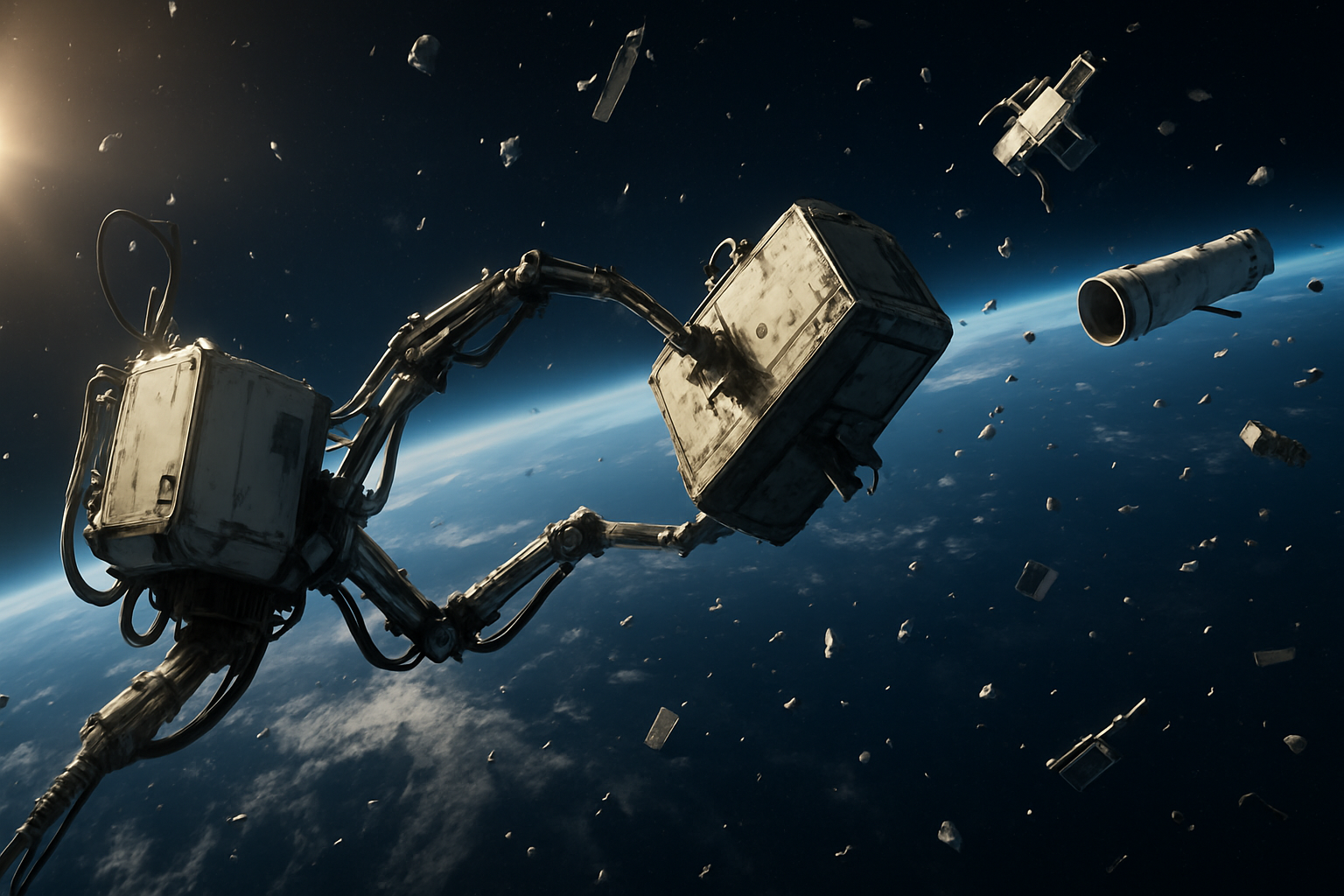
Space is becoming dangerously overcrowded, with thousands of defunct satellites and debris fragments threatening the future of orbital operations, according to Holger Krag, head of ESA's Space Safety Programme, who warns that urgent action is needed to prevent a cascade of collisions that could make Earth's orbit unusable for future generations.
Speaking about the mounting crisis in Earth's orbital environment, Krag emphasized that the current trajectory of space debris accumulation poses an existential threat to humanity's ability to operate in space. "We are literally building ourselves into a prison of our own making," he stated, describing how the exponential growth in satellite launches without corresponding cleanup efforts creates an unsustainable situation.
The Growing Threat of Space Debris
The space environment around Earth has become increasingly congested over recent decades, with over 34,000 tracked objects larger than 10 centimeters currently orbiting our planet. However, this represents only the tip of the iceberg—scientists estimate that millions of smaller debris pieces, too small to track but large enough to cause catastrophic damage, populate Earth's orbital regions.
The problem stems from decades of space activity without adequate disposal protocols. Every satellite launch, every rocket deployment, and every collision creates additional debris that remains in orbit for decades or even centuries, depending on altitude. At orbital speeds exceeding 17,500 miles per hour, even paint flecks can puncture spacecraft hulls and threaten astronaut safety.
Recent analysis of atmospheric pollution from rocket debris has revealed new dimensions to the crisis. Austrian scientists achieved the first direct measurement of atmospheric contamination from Falcon-9 rocket stage reentry, documenting lithium concentrations elevated tenfold above normal levels. This research establishes baseline data for assessing the environmental impact of increasing space activity, raising questions about the sustainability of current launch practices.
Innovative Cleanup Solutions on the Horizon
Despite the severity of the crisis, innovative solutions are emerging from both established space agencies and private companies. ESA is developing active debris removal technologies, including spacecraft designed to capture and deorbit defunct satellites using robotic arms and nets. These "space janitor" missions represent a new category of orbital services essential for long-term space sustainability.
The concept operates like an orbital garbage collection service—specialized spacecraft equipped with advanced sensors and capture mechanisms would identify, approach, and safely remove large debris objects. The captured debris would then be guided into Earth's atmosphere for controlled destruction, clearing valuable orbital real estate for future missions.
NASA's complementary approach focuses on collision avoidance through improved tracking and prediction systems. The agency's DAGGER AI system achieved a revolutionary breakthrough in February 2026, enabling 30-minute geomagnetic storm predictions that help protect satellites from solar storm damage. This space weather forecasting capability represents a quantum leap in satellite protection technology.
Satellite Technology Advances Amid Debris Concerns
While debris cleanup efforts advance, satellite technology continues to evolve rapidly. The space industry is transitioning from what analysts term the "AI revolution" to the "space economy golden age," with unprecedented private investment driving innovation across multiple sectors.
Amazon launched its first Leo satellite constellation in February 2026, challenging SpaceX's Starlink monopoly in the strategic satellite internet market. This development reflects the growing commercial space economy, with companies recognizing space-based infrastructure as essential rather than experimental technology.
SpaceX demonstrated sophisticated control capabilities by blocking unauthorized Russian military use of Starlink services in Ukraine, highlighting how commercial satellite operators now wield significant geopolitical influence. The ability to selectively enable or disable satellite services raises important questions about space governance and international cooperation frameworks.
International Cooperation and Competition
The dual nature of current space activities—combining unprecedented international cooperation with intensifying strategic competition—creates both opportunities and challenges for debris management. The International Space Station continues operating through NASA-ESA-Roscosmos partnerships, demonstrating that space cooperation can transcend terrestrial conflicts.
However, competitive dynamics are intensifying globally. China's fourth Shenlong reusable spacecraft launch, European rocket facility expansion, and Pakistan's historic astronaut mission to China's Tiangong station reflect the democratization of space capabilities. While this expansion provides valuable opportunities for developing nations, it also multiplies the potential sources of orbital debris.
Thailand's appointment as chair of the UN Scientific and Technical Subcommittee for space governance reflects the growing recognition that space activities require coordinated international oversight. The emergence of new space-faring nations necessitates updated governance frameworks that balance innovation with sustainability.
Economic Implications of Space Infrastructure
The space economy's transformation from experimental ventures to essential infrastructure carries massive economic implications. SpaceX's preparation for a June 2026 IPO potentially valuing the company over $1 trillion reflects this fundamental shift in how markets perceive space-based businesses.
The global memory crisis, with semiconductor prices increasing sixfold and affecting companies like Samsung, SK Hynix, and Micron, is driving interest in space-based data centers. These orbital computing facilities could offer unlimited expansion capacity without terrestrial cooling requirements, though they would require robust debris protection systems.
Space-based infrastructure offers solutions to multiple terrestrial challenges, from providing global internet coverage to enabling advanced Earth observation capabilities for climate monitoring and disaster response. However, the economic value of these services depends entirely on maintaining safe orbital operations through effective debris management.
The Medical Research Connection
Current International Space Station operations demonstrate the interconnected nature of space activities. The successful Crew-12 mission, featuring French astronaut Sophie Adenot on a record eight-month European mission, conducts crucial research including lung tissue cultivation studies and investigation of Space-Associated Neuro-Ocular Syndrome (SANS).
This medical research directly supports future lunar settlements and Mars exploration missions, but it depends on maintaining safe orbital operations. SANS research by Portuguese scientists addresses critical health challenges affecting astronaut vision during extended missions—knowledge essential for deep space exploration but impossible to obtain if debris makes orbital research stations too dangerous to operate.
Technology Innovation and Environmental Responsibility
The convergence of advanced technology with environmental stewardship represents a critical challenge for the space industry. Successful debris management requires sophisticated integration of AI systems, robotic capabilities, and international coordination—the same technologies driving the current space economy boom.
Balloon telescope innovations offer cost-effective alternatives to space-based observations for certain research applications, potentially reducing the need for some orbital missions. These near-space platforms operate above atmospheric interference while avoiding the debris-congested orbital environment, providing valuable scientific capabilities without adding to the space junk problem.
Advanced monitoring systems using satellite networks enable real-time tracking of debris objects, collision prediction, and automated avoidance maneuvers. These same technologies support the growing satellite constellations that make modern global communications possible, creating a symbiotic relationship between debris management and space commerce.
Future Implications and Urgent Action Required
The window for effective debris remediation is narrowing rapidly. Each passing year adds thousands of new objects to orbital space while existing debris continues to fragment through collisions and degradation. The cascade effect—where collisions create more debris that causes additional collisions—could render entire orbital regions unusable within decades.
Success in managing the space debris crisis will determine humanity's long-term access to space-based resources and services. Failure could trap civilization on Earth, cutting off access to the space-based infrastructure increasingly essential for global communications, navigation, weather forecasting, and scientific research.
The current generation of space leaders faces a historic responsibility: implementing comprehensive debris cleanup programs while establishing sustainable practices for future space activities. The tools and technologies exist to address the crisis, but success depends on unprecedented international cooperation, sustained funding commitments, and the political will to prioritize long-term sustainability over short-term commercial interests.
As Holger Krag emphasizes, the choice is stark—act now to clean up space, or risk losing access to the orbital environment that has become essential to modern civilization. The future of humanity's relationship with space depends on the decisions made in the coming years, making space debris management one of the most critical technological and policy challenges of our time.