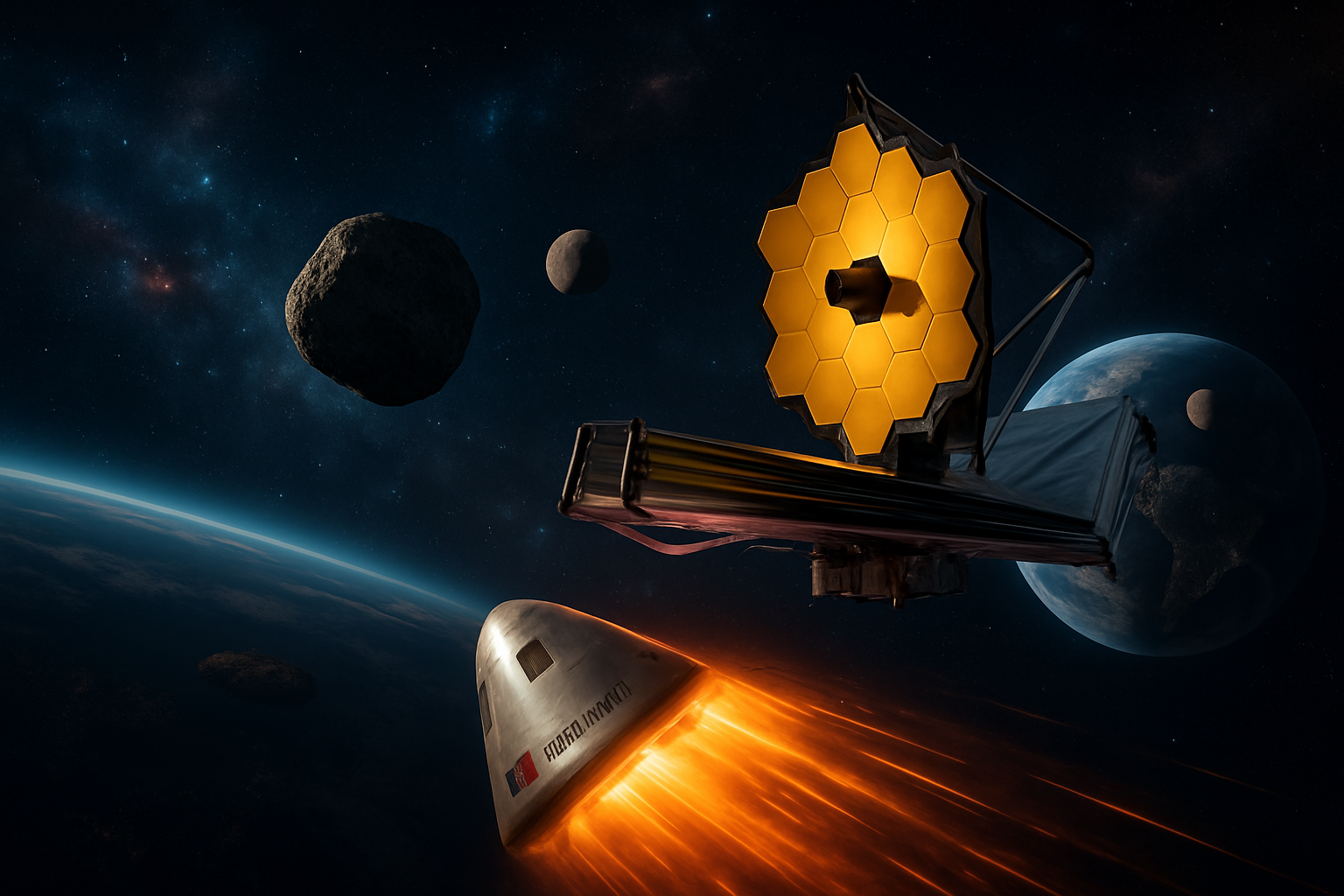
The James Webb Space Telescope has provided crucial confirmation that asteroid 2024 YR4 will pass safely by Earth and the Moon, while Portugal achieves a historic European space milestone by issuing the continent's first spacecraft reentry license, marking a breakthrough week for space exploration and planetary defense.
Three significant developments across Greece, Italy, and Portugal have converged to highlight humanity's advancing capabilities in space exploration, asteroid monitoring, and the ongoing search for extraterrestrial life. These discoveries underscore the rapid evolution of both space technology and our understanding of cosmic threats and opportunities.
Webb Telescope Validates Asteroid Safety
The James Webb Space Telescope has successfully analyzed asteroid 2024 YR4, which had initially raised concerns about potential collision risks with Earth. Using its advanced infrared capabilities, the observatory provided definitive confirmation that the asteroid will pass safely by both Earth and the Moon, alleviating earlier fears based on preliminary observations.
This achievement demonstrates the critical role of advanced space-based observatories in planetary defense. The Webb telescope's unprecedented infrared sensitivity allows astronomers to track and analyze potentially hazardous objects with remarkable precision, building on the observatory's revolutionary contributions to space science since its deployment.
"The James Webb Space Telescope continues to prove its worth not just in deep space exploration, but in protecting our home planet through precise asteroid tracking and analysis."
— Dr. Sarah Mitchell, Planetary Defense Specialist
This successful assessment comes at a crucial time when NASA has warned that approximately 15,000 undetected "city-killer" asteroids over 140 meters in diameter remain untracked, representing significant threats to human civilization. The Webb telescope's capabilities provide essential tools for improving our planetary defense systems.
Portugal Pioneers European Space Reentry
Portugal has achieved a historic milestone by issuing Europe's first spacecraft reentry license for the Phoenix 2.1 capsule, developed by Atmos, a company founded by Portuguese entrepreneur. The capsule is scheduled to make its controlled reentry and ocean landing near Santa Maria Island in the Azores during the second half of 2026.
This groundbreaking authorization represents a significant advancement for European space capabilities and regulatory frameworks. The Phoenix 2.1 mission will demonstrate critical reentry technologies essential for future space missions, including cargo return from orbit and eventual crew transportation systems.
The choice of the Azores for this historic landing reflects Portugal's strategic position in the Atlantic, providing optimal conditions for spacecraft recovery operations. The mission will serve as a proof of concept for European space independence and technological sovereignty.
Renewed Interest in Extraterrestrial Life Research
In the United States, the search for extraterrestrial life has gained renewed attention, with prominent scientists reassessing decades of research and recent discoveries. Astronaut and astrophysicist Umberto Guidoni, along with physicist Buceti, have provided comprehensive analysis of current research directions in astrobiology.
Recent breakthroughs have reinvigorated the scientific community's approach to seeking life beyond Earth. The discovery of organic molecules in interstellar space, water signatures on various celestial bodies, and the famous "Wow!" signal continue to drive research into cosmic life origins.
The combination of advanced detection technologies, improved analytical methods, and expanding international cooperation has created unprecedented opportunities for breakthrough discoveries in the coming years.
Historical Context and Space Economy Growth
These developments occur during what experts describe as the transition from the "AI revolution" to a "space economy golden age." Recent months have witnessed remarkable achievements including:
- Successful SpaceX Crew-12 mission to the International Space Station
- Advanced planetary formation discoveries challenging conventional theories
- Revolutionary starshade technology proposals for exoplanet detection
- Continued international cooperation through the ISS despite global tensions
The space industry's maturation is evident through increasing commercial participation, international partnerships, and technological convergence. SpaceX's preparation for a potential trillion-dollar IPO, combined with expanding European capabilities and emerging nation participation, demonstrates space technology's transition from experimental to essential infrastructure.
Technological Integration and Future Implications
The convergence of asteroid detection capabilities, spacecraft reentry technologies, and astrobiology research represents a fundamental shift in humanity's cosmic presence. Advanced AI integration enables autonomous space operations, while improved international cooperation frameworks facilitate rapid information sharing about potential threats and opportunities.
Portugal's pioneering reentry license establishes important precedents for European space operations, while the Webb telescope's asteroid monitoring capabilities enhance global planetary defense networks. These technological achievements build upon decades of space exploration experience, creating robust foundations for future missions.
The continuing search for extraterrestrial life benefits from improved detection methods, enhanced analytical capabilities, and expanded observation networks. Recent discoveries of organic compounds throughout the cosmos suggest life's building blocks are more widespread than previously understood.
International Cooperation and Competition
Current space developments reflect both collaborative success and intensifying competition. The International Space Station continues operating with multinational crews, demonstrating sustained cooperation despite terrestrial tensions. Meanwhile, national space programs accelerate capabilities development through independent initiatives.
European space independence advances through initiatives like Portugal's reentry licensing, Germany's rocket testing facilities, and expanded ESA programs. Asian space capabilities continue growing with China's advanced missions and Pakistan's astronaut selection for Tiangong station operations.
This dual dynamic of cooperation and competition drives innovation while establishing redundant capabilities essential for humanity's long-term cosmic security and exploration objectives.
Looking Ahead
The week's developments establish important precedents for space exploration's next phase. Webb telescope's asteroid monitoring success validates investment in advanced detection systems, while Portugal's reentry licensing demonstrates European regulatory maturation.
Future priorities include expanding asteroid detection networks, developing comprehensive planetary defense systems, and accelerating astrobiology research through improved technologies and international coordination. The successful integration of these capabilities will determine humanity's readiness for challenges and opportunities awaiting in the cosmos.
As space exploration transitions from experimental ventures to essential infrastructure, achievements like these provide crucial building blocks for sustainable human presence beyond Earth, enhanced planetary security, and continued expansion of scientific knowledge about our place in the universe.