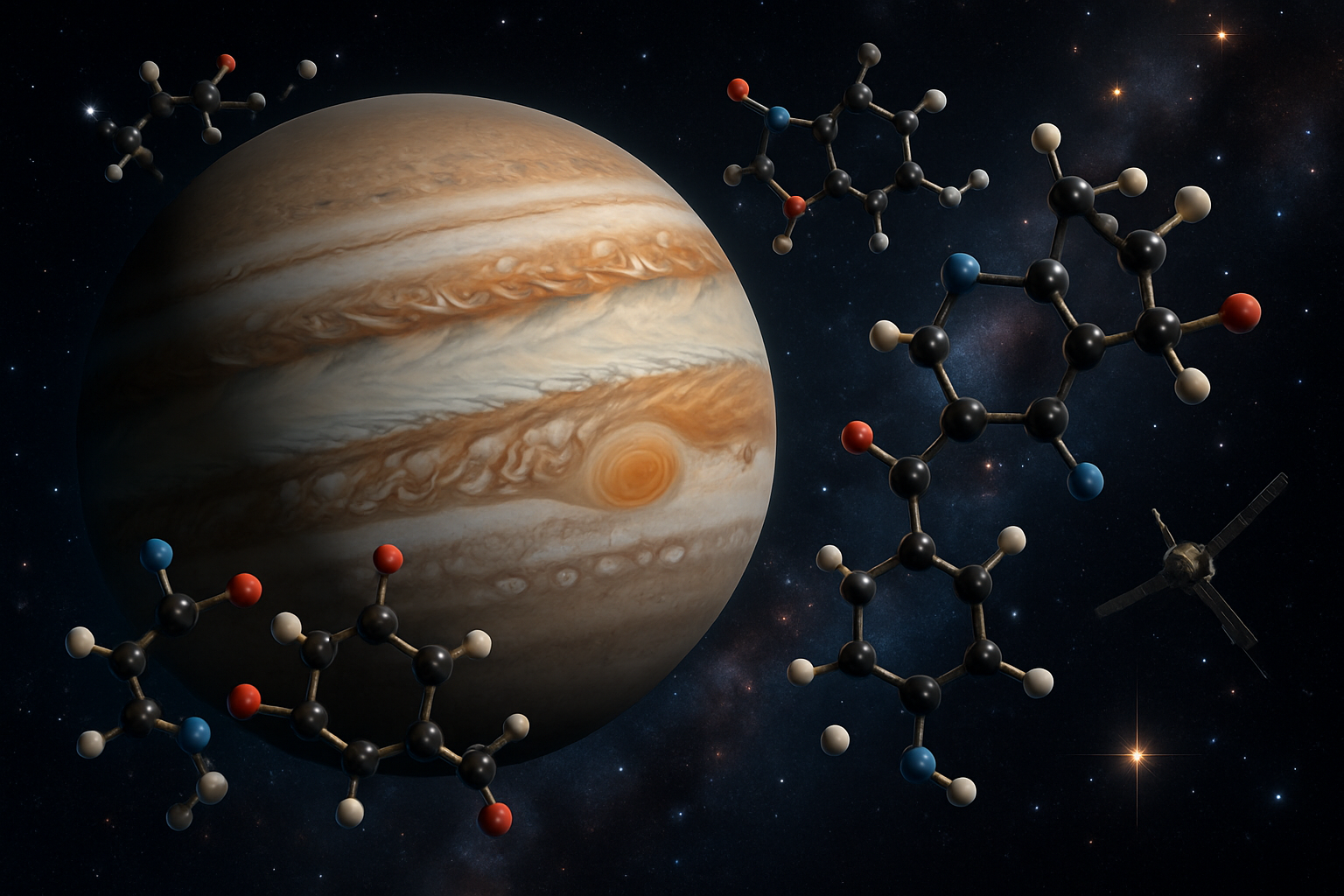
February 2026 has delivered remarkable scientific breakthroughs in space exploration, with NASA's Juno spacecraft revealing that Jupiter is slightly smaller than previously calculated, while European researchers have identified the largest sulfur-containing organic molecule ever found in interstellar space - discoveries that collectively advance our understanding of planetary formation and the cosmic origins of life.
These findings represent significant milestones in space science, building upon recent achievements including NASA's successful deployment of AI-controlled Mars rovers and ongoing preparations for the Artemis II lunar mission, now scheduled for March 2026 following technical delays.
Jupiter's Surprising Size Revision
NASA's Juno mission has provided new measurements indicating that Jupiter, our solar system's largest planet, is marginally smaller than astronomers previously believed. The discovery, announced on February 4, 2026, comes from the spacecraft's extended mission phase, which has allowed for increasingly precise measurements of the gas giant's dimensions and structure.
The Juno spacecraft, which has been orbiting Jupiter since July 2016, continues to revolutionize our understanding of the planet's interior structure, magnetic field, and atmospheric composition. This latest finding adds to a growing body of knowledge that has consistently challenged previous assumptions about the gas giant.
The size revision, while seemingly minor, has significant implications for models of planetary formation and the early solar system. Jupiter's gravitational influence has shaped the architecture of our entire solar system, and precise measurements of its mass and size are crucial for understanding how planets form and migrate within stellar systems.
Cosmic Chemistry: Life's Building Blocks in Deep Space
In a parallel breakthrough that could reshape our understanding of life's origins, scientists have identified the largest sulfur-containing organic molecule ever discovered in interstellar space. This finding, described by researchers as a "missing link" in understanding how the chemistry of life develops in the universe, represents a major advance in astrobiology.
Sulfur is an essential element for proteins and enzymes on Earth, making this discovery particularly significant for theories about how life's fundamental building blocks form in cosmic environments. Previously, such complex sulfur-containing compounds had only been found in comets and meteorites - objects that originated within our solar system.
The discovery extends the known complexity of organic chemistry in the harsh environment of interstellar space, where temperatures approach absolute zero and radiation levels would be lethal to terrestrial life. Finding such sophisticated molecular structures in these conditions suggests that the chemical foundations for life may be more widespread throughout the universe than previously imagined.
"This represents a chybějící článek - a missing link - in our understanding of how life's chemistry emerges in the cosmos," according to the research team's published findings.
— Research Team, Czech Academy of Sciences
Autonomous Space Technology Advances
These discoveries come amid rapid advancement in autonomous space exploration technologies. The recent success of NASA's AI-controlled Mars rover missions in December 2025 has demonstrated the potential for artificial intelligence to revolutionize planetary exploration by enabling real-time decision-making without Earth-based mission control delays.
Concurrently, military applications of autonomous aerospace technology are advancing, with the U.S. Navy's MQ-25 "Stingray" tanker drone achieving its first autonomous ground operations. This milestone in aerial refueling technology represents broader trends toward unmanned systems in both civilian and defense space applications.
The integration of AI and autonomous systems into space exploration addresses fundamental challenges of operating across vast cosmic distances, where communication delays of 4-24 minutes between Earth and Mars make real-time human control impossible for many mission-critical decisions.
International Collaboration and Future Missions
These scientific advances occur within a rapidly evolving landscape of international space cooperation and commercial space industry growth. Thailand's recent appointment as chair of the UN Scientific and Technical Subcommittee positions developing nations at the center of global space governance discussions, while private enterprises like SpaceX continue expanding satellite constellations and planning ambitious missions.
The delayed Artemis II mission, now targeting March 2026, remains a critical milestone for NASA's lunar exploration program. Technical challenges with hydrogen fuel systems have required additional safety testing, but the mission will mark humanity's return to lunar orbit for the first time since Apollo 17 in 1972.
European space capabilities are also expanding, with German manufacturer Isar Aerospace constructing new rocket engine testing facilities in Sweden capable of testing 30 engines monthly, reflecting the continent's drive for launch independence and technological sovereignty.
Implications for Astrobiology and Planetary Science
The combination of Jupiter's refined measurements and the discovery of complex organic molecules in interstellar space provides new constraints for models of solar system formation and the distribution of life's building blocks throughout the galaxy.
Jupiter's role as a "cosmic vacuum cleaner" - protecting inner planets from asteroid and comet impacts - may need recalibration based on its updated size measurements. Similarly, the presence of sophisticated organic chemistry in interstellar space suggests that incoming comets and asteroids may have delivered more complex molecular precursors to early Earth than previously recognized.
These findings support theories that life's chemical foundations may be universal features of cosmic evolution, formed through natural processes in the interstellar medium and delivered to planetary surfaces throughout the galaxy via meteorites and comets.
Looking Ahead: Space Science in 2026
As 2026 progresses, multiple space missions will build upon these discoveries. The Vera C. Rubin Observatory in Chile, which recently achieved its first record-breaking asteroid discovery, will continue scanning the sky with unprecedented sensitivity. The facility's Legacy Survey of Space and Time promises to detect millions of previously unknown celestial objects.
Commercial space ventures, including the planned $1.25 trillion SpaceX-xAI merger, aim to establish space-based infrastructure that could support expanded scientific research capabilities. These developments suggest that space-based astronomy and planetary science will accelerate dramatically in the coming years.
The convergence of AI technology, international cooperation, and commercial investment in space exploration creates unprecedented opportunities for scientific discovery. As autonomous systems become more sophisticated and space access costs continue declining, humanity's ability to explore and understand the cosmos will expand exponentially.
These February 2026 discoveries in planetary science and astrobiology represent just the beginning of what promises to be a transformative era in space exploration, where robotic explorers equipped with artificial intelligence will extend human scientific capability throughout the solar system and beyond.