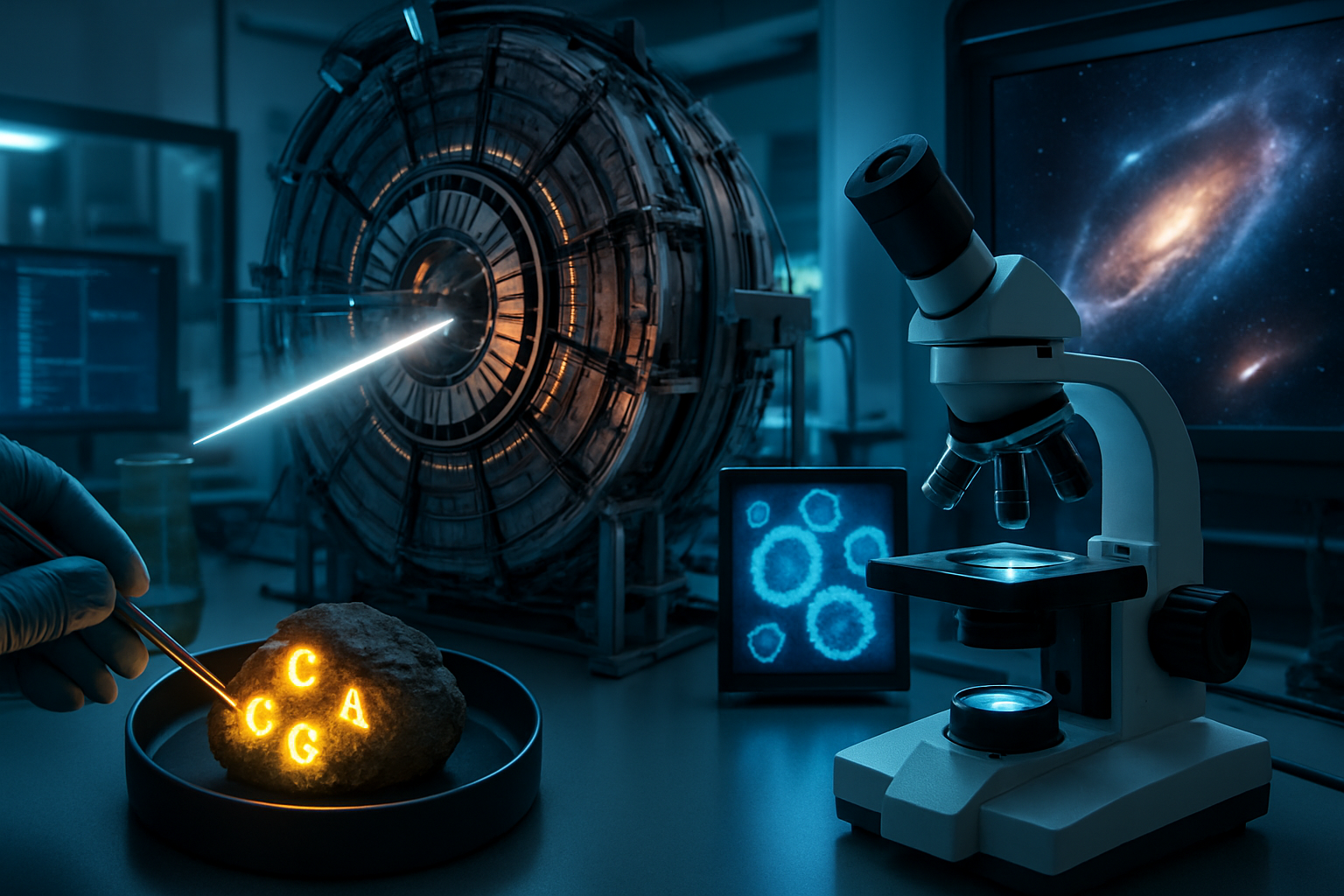
A convergence of groundbreaking scientific discoveries across multiple disciplines is reshaping our understanding of life's origins, fundamental physics, and human biology, as international researchers achieve unprecedented breakthroughs that bridge the cosmic and terrestrial realms.
From Austrian laboratories analyzing asteroid dust to reveal the building blocks of life came from space, to CERN physicists discovering new particles that challenge our understanding of matter, the past week has delivered a series of revelations that underscore the interconnected nature of scientific inquiry and the power of international collaboration.
Cosmic Origins: Life's Building Blocks Discovered in Space Dust
Austrian scientists have made a revolutionary discovery in samples from the asteroid Ryugu, revealing that all nucleobases found in terrestrial DNA and RNA—adenine, guanine, cytosine, thymine, and uracil—are present in the asteroid dust. This finding provides compelling evidence for the panspermia hypothesis, suggesting that life's fundamental building blocks originated in space and were delivered to Earth through cosmic bombardment.
The research, conducted through analysis of samples returned by Japan's Hayabusa2 mission, represents a culmination of decades of international space exploration cooperation. The pristine samples, protected from terrestrial contamination, offer an unprecedented window into the chemical processes that preceded and potentially enabled life on Earth.
"This discovery fundamentally changes our understanding of life's origins," said Dr. Elena Volkov, a leading researcher in the field. "The presence of all DNA and RNA nucleobases in pristine asteroid material suggests that the cosmos played a direct role in seeding the chemical foundation for life."
— Dr. Elena Volkov, Astrobiologist
The implications extend far beyond Earth's origins. As NASA and other space agencies prepare for missions to Mars and beyond, understanding the distribution of organic compounds throughout the solar system becomes crucial for astrobiology research and the search for extraterrestrial life.
Particle Physics Revolution: CERN Unveils New Matter
Simultaneously, physicists at the European Organization for Nuclear Research (CERN) near Geneva have identified a previously unknown particle designated Xi-cc-plus, four times heavier than a standard proton. The discovery, made possible by upgrades to the Large Hadron Collider's detection systems, provides new insights into the strong nuclear force that binds atomic nuclei together.
The particle was detected in the shower of debris created when protons collide at near-light speeds, recreating conditions similar to those immediately following the Big Bang. This discovery adds to growing evidence that the standard model of particle physics, while remarkably successful, may require revision to account for newly discovered phenomena.
Dr. Kelly Fast, a particle physicist involved in the research, emphasized the international nature of the achievement: "This breakthrough represents the collaborative effort of thousands of scientists from dozens of countries, demonstrating how fundamental scientific questions require global cooperation to answer."
Medical Research Renaissance
Parallel to these cosmic discoveries, medical researchers are achieving remarkable breakthroughs across multiple fields. Australian scientists are investigating links between gut microbiome composition and rising rates of bowel cancer in individuals under 50, potentially identifying preventable factors in a growing health crisis.
Meanwhile, researchers at the University of Coimbra in Portugal, collaborating with Carnegie Mellon University in the United States, have revealed sophisticated neural systems that coordinate human movement in "surprisingly systematic" ways. This research provides new understanding of how the brain orchestrates complex motor functions, with implications for treating movement disorders and developing rehabilitation therapies.
Advancing Human Knowledge Through International Cooperation
Perhaps most remarkably, Japanese researchers have solved a centuries-old puzzle in behavioral biology by explaining the mechanism behind rhinoceros beetles' mating patterns. Their findings reveal that most female rhinoceros beetles mate only once in their brief two-to-three-week lifespan, representing a precisely evolved reproductive strategy that maximizes genetic success within extreme time constraints.
This research exemplifies the breadth of scientific inquiry occurring simultaneously across disciplines, from the cosmic scale of asteroid analysis to the intimate details of insect behavior, all contributing to humanity's expanding understanding of life's complexity.
Technology and Traditional Methods Converge
These discoveries share common methodological approaches that represent the modern scientific renaissance. Advanced analytical techniques including DNA sequencing, sophisticated imaging, AI-powered data processing, and international data sharing enable researchers to extract unprecedented insights from both new samples and historical specimens.
The Austrian asteroid research utilized spectroscopic analysis impossible even a decade ago, while the CERN particle discovery required detector upgrades that represent the cutting edge of engineering precision. Similarly, medical researchers employ genetic analysis, advanced microscopy, and computational modeling to reveal biological mechanisms previously invisible to scientific investigation.
Climate Urgency Drives Scientific Innovation
These breakthroughs occur during a period of environmental urgency, with March 2026 marking the 19th consecutive month of global temperatures exceeding 1.5°C above pre-industrial levels. This context adds significance to scientific discoveries that could inform everything from space-based climate monitoring to medical treatments for climate-related health challenges.
The convergence of space science and medical research also reflects practical considerations for humanity's expanding presence beyond Earth. Understanding life's cosmic origins informs the search for habitable worlds, while medical advances prepare for the physiological challenges of long-duration space missions.
Economic and Strategic Implications
The economic implications of these scientific advances extend across multiple sectors. Space-based research supports the growing space economy, projected to exceed $1 trillion by 2030. Medical breakthroughs contribute to pharmaceutical development and personalized medicine approaches that could revolutionize healthcare delivery.
Countries investing in fundamental scientific research are positioning themselves as leaders in emerging high-value markets while contributing to humanity's collective knowledge base. The international cooperation evident in these discoveries provides models for addressing global challenges that transcend national boundaries.
Future Research Directions
Looking ahead, these discoveries establish foundations for continued breakthroughs. Asteroid research will inform upcoming Mars sample return missions and the search for signs of ancient or present life throughout the solar system. Particle physics research guides the development of new technologies with applications ranging from medical imaging to quantum computing.
Medical advances in gut microbiome research, neural system understanding, and behavioral biology provide roadmaps for treating diseases, improving human performance, and understanding the biological foundations of consciousness and behavior.
The convergence of these diverse scientific fields demonstrates that humanity's greatest challenges and most profound questions require interdisciplinary approaches supported by sustained international cooperation, adequate funding, and commitment to evidence-based inquiry that transcends political and economic constraints.
As researchers continue to push the boundaries of human knowledge, these March 2026 breakthroughs will likely be remembered as pivotal moments when cosmic and terrestrial sciences converged to reveal fundamental truths about life's origins, matter's nature, and biology's complexity—insights that illuminate both our cosmic context and our biological potential.