In a moment that redefined humanity's relationship with the cosmos, the crew of NASA's historic Artemis II mission described viewing Earth as a "lifeboat" floating in the vast darkness of space, even as China accelerates its lunar program with breakthrough AI technology that threatens American space supremacy.
The four-astronaut crew—Canadian Jeremy Hansen (the first Canadian beyond Earth orbit), NASA Commander Reid Wiseman, Christina Koch, and Victor Glover—completed humanity's first crewed lunar flyby in 54 years on April 11, 2026, achieving a new human distance record of 406,777.8 kilometers from Earth. Their successful Pacific Ocean splashdown at 8:07 PM ET marked the end of a 10-day, 685,000-mile journey that ended the longest gap in human deep space exploration since Apollo 17 in December 1972.
Breaking Records and Barriers
The Artemis II crew shattered Apollo 13's 1970 distance record by more than 6,600 kilometers, traveling 4,000 miles beyond the Moon's far side during their closest approach. The mission's most dramatic moment came during a 40-minute communication blackout as the spacecraft passed behind the lunar far side—completely isolating the crew from Earth during humanity's deepest penetration into space.
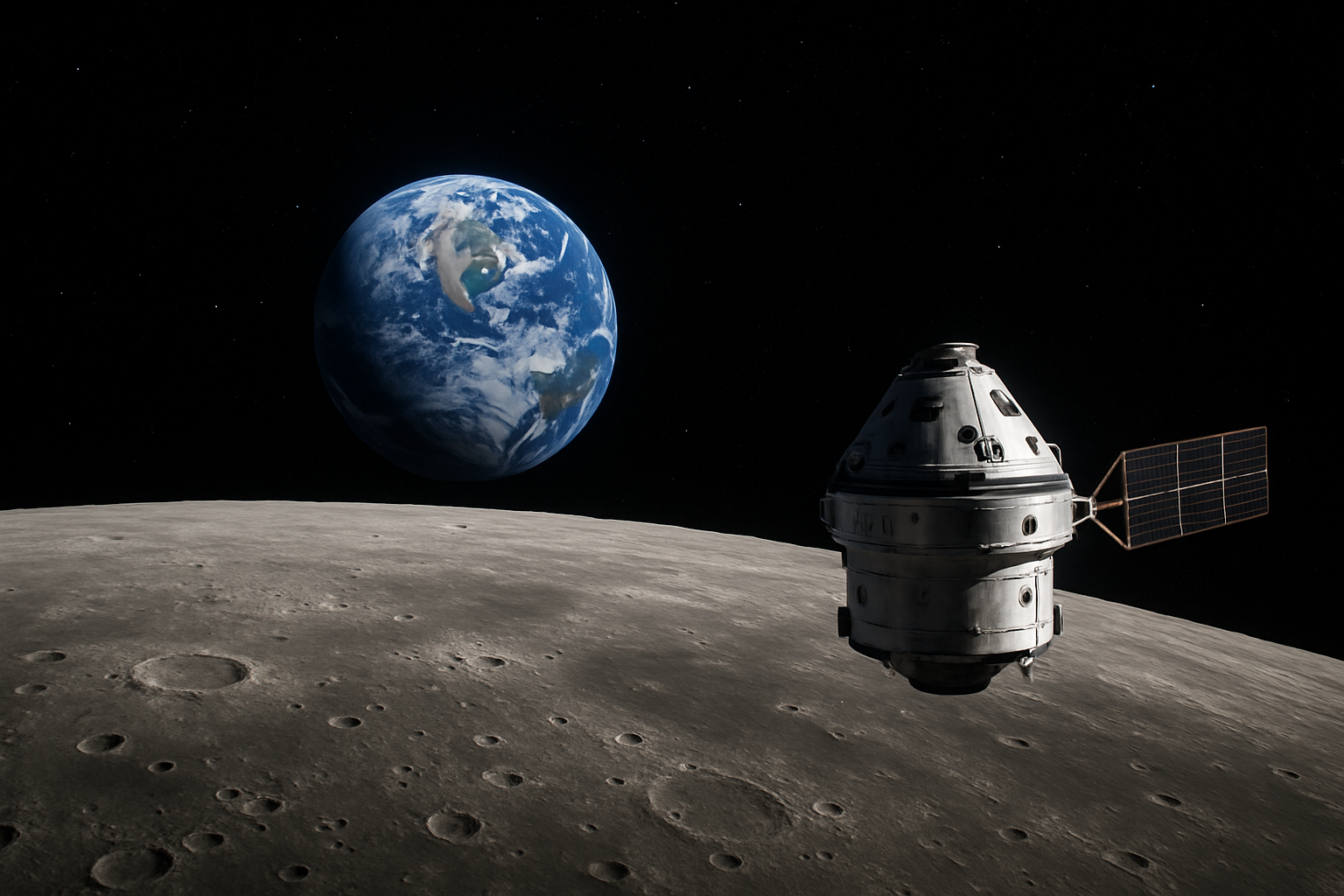
"We love you from the Moon," were Victor Glover's final words before the blackout, while Houston's response echoed through mission control: "See you on the other side." Upon restoration of contact, the crew provided unprecedented live footage of Earth rising behind the Moon, both celestial bodies appearing as crescents from their unique deep space vantage point.
"Humanity has demonstrated once again what it is capable of."
— Jeremy Hansen, Artemis II Astronaut
The Earth as "Lifeboat" Perspective
Norwegian sources report that the crew's profound emotional response to viewing Earth from deep space led them to describe their home planet as a "lifeboat" in the cosmos—a fragile oasis of life surrounded by the infinite void. This perspective echoes the transformative impact of Apollo astronauts who first witnessed the "pale blue dot" phenomenon decades earlier.
Commander Reid Wiseman captured the first Earth photographs from a crewed spacecraft beyond Earth orbit since Apollo 17, showing curved planetary slices, continental outlines, and aurora displays. "Guys, you look great," Christina Koch told her crewmates while gazing at Earth, unable to "get away from the windows" during their historic journey.
China's Lunar Race Acceleration
While NASA celebrated its triumphant return to deep space, China has been quietly but aggressively advancing its own lunar ambitions. Austrian sources reveal that China's space program is running ahead of schedule, potentially overtaking the United States in the next lunar landing race with "a fraction of the budget."
Chinese scientists at the Shanghai Institute of Technical Physics achieved a historic breakthrough by using artificial intelligence to determine the chemical composition of the Moon's far side for the first time in history. The AI-powered analysis of samples from China's Chang'e-6 mission provided detailed mapping of previously unknown lunar regions—nearly half of the Moon's surface that permanently faces away from Earth.
This technological leap demonstrates China's systematic approach to lunar exploration, combining advanced AI capabilities with steady government-led planning that enables long-term strategic objectives without the market pressures affecting commercial space ventures.
Technical Triumphs and Viral Moments
The Artemis II mission wasn't without its challenges. A toilet system malfunction became a viral social media moment when Christina Koch led repair efforts after frozen urine clogged the spacecraft's Universal Waste Management System. The incident, while seemingly mundane, highlighted both the practical realities of space exploration and the crew's remarkable adaptability in resolving technical issues without affecting the mission timeline.
The crew also successfully addressed communication system failures and thermal sensor malfunctions during their first day in space, demonstrating significant advancement over Apollo-era missions in terms of crew comfort and mission sustainability.
The SLS rocket—standing 322 feet tall and weighing 5.75 million pounds when fully fueled with 700,000+ gallons of liquid hydrogen and oxygen—proved itself as the most powerful NASA rocket ever built, validating years of development after overcoming persistent helium system failures and hydrogen leak problems.
International Cooperation Meets Competition
The mission validated the Artemis Accords framework for peaceful lunar exploration through Jeremy Hansen's participation—the most significant Canadian space contribution since the Space Shuttle era. Argentina's Atenea radiation device and Czech ADVACAM safety monitoring chips collected crucial deep space data, demonstrating successful international scientific collaboration.
However, this cooperation occurs against a backdrop of intensifying space competition. China plans crewed lunar missions by 2030, while Pakistan has selected astronaut candidates for China's Tiangong space station. The democratization of space capabilities is creating both opportunities and challenges for traditional space powers.
Strategic Implications for Space Supremacy
NASA's response to Chinese advancement includes a historic $20 billion commitment to establish a permanent lunar surface base by 2030—the largest space infrastructure investment in agency history. The cancellation of the Lunar Gateway project redirects funds toward surface operations, reflecting a strategic pivot toward establishing sustained lunar presence rather than orbital facilities.
The Space Reactor 1 Freedom nuclear spacecraft program, announced for Mars exploration, provides the energy density necessary for interplanetary missions where solar power is insufficient. This nuclear propulsion capability enables faster transit times, continuous power generation, and reduced radiation exposure—critical advantages for deep space operations.
The New Space Economy Golden Age
The mission occurs during what analysts term the "space economy golden age," with global space economy projections exceeding $1 trillion by 2030. SpaceX is preparing a potentially trillion-dollar IPO scheduled for June 2026, while commercial space capabilities advance alongside government programs, creating integrated Earth-space technological systems.
This economic transformation positions space exploration as critical infrastructure rather than experimental endeavor. Space-based data centers are emerging as solutions to Earth's memory crisis, with continuous solar power and unlimited expansion potential in the zero-gravity environment.
Medical Breakthroughs and Human Adaptation
The mission builds on crucial space medicine research, including French astronaut Sophie Adenot's record eight-month ISS mission focusing on lung tissue cultivation and Space-Associated Neuro-Ocular Syndrome (SANS) research. European studies reveal reproduction challenges in microgravity environments, requiring artificial gravity solutions through rotating habitats for permanent settlements.
These medical advances directly inform protocols for lunar bases and Mars expeditions, where astronauts may spend years without the possibility of medical evacuation to Earth.
Presidential Recognition and Political Support
President Donald Trump personally called the crew during their return, describing them as "truly extraordinary" and declaring they had "made history today." This political recognition emphasizes Artemis as an administration priority, highlighting American space leadership during intensifying international competition.
Looking Forward: A Spacefaring Civilization
The successful completion of Artemis II represents humanity's transition from brief space visits to sustained cosmic expansion capabilities. The mission establishes the foundation for permanent extraterrestrial settlements and multi-planetary species development—a truly spacefaring civilization through advanced technology, international cooperation, and space medicine knowledge convergence.
As the crew walked across the USS John P. Murtha recovery ship's deck, refusing wheelchairs and demonstrating excellent health after their ordeal, they embodied humanity's resilience and adaptability in the cosmic environment. Their journey validates the systems essential for permanent lunar settlements and Mars exploration, marking the beginning of sustained human presence beyond Earth orbit for the first time in human history.
With China's systematic advancement threatening American space dominance and technological breakthroughs accelerating across multiple nations, the successful Artemis II mission provides both vindication of current strategies and urgency for the ambitious goals ahead. The crew's description of Earth as a "lifeboat" serves as a poignant reminder that while humanity reaches for the stars, our home planet remains precious and irreplaceable—at least until we establish our next foothold among the cosmos.