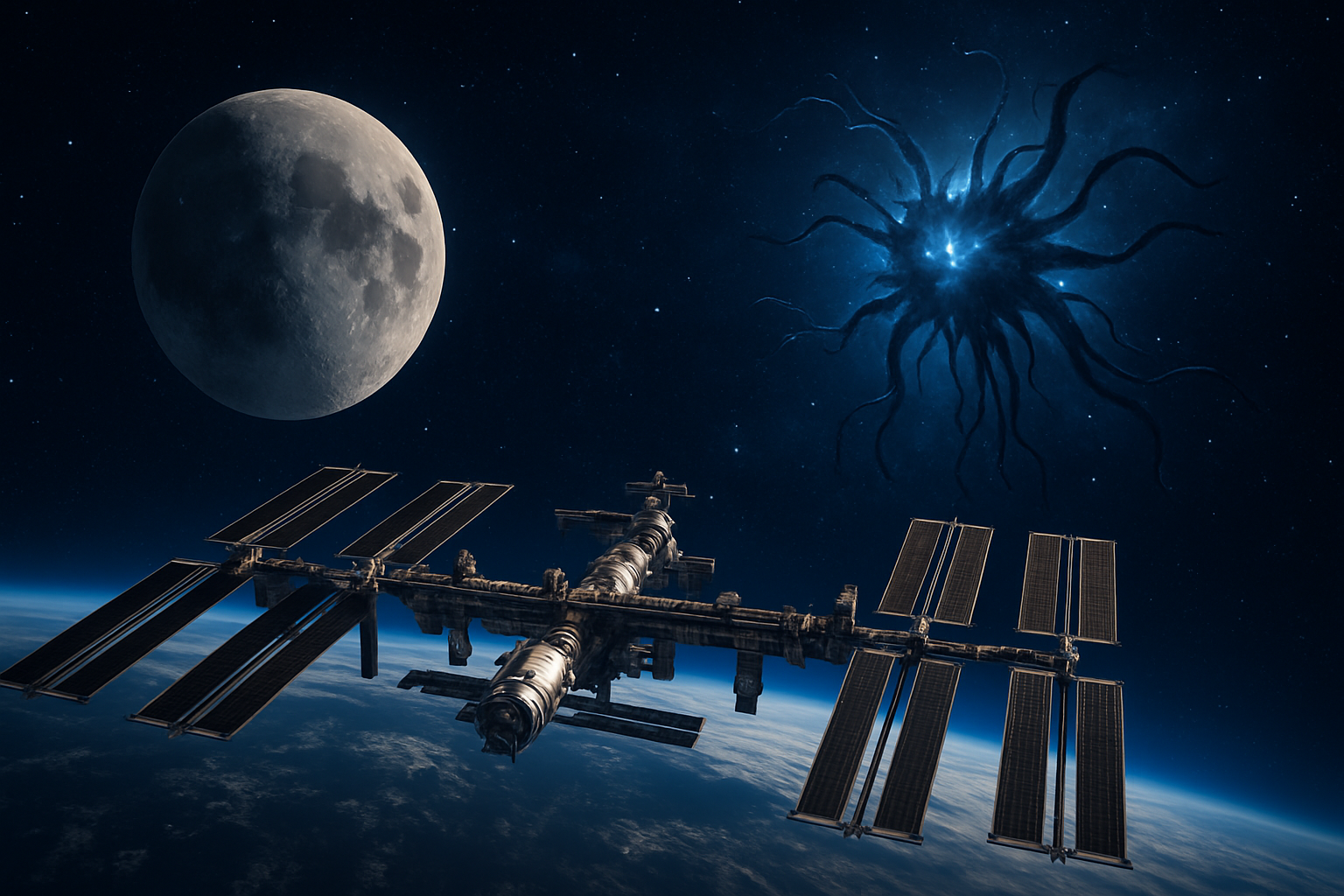
April 2026 has witnessed an unprecedented convergence of space exploration achievements, from NASA's historic Artemis II mission breaking Apollo-era distance records to mysterious cosmic discoveries that challenge our understanding of the universe.
Artemis II Makes History
NASA's Artemis II mission has successfully completed humanity's first lunar flyby in over 50 years, with the four-astronaut crew reaching a record-breaking distance of 406,777.8 kilometers from Earth—surpassing Apollo 13's 1970 record by more than 6,600 kilometers. The international crew, led by NASA Commander Reid Wiseman and including Canadian astronaut Jeremy Hansen (the first Canadian to venture beyond Earth orbit), Christina Koch, and Victor Glover, experienced a dramatic 40-minute communication blackout during their passage around the Moon's far side.
The mission achieved multiple historic milestones, including the first Earth photographs captured from a crewed spacecraft beyond Earth orbit since Apollo 17 in December 1972, ending a 54-year gap in human deep space exploration. President Donald Trump personally called the crew during their return journey, congratulating them as "truly extraordinary" and declaring they had "made history today."
Technical Triumphs and Viral Moments
Despite initial challenges, including a toilet system malfunction that became a viral social media sensation with Christina Koch leading repairs, the crew demonstrated remarkable technical proficiency. The team successfully resolved multiple first-day issues including communication system failures and thermal sensor malfunctions without affecting the mission timeline.
"Humanity has demonstrated once again what it is capable of."
— Jeremy Hansen, First Canadian Beyond Earth Orbit
The SLS rocket, standing 322 feet tall and weighing 5.75 million pounds when fully fueled with over 700,000 gallons of liquid hydrogen and oxygen, proved itself as the most powerful rocket NASA has ever built for deep space missions.
Mysterious Cosmic Phenomena Captivate Scientists
Simultaneously, the International Space Station has been the focus of intrigue due to a mysterious object captured in recent photographs. Initially sparking speculation about extraterrestrial visitors due to its tentacle-like appearance, the object has been revealed to have a surprisingly mundane explanation, demonstrating how even routine space operations can capture public imagination.
Adding to the cosmic mysteries, scientists have identified what they believe to be a "dirty fireball" phenomenon—an explosive event from the depths of the universe unlike anything previously observed. This discovery represents potentially the first identification of a phenomenon that previously existed only in theoretical models, expanding our understanding of cosmic architecture.
Scientific Discoveries and International Cooperation
The April achievements extend beyond American accomplishments. International cooperation has been exemplified through the Artemis mission's inclusion of Canadian astronaut Jeremy Hansen and scientific payloads from Argentina and the Czech Republic. The Argentina Atenea radiation device collected crucial deep space safety data, while Czech ADVACAM chips monitored astronaut safety throughout the journey.
These developments occur during what experts are calling a "space economy golden age," with the space industry projected to exceed $1 trillion by 2030. NASA's commitment to establishing a permanent lunar base by 2030, backed by a historic $20 billion investment—the largest space infrastructure investment in the agency's history—signals humanity's transition from brief space visits to sustained cosmic expansion.
The Broader Impact on Space Medicine and Research
The success of Artemis II builds upon ongoing International Space Station research, including Sophie Adenot's record-breaking eight-month mission focusing on lung tissue cultivation and Space-Associated Neuro-Ocular Syndrome (SANS) research. These studies are essential for understanding human adaptation to extended missions beyond Earth's magnetic field protection.
European research has revealed reproduction challenges in microgravity environments, highlighting the need for artificial gravity solutions in permanent space settlements. These findings directly inform the protocols being developed for lunar bases and Mars expeditions, where astronauts may spend years without the possibility of medical evacuation to Earth.
Looking to the Future
The success of Artemis II serves as a stepping stone toward Artemis III's planned 2028 lunar landing and establishes the foundation for permanent extraterrestrial settlements. The mission validates critical deep space systems for radiation protection, life support, and navigation capabilities essential for sustained human presence beyond Earth orbit.
As humanity stands at this watershed moment in space exploration, the convergence of advanced technology, international cooperation, and space medicine knowledge represents more than scientific achievement—it marks the beginning of our transition to a truly spacefaring civilization capable of sustained cosmic expansion.
"This is a historic moment for the entire space exploration community. We're not just visiting space anymore; we're preparing to live there."
— NASA Administrator, on the mission's significance
With China planning lunar crews by 2030, SpaceX preparing for a trillion-dollar IPO, and emerging nations gaining space capabilities, April 2026 will be remembered as the month when humanity's cosmic future truly began to unfold among the stars.